

4.3. THE DEFINITE INTEGRAL
239
1
4
3
9
f (x) = 2x + 1
4
1 (2x + 1) dx
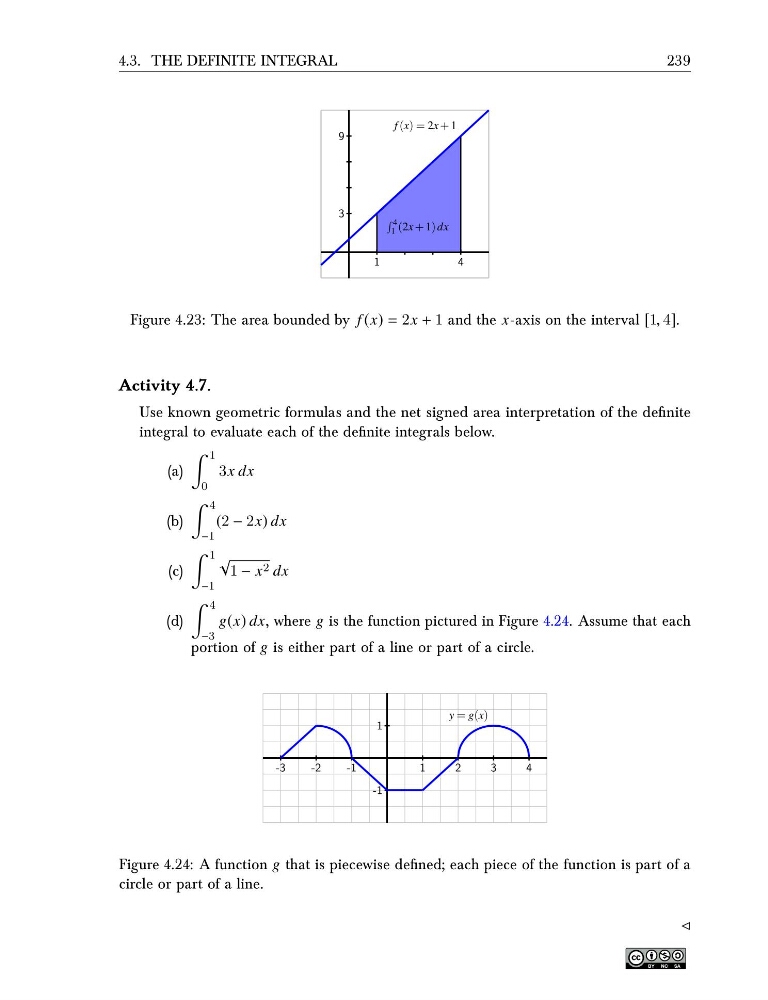
Figure 4.23: The area bounded by f (x) = 2x + 1 and the x-axis on the interval [1, 4].
Activity 4.7.
Use known geometric formulas and the net signed area interpretation of the definite
integral to evaluate each of the definite integrals below.
(a)
1
0
3x dx
(b)
4
−1
(2 − 2x) dx
(c)
1
−1
√
1 − x 2 dx
(d)
4
−3
g(x) dx, where g is the function pictured in Figure 4.24. Assume that each
portion of g is either part of a line or part of a circle.
-3
-2
-1
1
2
3
4
-1
1
y = g(x)
Figure 4.24: A function g that is piecewise defined; each piece of the function is part of a
circle or part of a line.
⊳
239
1
4
3
9
f (x) = 2x + 1
4
1 (2x + 1) dx
Figure 4.23: The area bounded by f (x) = 2x + 1 and the x-axis on the interval [1, 4].
Activity 4.7.
Use known geometric formulas and the net signed area interpretation of the definite
integral to evaluate each of the definite integrals below.
(a)
1
0
3x dx
(b)
4
−1
(2 − 2x) dx
(c)
1
−1
√
1 − x 2 dx
(d)
4
−3
g(x) dx, where g is the function pictured in Figure 4.24. Assume that each
portion of g is either part of a line or part of a circle.
-3
-2
-1
1
2
3
4
-1
1
y = g(x)
Figure 4.24: A function g that is piecewise defined; each piece of the function is part of a
circle or part of a line.
⊳