

238
4.3. THE DEFINITE INTEGRAL
y = f (x)
A 1
A 2
A 3
a
b
c
d
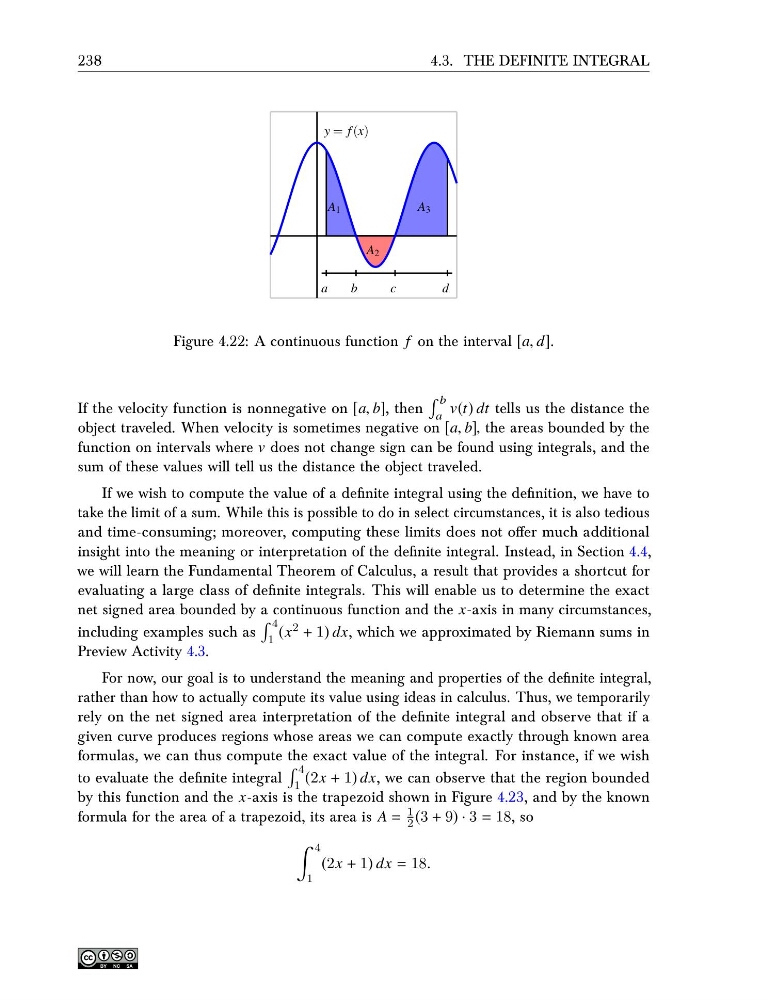
Figure 4.22: A continuous function f on the interval [a, d].
If the velocity function is nonnegative on [a, b], then
b
a
v(t) dt tells us the distance the
object traveled. When velocity is sometimes negative on [a, b], the areas bounded by the
function on intervals where v does not change sign can be found using integrals, and the
sum of these values will tell us the distance the object traveled.
If we wish to compute the value of a definite integral using the definition, we have to
take the limit of a sum. While this is possible to do in select circumstances, it is also tedious
and time-consuming; moreover, computing these limits does not offer much additional
insight into the meaning or interpretation of the definite integral. Instead, in Section 4.4,
we will learn the Fundamental Theorem of Calculus, a result that provides a shortcut for
evaluating a large class of definite integrals. This will enable us to determine the exact
net signed area bounded by a continuous function and the x-axis in many circumstances,
including examples such as
4
1
(x 2 + 1) dx, which we approximated by Riemann sums in
Preview Activity 4.3.
For now, our goal is to understand the meaning and properties of the definite integral,
rather than how to actually compute its value using ideas in calculus. Thus, we temporarily
rely on the net signed area interpretation of the definite integral and observe that if a
given curve produces regions whose areas we can compute exactly through known area
formulas, we can thus compute the exact value of the integral. For instance, if we wish
to evaluate the definite integral
4
1
(2x + 1) dx, we can observe that the region bounded
by this function and the x-axis is the trapezoid shown in Figure 4.23, and by the known
formula for the area of a trapezoid, its area is A =
1
2 (3 + 9) · 3 = 18, so
4
1
(2x + 1) dx = 18.
4.3. THE DEFINITE INTEGRAL
y = f (x)
A 1
A 2
A 3
a
b
c
d
Figure 4.22: A continuous function f on the interval [a, d].
If the velocity function is nonnegative on [a, b], then
b
a
v(t) dt tells us the distance the
object traveled. When velocity is sometimes negative on [a, b], the areas bounded by the
function on intervals where v does not change sign can be found using integrals, and the
sum of these values will tell us the distance the object traveled.
If we wish to compute the value of a definite integral using the definition, we have to
take the limit of a sum. While this is possible to do in select circumstances, it is also tedious
and time-consuming; moreover, computing these limits does not offer much additional
insight into the meaning or interpretation of the definite integral. Instead, in Section 4.4,
we will learn the Fundamental Theorem of Calculus, a result that provides a shortcut for
evaluating a large class of definite integrals. This will enable us to determine the exact
net signed area bounded by a continuous function and the x-axis in many circumstances,
including examples such as
4
1
(x 2 + 1) dx, which we approximated by Riemann sums in
Preview Activity 4.3.
For now, our goal is to understand the meaning and properties of the definite integral,
rather than how to actually compute its value using ideas in calculus. Thus, we temporarily
rely on the net signed area interpretation of the definite integral and observe that if a
given curve produces regions whose areas we can compute exactly through known area
formulas, we can thus compute the exact value of the integral. For instance, if we wish
to evaluate the definite integral
4
1
(2x + 1) dx, we can observe that the region bounded
by this function and the x-axis is the trapezoid shown in Figure 4.23, and by the known
formula for the area of a trapezoid, its area is A =
1
2 (3 + 9) · 3 = 18, so
4
1
(2x + 1) dx = 18.