

4.1. DETERMINING DISTANCE TRAVELED FROM VELOCITY
215
Finally, similar calculations reveal that in the final hour, the person walked
D [2,3] = 3 miles per hour · 1 hours = 3 miles,
so the total distance traveled is
D = D [0,1.5] + D [1.5,2] + D [2,3] = 4.5 + 2 + 3 = 9.5 miles.
Since the velocity on 1.5 < t < 2 is actually v = −4, being negative to indicate motion in
the westward direction, this tells us that the person first walked 4.5 miles east, then 2 miles
west, followed by 3 more miles east. Thus, the walker’s total change in position is
change in position = 4.5 − 2 + 3 = 5.5 miles.
While we have been able to answer these questions fairly easily, it is also important to
think about this problem graphically in order that we can generalize our solution to the
more complicated setting when velocity is not constant, as well as to note the particular
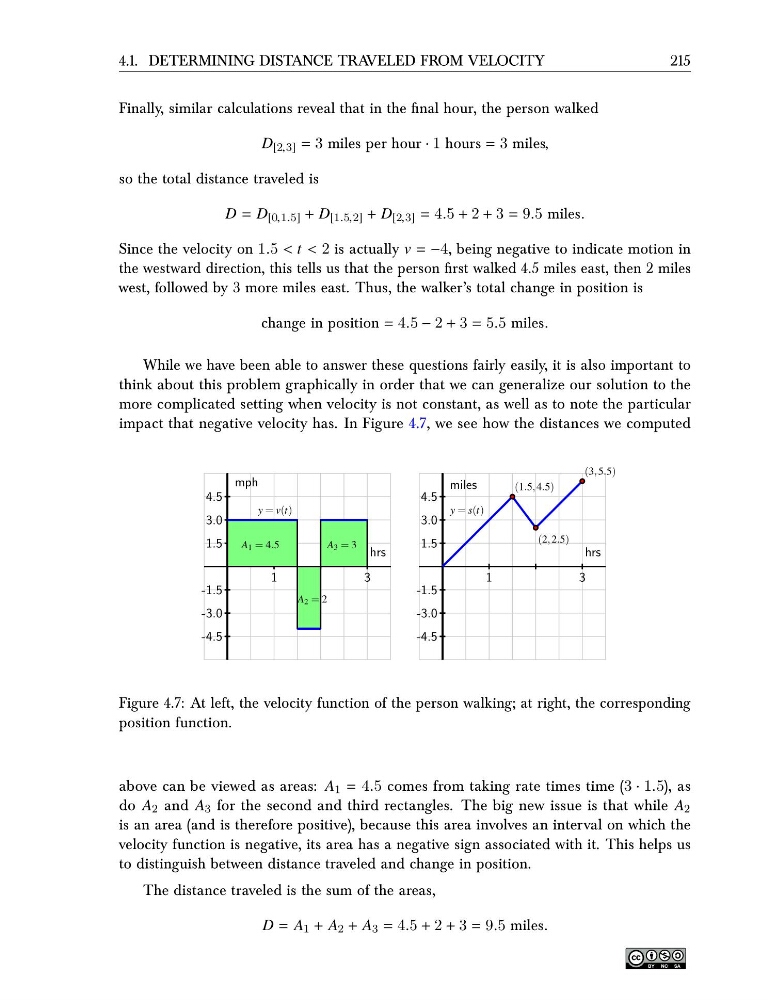
impact that negative velocity has. In Figure 4.7, we see how the distances we computed
1
3
-4.5
-3.0
-1.5
1.5
3.0
4.5
mph
hrs
A 1 = 4.5
A 2 = 2
A 3 = 3
y = v(t)
1
3
-4.5
-3.0
-1.5
1.5
3.0
4.5
miles
hrs
(1.5, 4.5)
(2, 2.5)
(3, 5.5)
y = s(t)
Figure 4.7: At left, the velocity function of the person walking; at right, the corresponding
position function.
above can be viewed as areas: A 1 = 4.5 comes from taking rate times time (3 · 1.5), as
do A 2 and A 3 for the second and third rectangles. The big new issue is that while A 2
is an area (and is therefore positive), because this area involves an interval on which the
velocity function is negative, its area has a negative sign associated with it. This helps us
to distinguish between distance traveled and change in position.
The distance traveled is the sum of the areas,
D = A 1 + A 2 + A 3 = 4.5 + 2 + 3 = 9.5 miles.
215
Finally, similar calculations reveal that in the final hour, the person walked
D [2,3] = 3 miles per hour · 1 hours = 3 miles,
so the total distance traveled is
D = D [0,1.5] + D [1.5,2] + D [2,3] = 4.5 + 2 + 3 = 9.5 miles.
Since the velocity on 1.5 < t < 2 is actually v = −4, being negative to indicate motion in
the westward direction, this tells us that the person first walked 4.5 miles east, then 2 miles
west, followed by 3 more miles east. Thus, the walker’s total change in position is
change in position = 4.5 − 2 + 3 = 5.5 miles.
While we have been able to answer these questions fairly easily, it is also important to
think about this problem graphically in order that we can generalize our solution to the
more complicated setting when velocity is not constant, as well as to note the particular
impact that negative velocity has. In Figure 4.7, we see how the distances we computed
1
3
-4.5
-3.0
-1.5
1.5
3.0
4.5
mph
hrs
A 1 = 4.5
A 2 = 2
A 3 = 3
y = v(t)
1
3
-4.5
-3.0
-1.5
1.5
3.0
4.5
miles
hrs
(1.5, 4.5)
(2, 2.5)
(3, 5.5)
y = s(t)
Figure 4.7: At left, the velocity function of the person walking; at right, the corresponding
position function.
above can be viewed as areas: A 1 = 4.5 comes from taking rate times time (3 · 1.5), as
do A 2 and A 3 for the second and third rectangles. The big new issue is that while A 2
is an area (and is therefore positive), because this area involves an interval on which the
velocity function is negative, its area has a negative sign associated with it. This helps us
to distinguish between distance traveled and change in position.
The distance traveled is the sum of the areas,
D = A 1 + A 2 + A 3 = 4.5 + 2 + 3 = 9.5 miles.