

216
4.1. DETERMINING DISTANCE TRAVELED FROM VELOCITY
But the change in position has to account for the sign associated with the area, where
those above the t-axis are considered positive while those below the t-axis are viewed as
negative, so that
s(3) − s(0) = (+4.5) + (−2) + (+3) = 5.5 miles,
assigning the “−2” to the area in the interval [1.5, 2] because there velocity is negative and
the person is walking in the “negative” direction. In other words, the person walks 4.5
miles in the positive direction, followed by two miles in the negative direction, and then
3 more miles in the positive direction. This affect of velocity being negative is also seen
in the graph of the function y = s(t), which has a negative slope (specifically, its slope is
−4) on the interval 1.5 < t < 2 since the velocity is −4 on that interval, which shows the
person’s position function is decreasing due to the fact that she is walking east, rather
than west. On the intervals where she is walking west, the velocity function is positive and
the slope of the position function s is therefore also positive.
To summarize, we see that if velocity is sometimes negative, this makes the moving
object’s change in position different from its distance traveled. By viewing the intervals on
which velocity is positive and negative separately, we may compute the distance traveled
on each such interval, and then depending on whether we desire total distance traveled or
total change in position, we may account for negative velocities that account for negative
change in position, while still contributing positively to total distance traveled. We close
this section with one additional activity that further explores the effects of negative velocity
on the problem of finding change in position and total distance traveled.
Activity 4.3.
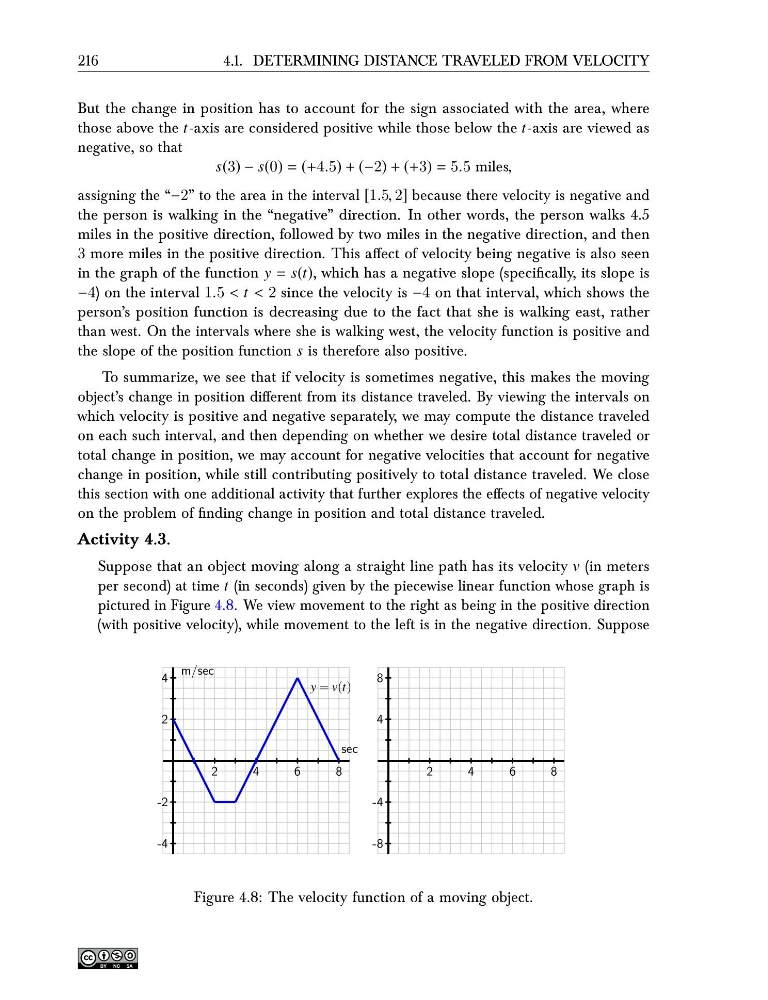
Suppose that an object moving along a straight line path has its velocity v (in meters
per second) at time t (in seconds) given by the piecewise linear function whose graph is
pictured in Figure 4.8. We view movement to the right as being in the positive direction
(with positive velocity), while movement to the left is in the negative direction. Suppose
2
4
6
8
-4
-2
2
4
m/sec
sec
y = v(t)
2
4
6
8
-8
-4
4
8
Figure 4.8: The velocity function of a moving object.
4.1. DETERMINING DISTANCE TRAVELED FROM VELOCITY
But the change in position has to account for the sign associated with the area, where
those above the t-axis are considered positive while those below the t-axis are viewed as
negative, so that
s(3) − s(0) = (+4.5) + (−2) + (+3) = 5.5 miles,
assigning the “−2” to the area in the interval [1.5, 2] because there velocity is negative and
the person is walking in the “negative” direction. In other words, the person walks 4.5
miles in the positive direction, followed by two miles in the negative direction, and then
3 more miles in the positive direction. This affect of velocity being negative is also seen
in the graph of the function y = s(t), which has a negative slope (specifically, its slope is
−4) on the interval 1.5 < t < 2 since the velocity is −4 on that interval, which shows the
person’s position function is decreasing due to the fact that she is walking east, rather
than west. On the intervals where she is walking west, the velocity function is positive and
the slope of the position function s is therefore also positive.
To summarize, we see that if velocity is sometimes negative, this makes the moving
object’s change in position different from its distance traveled. By viewing the intervals on
which velocity is positive and negative separately, we may compute the distance traveled
on each such interval, and then depending on whether we desire total distance traveled or
total change in position, we may account for negative velocities that account for negative
change in position, while still contributing positively to total distance traveled. We close
this section with one additional activity that further explores the effects of negative velocity
on the problem of finding change in position and total distance traveled.
Activity 4.3.
Suppose that an object moving along a straight line path has its velocity v (in meters
per second) at time t (in seconds) given by the piecewise linear function whose graph is
pictured in Figure 4.8. We view movement to the right as being in the positive direction
(with positive velocity), while movement to the left is in the negative direction. Suppose
2
4
6
8
-4
-2
2
4
m/sec
sec
y = v(t)
2
4
6
8
-8
-4
4
8
Figure 4.8: The velocity function of a moving object.