

214
4.1. DETERMINING DISTANCE TRAVELED FROM VELOCITY
1
2
-24
-12
12
24
ft/sec
sec
v(t) = 32 − 32t
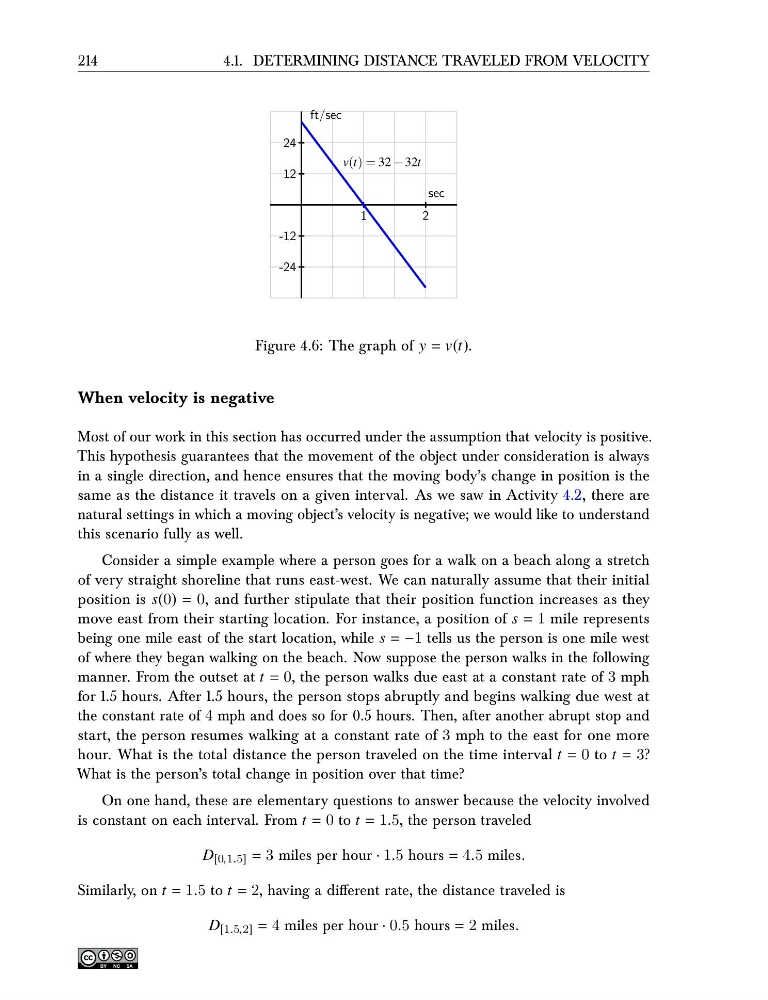
Figure 4.6: The graph of y = v(t).
When velocity is negative
Most of our work in this section has occurred under the assumption that velocity is positive.
This hypothesis guarantees that the movement of the object under consideration is always
in a single direction, and hence ensures that the moving body’s change in position is the
same as the distance it travels on a given interval. As we saw in Activity 4.2, there are
natural settings in which a moving object’s velocity is negative; we would like to understand
this scenario fully as well.
Consider a simple example where a person goes for a walk on a beach along a stretch
of very straight shoreline that runs east-west. We can naturally assume that their initial
position is s(0) = 0, and further stipulate that their position function increases as they
move east from their starting location. For instance, a position of s = 1 mile represents
being one mile east of the start location, while s = −1 tells us the person is one mile west
of where they began walking on the beach. Now suppose the person walks in the following
manner. From the outset at t = 0, the person walks due east at a constant rate of 3 mph
for 1.5 hours. After 1.5 hours, the person stops abruptly and begins walking due west at
the constant rate of 4 mph and does so for 0.5 hours. Then, after another abrupt stop and
start, the person resumes walking at a constant rate of 3 mph to the east for one more
hour. What is the total distance the person traveled on the time interval t = 0 to t = 3?
What is the person’s total change in position over that time?
On one hand, these are elementary questions to answer because the velocity involved
is constant on each interval. From t = 0 to t = 1.5, the person traveled
D [0,1.5] = 3 miles per hour · 1.5 hours = 4.5 miles.
Similarly, on t = 1.5 to t = 2, having a different rate, the distance traveled is
D [1.5,2] = 4 miles per hour · 0.5 hours = 2 miles.
4.1. DETERMINING DISTANCE TRAVELED FROM VELOCITY
1
2
-24
-12
12
24
ft/sec
sec
v(t) = 32 − 32t
Figure 4.6: The graph of y = v(t).
When velocity is negative
Most of our work in this section has occurred under the assumption that velocity is positive.
This hypothesis guarantees that the movement of the object under consideration is always
in a single direction, and hence ensures that the moving body’s change in position is the
same as the distance it travels on a given interval. As we saw in Activity 4.2, there are
natural settings in which a moving object’s velocity is negative; we would like to understand
this scenario fully as well.
Consider a simple example where a person goes for a walk on a beach along a stretch
of very straight shoreline that runs east-west. We can naturally assume that their initial
position is s(0) = 0, and further stipulate that their position function increases as they
move east from their starting location. For instance, a position of s = 1 mile represents
being one mile east of the start location, while s = −1 tells us the person is one mile west
of where they began walking on the beach. Now suppose the person walks in the following
manner. From the outset at t = 0, the person walks due east at a constant rate of 3 mph
for 1.5 hours. After 1.5 hours, the person stops abruptly and begins walking due west at
the constant rate of 4 mph and does so for 0.5 hours. Then, after another abrupt stop and
start, the person resumes walking at a constant rate of 3 mph to the east for one more
hour. What is the total distance the person traveled on the time interval t = 0 to t = 3?
What is the person’s total change in position over that time?
On one hand, these are elementary questions to answer because the velocity involved
is constant on each interval. From t = 0 to t = 1.5, the person traveled
D [0,1.5] = 3 miles per hour · 1.5 hours = 4.5 miles.
Similarly, on t = 1.5 to t = 2, having a different rate, the distance traveled is
D [1.5,2] = 4 miles per hour · 0.5 hours = 2 miles.