

4.1. DETERMINING DISTANCE TRAVELED FROM VELOCITY
211
can we attain the exact area under any non-constant curve? These questions and more
are ones we will study in what follows; for now it suffices to realize that the simple idea of
the area of a rectangle gives us a powerful tool for estimating both distance traveled from
a velocity function as well as the area under an arbitrary curve. To explore the setting of
multiple rectangles to approximate area under a non-constant velocity function, see the
applet found at http://gvsu.edu/s/9U. 2
Activity 4.1.
Suppose that a person is walking in such a way that her velocity varies slightly according
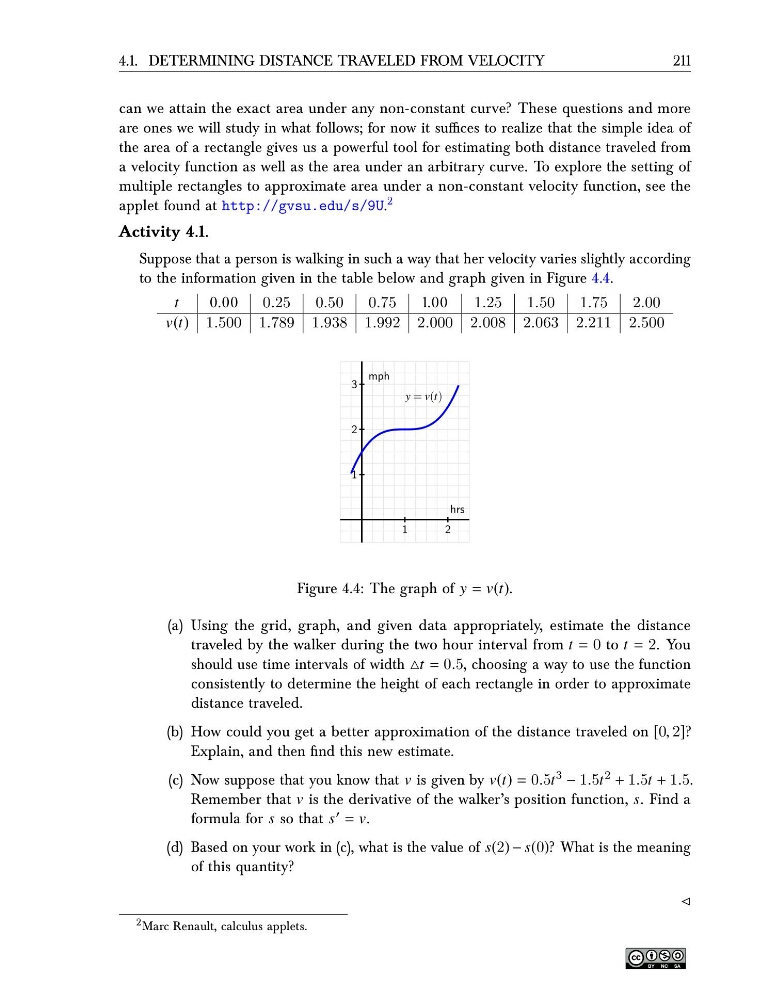
to the information given in the table below and graph given in Figure 4.4.
t
0.00
0.25
0.50
0.75
1.00
1.25
1.50
1.75
2.00
v(t) 1.500 1.789 1.938 1.992 2.000 2.008 2.063 2.211 2.500
1
2
1
2
3
mph
hrs
y = v(t)
Figure 4.4: The graph of y = v(t).
(a) Using the grid, graph, and given data appropriately, estimate the distance
traveled by the walker during the two hour interval from t = 0 to t = 2. You
should use time intervals of width △t = 0.5, choosing a way to use the function
consistently to determine the height of each rectangle in order to approximate
distance traveled.
(b) How could you get a better approximation of the distance traveled on [0, 2]?
Explain, and then find this new estimate.
(c) Now suppose that you know that v is given by v(t) = 0.5t 3 − 1.5t 2 + 1.5t + 1.5.
Remember that v is the derivative of the walker’s position function, s. Find a
formula for s so that s ′ = v.
(d) Based on your work in (c), what is the value of s(2) − s(0)? What is the meaning
of this quantity?
⊳
2 Marc Renault, calculus applets.
211
can we attain the exact area under any non-constant curve? These questions and more
are ones we will study in what follows; for now it suffices to realize that the simple idea of
the area of a rectangle gives us a powerful tool for estimating both distance traveled from
a velocity function as well as the area under an arbitrary curve. To explore the setting of
multiple rectangles to approximate area under a non-constant velocity function, see the
applet found at http://gvsu.edu/s/9U. 2
Activity 4.1.
Suppose that a person is walking in such a way that her velocity varies slightly according
to the information given in the table below and graph given in Figure 4.4.
t
0.00
0.25
0.50
0.75
1.00
1.25
1.50
1.75
2.00
v(t) 1.500 1.789 1.938 1.992 2.000 2.008 2.063 2.211 2.500
1
2
1
2
3
mph
hrs
y = v(t)
Figure 4.4: The graph of y = v(t).
(a) Using the grid, graph, and given data appropriately, estimate the distance
traveled by the walker during the two hour interval from t = 0 to t = 2. You
should use time intervals of width △t = 0.5, choosing a way to use the function
consistently to determine the height of each rectangle in order to approximate
distance traveled.
(b) How could you get a better approximation of the distance traveled on [0, 2]?
Explain, and then find this new estimate.
(c) Now suppose that you know that v is given by v(t) = 0.5t 3 − 1.5t 2 + 1.5t + 1.5.
Remember that v is the derivative of the walker’s position function, s. Find a
formula for s so that s ′ = v.
(d) Based on your work in (c), what is the value of s(2) − s(0)? What is the meaning
of this quantity?
⊳
2 Marc Renault, calculus applets.