

210
4.1. DETERMINING DISTANCE TRAVELED FROM VELOCITY
distance traveled on [a, b] is the area A that is given by
A = v(a)(b − a) = v(a)△t,
where △t is the change in t over the interval. Note, too, that we could use any value of
v(t) on the interval [a, b], since the velocity is constant; we simply chose v(a), the value at
the interval’s left endpoint. For several examples where the velocity function is piecewise
constant, see http://gvsu.edu/s/9T. 1
The situation is obviously more complicated when the velocity function is not constant.
At the same time, on relatively small intervals on which v(t) does not vary much, the area
principle allows us to estimate the distance the moving object travels on that time interval.
For instance, for the non-constant velocity function shown at right in Figure 4.2, we see
that on the interval [1, 1.5], velocity varies from v(1) = 2.5 down to v(1.5) ≈ 2.1. Hence,
one estimate for distance traveled is the area of the pictured rectangle,
A 2 = v(1)△t = 2.5
miles
hour
·
1
2
hours = 1.25 miles.
Because v is decreasing on [1, 1.5] and the rectangle lies above the curve, clearly A 2 = 1.25
is an over-estimate of the actual distance traveled.
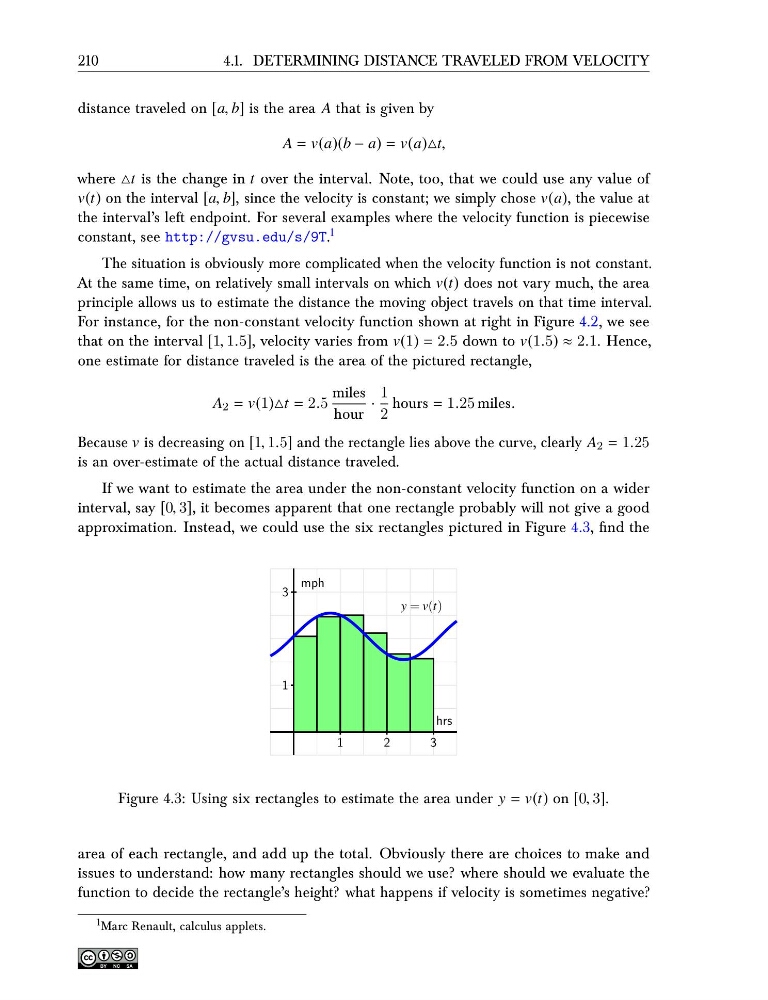
If we want to estimate the area under the non-constant velocity function on a wider
interval, say [0, 3], it becomes apparent that one rectangle probably will not give a good
approximation. Instead, we could use the six rectangles pictured in Figure 4.3, find the
1
2
3
1
3
mph
hrs
y = v(t)
Figure 4.3: Using six rectangles to estimate the area under y = v(t) on [0, 3].
area of each rectangle, and add up the total. Obviously there are choices to make and
issues to understand: how many rectangles should we use? where should we evaluate the
function to decide the rectangle’s height? what happens if velocity is sometimes negative?
1 Marc Renault, calculus applets.
4.1. DETERMINING DISTANCE TRAVELED FROM VELOCITY
distance traveled on [a, b] is the area A that is given by
A = v(a)(b − a) = v(a)△t,
where △t is the change in t over the interval. Note, too, that we could use any value of
v(t) on the interval [a, b], since the velocity is constant; we simply chose v(a), the value at
the interval’s left endpoint. For several examples where the velocity function is piecewise
constant, see http://gvsu.edu/s/9T. 1
The situation is obviously more complicated when the velocity function is not constant.
At the same time, on relatively small intervals on which v(t) does not vary much, the area
principle allows us to estimate the distance the moving object travels on that time interval.
For instance, for the non-constant velocity function shown at right in Figure 4.2, we see
that on the interval [1, 1.5], velocity varies from v(1) = 2.5 down to v(1.5) ≈ 2.1. Hence,
one estimate for distance traveled is the area of the pictured rectangle,
A 2 = v(1)△t = 2.5
miles
hour
·
1
2
hours = 1.25 miles.
Because v is decreasing on [1, 1.5] and the rectangle lies above the curve, clearly A 2 = 1.25
is an over-estimate of the actual distance traveled.
If we want to estimate the area under the non-constant velocity function on a wider
interval, say [0, 3], it becomes apparent that one rectangle probably will not give a good
approximation. Instead, we could use the six rectangles pictured in Figure 4.3, find the
1
2
3
1
3
mph
hrs
y = v(t)
Figure 4.3: Using six rectangles to estimate the area under y = v(t) on [0, 3].
area of each rectangle, and add up the total. Obviously there are choices to make and
issues to understand: how many rectangles should we use? where should we evaluate the
function to decide the rectangle’s height? what happens if velocity is sometimes negative?
1 Marc Renault, calculus applets.