

212
4.1. DETERMINING DISTANCE TRAVELED FROM VELOCITY
Two approaches: area and antidifferentiation
When the velocity of a moving object is positive, the object’s position is always increasing.
While we will soon consider situations where velocity is negative and think about the
ramifications of this condition on distance traveled, for now we continue to assume that
we are working with a positive velocity function. In that setting, we have established that
whenever v is actually constant, the exact distance traveled on an interval is the area
under the velocity curve; furthermore, we have observed that when v is not constant,
we can estimate the total distance traveled by finding the areas of rectangles that help
to approximate the area under the velocity curve on the given interval. Hence, we see
the importance of the problem of finding the area between a curve and the horizontal
axis: besides being an interesting geometric question, in the setting of the curve being the
(positive) velocity of a moving object, the area under the curve over an interval tells us
the exact distance traveled on the interval. We can estimate this area any time we have a
graph of the velocity function or a table of data that tells us some relevant values of the
function.
In Activity 4.1, we also encountered an alternate approach to finding the distance
traveled. In particular, if we know a formula for the instantaneous velocity, y = v(t), of the
moving body at time t, then we realize that v must be the derivative of some corresponding
position function s. If we can find a formula for s from the formula for v, it follows that we
know the position of the object at time t. In addition, under the assumption that velocity
is positive, the change in position over a given interval then tells us the distance traveled
on that interval.
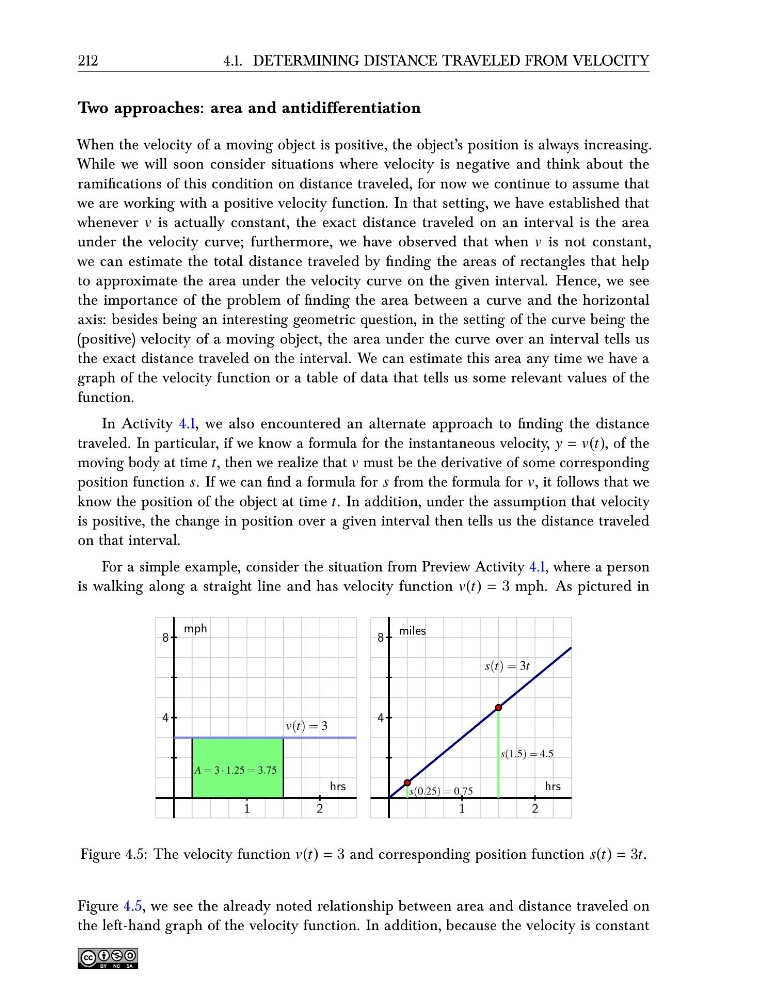
For a simple example, consider the situation from Preview Activity 4.1, where a person
is walking along a straight line and has velocity function v(t) = 3 mph. As pictured in
1
2
4
8
mph
hrs
v(t) = 3
A = 3 · 1.25 = 3.75
1
2
4
8
miles
hrs
s(0.25) = 0.75
s(1.5) = 4.5
s(t) = 3t
Figure 4.5: The velocity function v(t) = 3 and corresponding position function s(t) = 3t.
Figure 4.5, we see the already noted relationship between area and distance traveled on
the left-hand graph of the velocity function. In addition, because the velocity is constant
4.1. DETERMINING DISTANCE TRAVELED FROM VELOCITY
Two approaches: area and antidifferentiation
When the velocity of a moving object is positive, the object’s position is always increasing.
While we will soon consider situations where velocity is negative and think about the
ramifications of this condition on distance traveled, for now we continue to assume that
we are working with a positive velocity function. In that setting, we have established that
whenever v is actually constant, the exact distance traveled on an interval is the area
under the velocity curve; furthermore, we have observed that when v is not constant,
we can estimate the total distance traveled by finding the areas of rectangles that help
to approximate the area under the velocity curve on the given interval. Hence, we see
the importance of the problem of finding the area between a curve and the horizontal
axis: besides being an interesting geometric question, in the setting of the curve being the
(positive) velocity of a moving object, the area under the curve over an interval tells us
the exact distance traveled on the interval. We can estimate this area any time we have a
graph of the velocity function or a table of data that tells us some relevant values of the
function.
In Activity 4.1, we also encountered an alternate approach to finding the distance
traveled. In particular, if we know a formula for the instantaneous velocity, y = v(t), of the
moving body at time t, then we realize that v must be the derivative of some corresponding
position function s. If we can find a formula for s from the formula for v, it follows that we
know the position of the object at time t. In addition, under the assumption that velocity
is positive, the change in position over a given interval then tells us the distance traveled
on that interval.
For a simple example, consider the situation from Preview Activity 4.1, where a person
is walking along a straight line and has velocity function v(t) = 3 mph. As pictured in
1
2
4
8
mph
hrs
v(t) = 3
A = 3 · 1.25 = 3.75
1
2
4
8
miles
hrs
s(0.25) = 0.75
s(1.5) = 4.5
s(t) = 3t
Figure 4.5: The velocity function v(t) = 3 and corresponding position function s(t) = 3t.
Figure 4.5, we see the already noted relationship between area and distance traveled on
the left-hand graph of the velocity function. In addition, because the velocity is constant