

3.1. USING DERIVATIVES TO IDENTIFY EXTREME VALUES
171
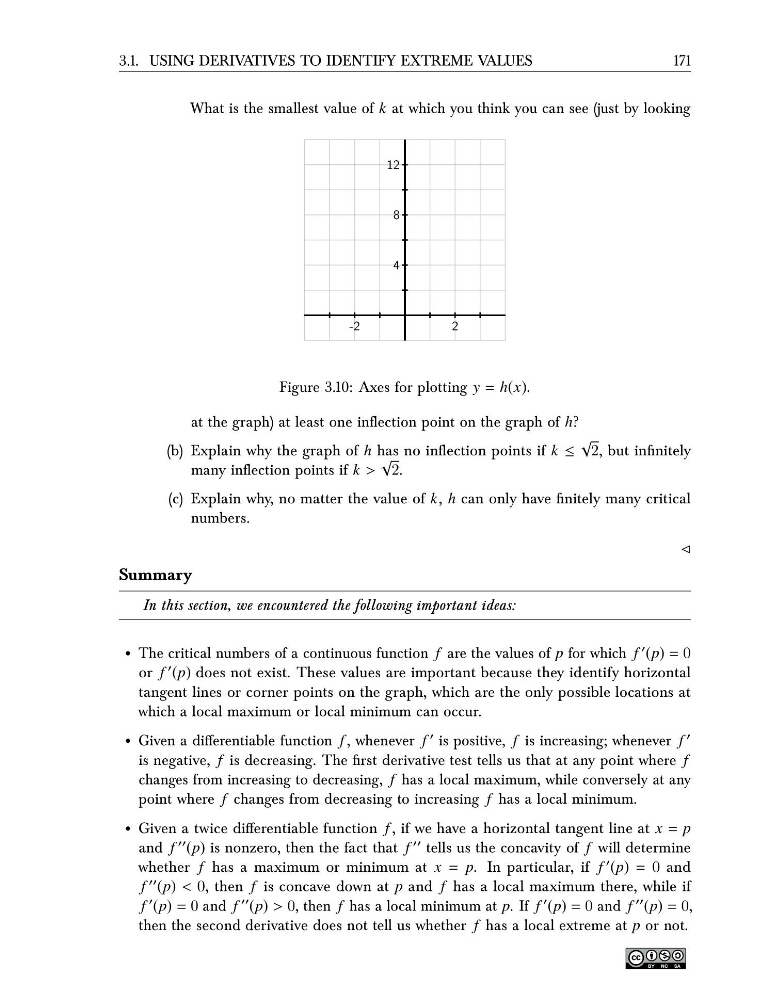
What is the smallest value of k at which you think you can see (just by looking
-2
2
4
8
12
Figure 3.10: Axes for plotting y = h(x).
at the graph) at least one inflection point on the graph of h?
(b) Explain why the graph of h has no inflection points if k ≤
√
2, but infinitely
many inflection points if k >
√
2.
(c) Explain why, no matter the value of k, h can only have finitely many critical
numbers.
⊳
Summary
In this section, we encountered the following important ideas:
• The critical numbers of a continuous function f are the values of p for which f ′ (p) = 0
or f ′ (p) does not exist. These values are important because they identify horizontal
tangent lines or corner points on the graph, which are the only possible locations at
which a local maximum or local minimum can occur.
• Given a differentiable function f , whenever f ′ is positive, f is increasing; whenever f ′
is negative, f is decreasing. The first derivative test tells us that at any point where f
changes from increasing to decreasing, f has a local maximum, while conversely at any
point where f changes from decreasing to increasing f has a local minimum.
• Given a twice differentiable function f , if we have a horizontal tangent line at x = p
and f ′′ (p) is nonzero, then the fact that f ′′ tells us the concavity of f will determine
whether f has a maximum or minimum at x = p. In particular, if f ′ (p) = 0 and
f ′′ (p) < 0, then f is concave down at p and f has a local maximum there, while if
f ′ (p) = 0 and f ′′ (p) > 0, then f has a local minimum at p. If f ′ (p) = 0 and f ′′ (p) = 0,
then the second derivative does not tell us whether f has a local extreme at p or not.
171
What is the smallest value of k at which you think you can see (just by looking
-2
2
4
8
12
Figure 3.10: Axes for plotting y = h(x).
at the graph) at least one inflection point on the graph of h?
(b) Explain why the graph of h has no inflection points if k ≤
√
2, but infinitely
many inflection points if k >
√
2.
(c) Explain why, no matter the value of k, h can only have finitely many critical
numbers.
⊳
Summary
In this section, we encountered the following important ideas:
• The critical numbers of a continuous function f are the values of p for which f ′ (p) = 0
or f ′ (p) does not exist. These values are important because they identify horizontal
tangent lines or corner points on the graph, which are the only possible locations at
which a local maximum or local minimum can occur.
• Given a differentiable function f , whenever f ′ is positive, f is increasing; whenever f ′
is negative, f is decreasing. The first derivative test tells us that at any point where f
changes from increasing to decreasing, f has a local maximum, while conversely at any
point where f changes from decreasing to increasing f has a local minimum.
• Given a twice differentiable function f , if we have a horizontal tangent line at x = p
and f ′′ (p) is nonzero, then the fact that f ′′ tells us the concavity of f will determine
whether f has a maximum or minimum at x = p. In particular, if f ′ (p) = 0 and
f ′′ (p) < 0, then f is concave down at p and f has a local maximum there, while if
f ′ (p) = 0 and f ′′ (p) > 0, then f has a local minimum at p. If f ′ (p) = 0 and f ′′ (p) = 0,
then the second derivative does not tell us whether f has a local extreme at p or not.