

78
GAUGE FIELDS AND STRINGS
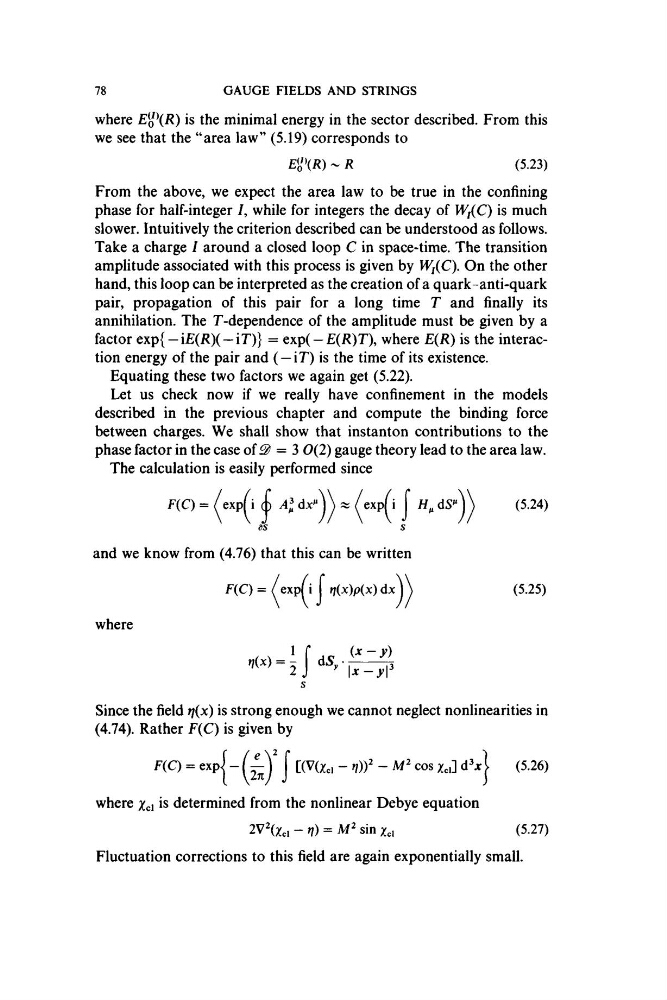
where E^¿XR) is the minimal energy in the sector described. From this
we see that the “area law” (5.19) corresponds to
^ R
(5.23)
From the above, we expect the area law to be true in the confining
phase for half-integer /, while for integers the decay of Wj(C) is much
slower. Intuitively the criterion described can be understood as follows.
Take a charge / around a closed loop C in space-time. The transition
amplitude associated with this process is given by Wj(C), On the other
hand, this loop can be interpreted as the creation of a quark-anti-quark
pair, propagation of this pair for a long time T and finally its
annihilation. The T-dependence of the amplitude must be given by a
factor exp{ — iE(R)( — iT)} = exp( —£(R)T), where E{R) is the interaction energy of the pair and ( — iT) is the time of its existence.
Equating these two factors we again get (5.22).
Let us check now if we really have confinement in the models
described in the previous chapter and compute the binding force
between charges. We shall show that instanton contributions to the
phase factor in the case of ^ = 3 0(2) gauge theory lead to the area law.
The calculation is easily performed since
F(C) = ( expi i O
dx'^
H, dS"
(5.24)
and we know from (4.76) that this can be written
f(C) = ^exp^i I n(x)p(x) dx
(5.25)
where
1
> )(x) = 2 d5„
(x-y)
Since the field r/(x) is strong enough we cannot neglect nonlinearities in
(4.74). Rather F(C) is given by
F(C) = expj -
I [(V(x„ - ri)y -
cos z„] d^xj
(5.26)
where Xci is determined from the nonlinear Debye equation
2 V U i - ^ / ) = M^sin;C,,
(5.27)
Fluctuation corrections to this field are again exponentially small.
GAUGE FIELDS AND STRINGS
where E^¿XR) is the minimal energy in the sector described. From this
we see that the “area law” (5.19) corresponds to
^ R
(5.23)
From the above, we expect the area law to be true in the confining
phase for half-integer /, while for integers the decay of Wj(C) is much
slower. Intuitively the criterion described can be understood as follows.
Take a charge / around a closed loop C in space-time. The transition
amplitude associated with this process is given by Wj(C), On the other
hand, this loop can be interpreted as the creation of a quark-anti-quark
pair, propagation of this pair for a long time T and finally its
annihilation. The T-dependence of the amplitude must be given by a
factor exp{ — iE(R)( — iT)} = exp( —£(R)T), where E{R) is the interaction energy of the pair and ( — iT) is the time of its existence.
Equating these two factors we again get (5.22).
Let us check now if we really have confinement in the models
described in the previous chapter and compute the binding force
between charges. We shall show that instanton contributions to the
phase factor in the case of ^ = 3 0(2) gauge theory lead to the area law.
The calculation is easily performed since
F(C) = ( expi i O
dx'^
H, dS"
(5.24)
and we know from (4.76) that this can be written
f(C) = ^exp^i I n(x)p(x) dx
(5.25)
where
1
> )(x) = 2 d5„
(x-y)
Since the field r/(x) is strong enough we cannot neglect nonlinearities in
(4.74). Rather F(C) is given by
F(C) = expj -
I [(V(x„ - ri)y -
cos z„] d^xj
(5.26)
where Xci is determined from the nonlinear Debye equation
2 V U i - ^ / ) = M^sin;C,,
(5.27)
Fluctuation corrections to this field are again exponentially small.