

QUARK CONFINEMENT
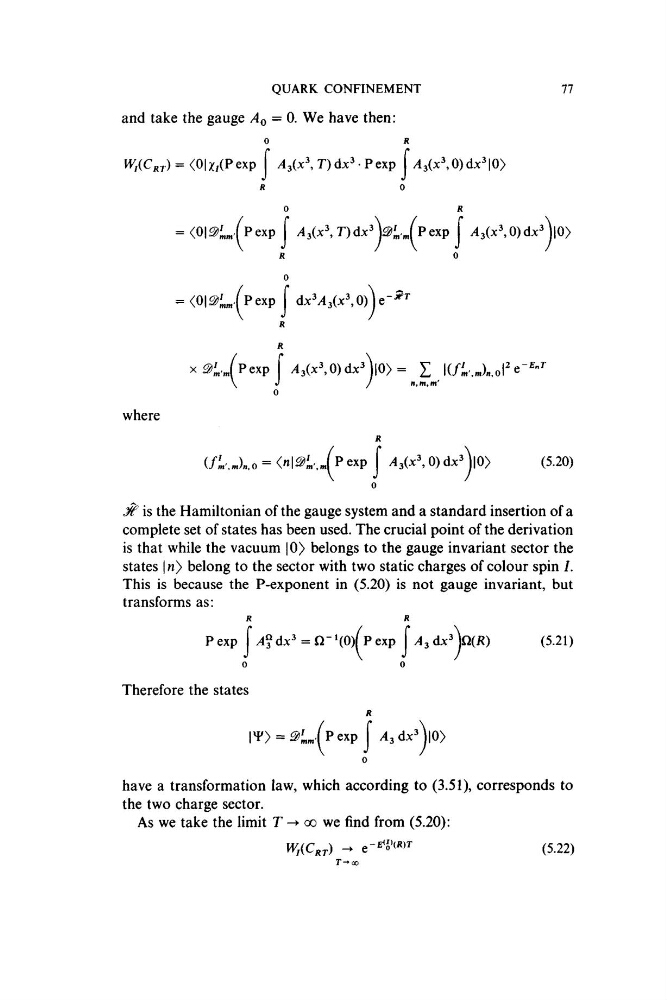
and take the gauge Aq = 0. We have then:
0
R
W , { C r t ) = <0I Z;(P exp I / l 3(x^ T) dx^ • P exp | / l 3(x^ 0) dx^ |0>
77
<0|® L /P exp f /l3(x^^)dx^^®í,.„^Pexp
A3(x^0)dx^ |0>
= < 0 |® L i Pexp
dx^/l3(x^,0) I e
R
R
X ^ m ' m ^ P e x p
^3(x^0)dxM|0>= X l(/Í.^J„,oPewhere
(/i.',m)n,0 = <"l^m'.m(Pexp /43(x^0)dx^j|0>
(5.20)
is the Hamiltonian of the gauge system and a standard insertion of a
complete set of states has been used. The crucial point of the derivation
is that while the vacuum |0> belongs to the gauge invariant sector the
states \ n} belong to the sector with two static charges of colour spin /.
This is because the P-exponent in (5.20) is not gauge invariant, but
transforms as:
R
R
P exp
Therefore the states
^3 dx^ = Q ^(0)i P exp
dx^ )Q{R)
(5.21)
K
l‘P> = ® L -(|p ex p j A3dx^^|0>
have a transformation law, which according to (3.51), corresponds to
the two charge sector.
As we take the limit T -► oo we find from (5.20):
(5.22)
and take the gauge Aq = 0. We have then:
0
R
W , { C r t ) = <0I Z;(P exp I / l 3(x^ T) dx^ • P exp | / l 3(x^ 0) dx^ |0>
77
<0|® L /P exp f /l3(x^^)dx^^®í,.„^Pexp
A3(x^0)dx^ |0>
= < 0 |® L i Pexp
dx^/l3(x^,0) I e
R
R
X ^ m ' m ^ P e x p
^3(x^0)dxM|0>= X l(/Í.^J„,oPewhere
(/i.',m)n,0 = <"l^m'.m(Pexp /43(x^0)dx^j|0>
(5.20)
is the Hamiltonian of the gauge system and a standard insertion of a
complete set of states has been used. The crucial point of the derivation
is that while the vacuum |0> belongs to the gauge invariant sector the
states \ n} belong to the sector with two static charges of colour spin /.
This is because the P-exponent in (5.20) is not gauge invariant, but
transforms as:
R
R
P exp
Therefore the states
^3 dx^ = Q ^(0)i P exp
dx^ )Q{R)
(5.21)
K
l‘P> = ® L -(|p ex p j A3dx^^|0>
have a transformation law, which according to (3.51), corresponds to
the two charge sector.
As we take the limit T -► oo we find from (5.20):
(5.22)