

76
GAUGE FIELDS AND STRINGS
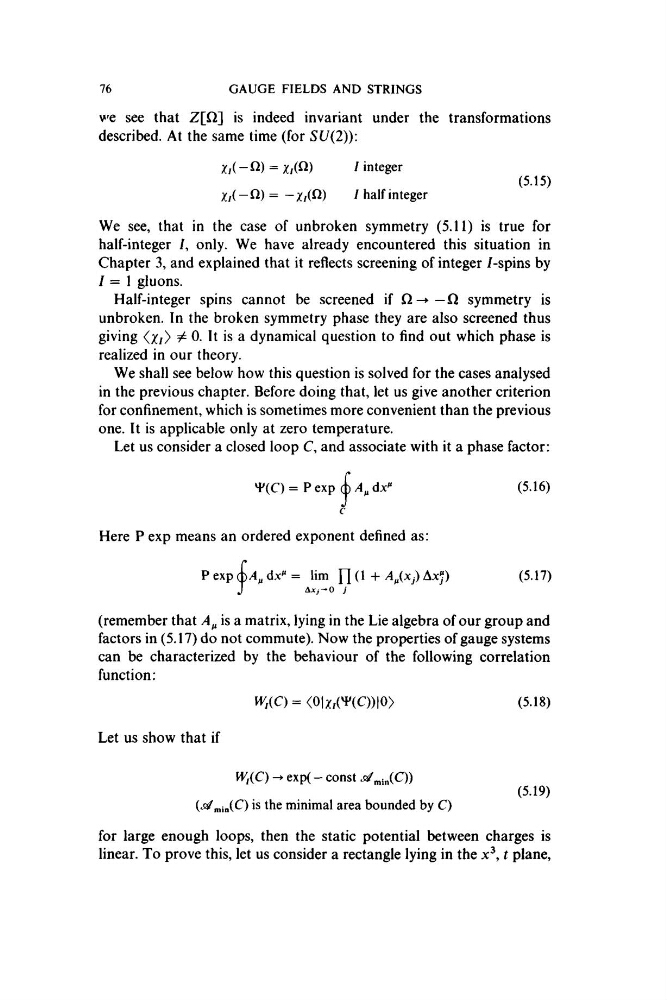
v'e see that Z[Q] is indeed invariant under the transformations
described. At the same time (for SU(2)):
Xii
~ Xii^)
x.i-n)=
/ integer
/ half integer
(5.15)
We see, that in the case of unbroken symmetry (5.11) is true for
half-integer /, only. We have already encountered this situation in
Chapter 3, and explained that it reflects screening of integer /-spins by
/ = 1 gluons.
Half-integer spins cannot be screened if Q->— Q symmetry is
unbroken. In the broken symmetry phase they are also screened thus
giving {xi} ^ 0. It is a dynamical question to find out which phase is
realized in our theory.
We shall see below how this question is solved for the cases analysed
in the previous chapter. Before doing that, let us give another criterion
for confinement, which is sometimes more convenient than the previous
one. It is applicable only at zero temperature.
Let us consider a closed loop C, and associate with it a phase factor:
4^(C) = P exp (b
dx^
(5.16)
Here P exp means an ordered exponent defined as:
P exp
dx^ = lim H
J
A xj - 0 j
(5.17)
(remember that A^ is a matrix, lying in the Lie algebra of our group and
factors in (5.17) do not commute). Now the properties of gauge systems
can be characterized by the behaviour of the following correlation
function:
^!ÌC) = <0|z;(4^(C))|0>
(5.18)
Let us show that if
Wj(C) -► exp( - const
(^ m in (0 is the minimal area bounded by C)
(5.19)
for large enough loops, then the static potential between charges is
linear. To prove this, let us consider a rectangle lying in the x^, t plane,
GAUGE FIELDS AND STRINGS
v'e see that Z[Q] is indeed invariant under the transformations
described. At the same time (for SU(2)):
Xii
~ Xii^)
x.i-n)=
/ integer
/ half integer
(5.15)
We see, that in the case of unbroken symmetry (5.11) is true for
half-integer /, only. We have already encountered this situation in
Chapter 3, and explained that it reflects screening of integer /-spins by
/ = 1 gluons.
Half-integer spins cannot be screened if Q->— Q symmetry is
unbroken. In the broken symmetry phase they are also screened thus
giving {xi} ^ 0. It is a dynamical question to find out which phase is
realized in our theory.
We shall see below how this question is solved for the cases analysed
in the previous chapter. Before doing that, let us give another criterion
for confinement, which is sometimes more convenient than the previous
one. It is applicable only at zero temperature.
Let us consider a closed loop C, and associate with it a phase factor:
4^(C) = P exp (b
dx^
(5.16)
Here P exp means an ordered exponent defined as:
P exp
dx^ = lim H
J
A xj - 0 j
(5.17)
(remember that A^ is a matrix, lying in the Lie algebra of our group and
factors in (5.17) do not commute). Now the properties of gauge systems
can be characterized by the behaviour of the following correlation
function:
^!ÌC) = <0|z;(4^(C))|0>
(5.18)
Let us show that if
Wj(C) -► exp( - const
(^ m in (0 is the minimal area bounded by C)
(5.19)
for large enough loops, then the static potential between charges is
linear. To prove this, let us consider a rectangle lying in the x^, t plane,