

QUARK CONFINEMENT
75
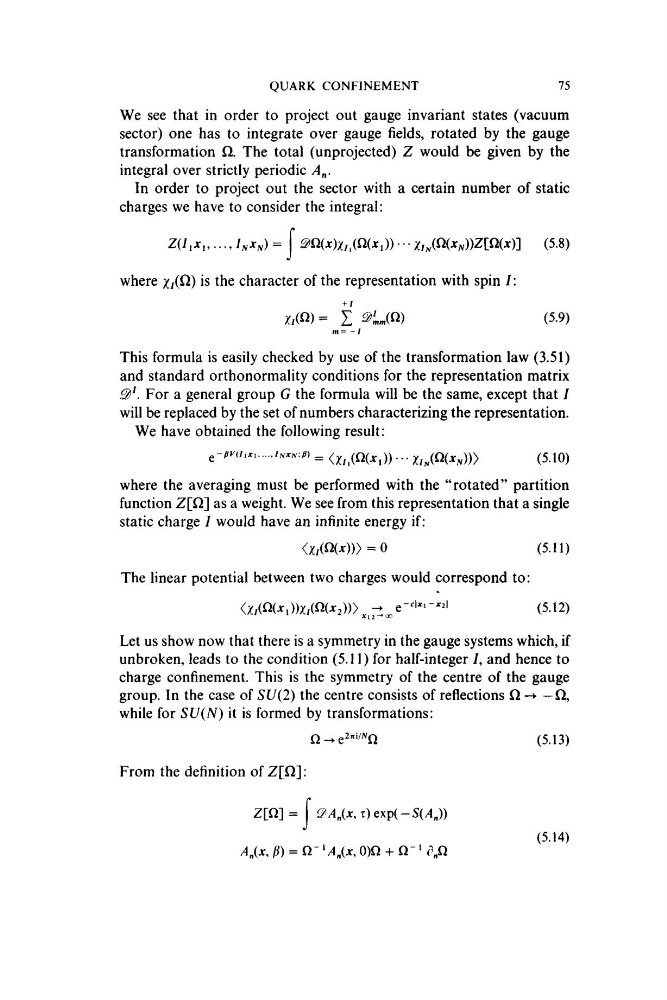
We see that in order to project out gauge invariant states (vacuum
sector) one has to integrate over gauge fields, rotated by the gauge
transformation Q. The total (unprojected) Z would be given by the
integral over strictly periodic A„.
In order to project out the sector with a certain number of static
charges we have to consider the integral:
Z(I
• • • /;,(Q(x^))Z[Q(jc)]
(5.8)
where //(Q) is the character of the representation with spin /:
X,(Q) = I ^L(i^)
(5.9)
This formula is easily checked by use of the transformation law (3.51)
and standard orthonormality conditions for the representation matrix
For a general group G the formula will be the same, except that /
will be replaced by the set of numbers characterizing the representation.
We have obtained the following result:
(5.10)
where the averaging must be performed with the “rotated” partition
function Z[Q] as a weight. We see from this representation that a single
static charge 1 would have an infinite energy if:
= 0
(5.11)
The linear potential between two charges would correspond to:
,
- * 2 |
(5.12)
Let us show now that there is a symmetry in the gauge systems which, if
unbroken, leads to the condition (5.11) for half-integer /, and hence to
charge confinement. This is the symmetry of the centre of the gauge
group. In the case of SU(2) the centre consists of reflections Q — Q,
while for SU{N) it is formed by transformations:
Q
ri/NQ
(5.13)
From the definition of Z[Q]:
Z[Q] = j T )exp(-S(^„))
/4„(x, li) = Q~
0)Q + Q" ‘
(5.14)
75
We see that in order to project out gauge invariant states (vacuum
sector) one has to integrate over gauge fields, rotated by the gauge
transformation Q. The total (unprojected) Z would be given by the
integral over strictly periodic A„.
In order to project out the sector with a certain number of static
charges we have to consider the integral:
Z(I
• • • /;,(Q(x^))Z[Q(jc)]
(5.8)
where //(Q) is the character of the representation with spin /:
X,(Q) = I ^L(i^)
(5.9)
This formula is easily checked by use of the transformation law (3.51)
and standard orthonormality conditions for the representation matrix
For a general group G the formula will be the same, except that /
will be replaced by the set of numbers characterizing the representation.
We have obtained the following result:
(5.10)
where the averaging must be performed with the “rotated” partition
function Z[Q] as a weight. We see from this representation that a single
static charge 1 would have an infinite energy if:
(5.11)
The linear potential between two charges would correspond to:
- * 2 |
(5.12)
Let us show now that there is a symmetry in the gauge systems which, if
unbroken, leads to the condition (5.11) for half-integer /, and hence to
charge confinement. This is the symmetry of the centre of the gauge
group. In the case of SU(2) the centre consists of reflections Q — Q,
while for SU{N) it is formed by transformations:
Q
ri/NQ
(5.13)
From the definition of Z[Q]:
Z[Q] = j T )exp(-S(^„))
/4„(x, li) = Q~
0)Q + Q" ‘
(5.14)