

QUARK CONFINEMENT
79
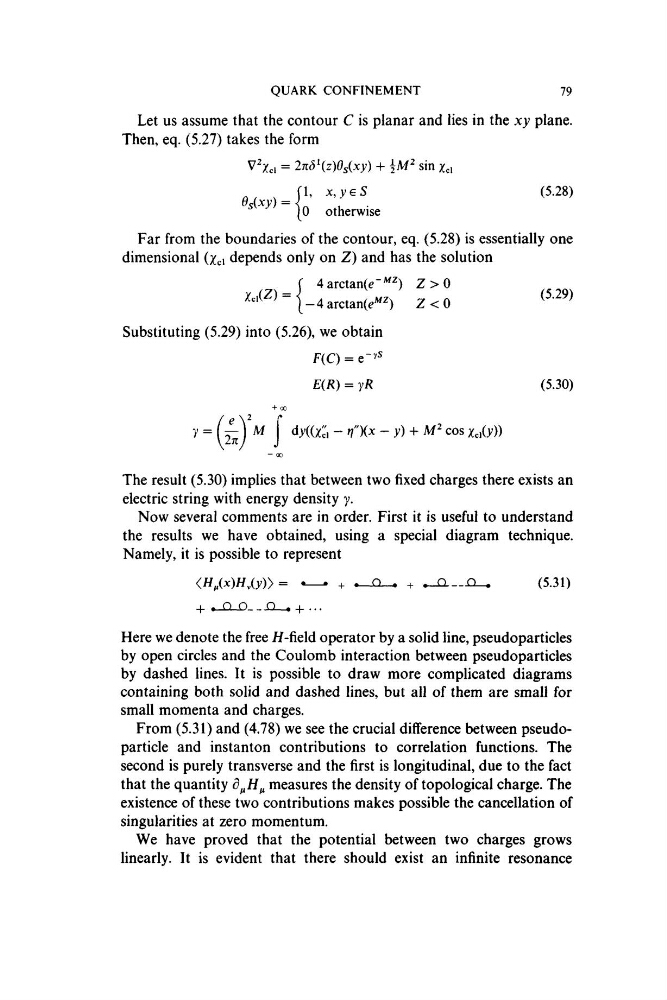
Let us assume that the contour C is planar and lies in the xy plane.
Then, eq. (5.27) takes the form
V^Xci = 2nó\z)es(xy) +
sin Xci
ri, x,yeS
(5.28)
6s(xy) =
0 otherwise
Far from the boundaries of the contour, eq. (5.28) is essentially one
dimensional (Xd depends only on Z) and has the solution
4 arctan(^"^^) Z > 0
-4 arctan(e^^) Z < 0
XdiZ)
(5.29)
Substituting (5.29) into (5.26), we obtain
F(C) = e~^^
E(R) = yR
(5.30)
''lèi**
dy((/ci - rj")(x - y) +
cos x,i(y))
The result (5.30) implies that between two fixed charges there exists an
electric string with energy density y.
Now several comments are in order. First it is useful to understand
the results we have obtained, using a special diagram technique.
Namely, it is possible to represent
= -
-H > O O- - Q- ^ + .
(5.31)
Here we denote the free //-field operator by a solid line, pseudoparticles
by open circles and the Coulomb interaction between pseudoparticles
by dashed lines. It is possible to draw more complicated diagrams
containing both solid and dashed lines, but all of them are small for
small momenta and charges.
From (5.31) and (4.78) we see the crucial difference between pseudoparticle and instanton contributions to correlation functions. The
second is purely transverse and the first is longitudinal, due to the fact
that the quantity
measures the density of topological charge. The
existence of these two contributions makes possible the cancellation of
singularities at zero momentum.
We have proved that the potential between two charges grows
linearly. It is evident that there should exist an infinite resonance
79
Let us assume that the contour C is planar and lies in the xy plane.
Then, eq. (5.27) takes the form
V^Xci = 2nó\z)es(xy) +
sin Xci
ri, x,yeS
(5.28)
6s(xy) =
0 otherwise
Far from the boundaries of the contour, eq. (5.28) is essentially one
dimensional (Xd depends only on Z) and has the solution
4 arctan(^"^^) Z > 0
-4 arctan(e^^) Z < 0
XdiZ)
(5.29)
Substituting (5.29) into (5.26), we obtain
F(C) = e~^^
E(R) = yR
(5.30)
''lèi**
dy((/ci - rj")(x - y) +
cos x,i(y))
The result (5.30) implies that between two fixed charges there exists an
electric string with energy density y.
Now several comments are in order. First it is useful to understand
the results we have obtained, using a special diagram technique.
Namely, it is possible to represent
-H > O O- - Q- ^ + .
(5.31)
Here we denote the free //-field operator by a solid line, pseudoparticles
by open circles and the Coulomb interaction between pseudoparticles
by dashed lines. It is possible to draw more complicated diagrams
containing both solid and dashed lines, but all of them are small for
small momenta and charges.
From (5.31) and (4.78) we see the crucial difference between pseudoparticle and instanton contributions to correlation functions. The
second is purely transverse and the first is longitudinal, due to the fact
that the quantity
measures the density of topological charge. The
existence of these two contributions makes possible the cancellation of
singularities at zero momentum.
We have proved that the potential between two charges grows
linearly. It is evident that there should exist an infinite resonance