

we obtain :t
56
GAUGE FIELDS AND STRINGS
z= I n
i«..i
,d(p^
2n
exp( - ^( Z (< P x -
+ 271^ X (<^x. -
) (4-30)
x*,y
P
^Gauss I exp - X Z a;.,',; q,. 2r
{ 9 * * 1
V
^ J C * . * *
„ C dq> ,
f P ^
^ G a u s , = n J ^ e x p i - 2 S (l» x -
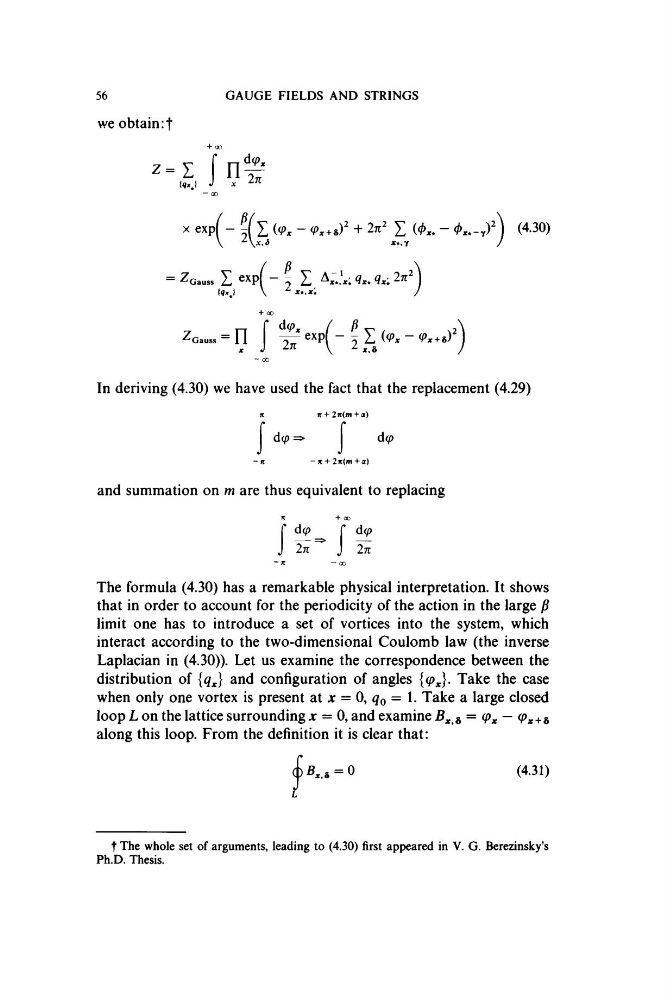
In deriving (4.30) we have used the fact that the replacement (4.29)
jt + 2jr(m + a)
dcp -
d(p
- n + 2n{m + a)
and summation on m are thus equivalent to replacing
d(p
2n''
d (p
2n
The formula (4.30) has a remarkable physical interpretation. It shows
that in order to account for the periodicity of the action in the large P
limit one has to introduce a set of vortices into the system, which
interact according to the two-dimensional Coulomb law (the inverse
Laplacian in (4.30)). Let us examine the correspondence between the
distribution of {q,^} and configuration of angles {cp^}. Take the case
when only one vortex is present at x = 0,
= 1- Take a large closed
loop L on the lattice surrounding x = 0, and examine ^x,8 =
“ <^x+6
along this loop. From the definition it is clear that:
^x.5 = 0
(4.31)
t The whole set of arguments, leading to (4.30) first appeared in V. G. Berezinsky’s
Ph.D. Thesis.
56
GAUGE FIELDS AND STRINGS
z= I n
i«..i
,d(p^
2n
exp( - ^( Z (< P x -
+ 271^ X (<^x. -
) (4-30)
x*,y
P
^Gauss I exp - X Z a;.,',; q,. 2r
{ 9 * * 1
V
^ J C * . * *
„ C dq> ,
f P ^
^ G a u s , = n J ^ e x p i - 2 S (l» x -
In deriving (4.30) we have used the fact that the replacement (4.29)
jt + 2jr(m + a)
dcp -
d(p
- n + 2n{m + a)
and summation on m are thus equivalent to replacing
d(p
2n''
d (p
2n
The formula (4.30) has a remarkable physical interpretation. It shows
that in order to account for the periodicity of the action in the large P
limit one has to introduce a set of vortices into the system, which
interact according to the two-dimensional Coulomb law (the inverse
Laplacian in (4.30)). Let us examine the correspondence between the
distribution of {q,^} and configuration of angles {cp^}. Take the case
when only one vortex is present at x = 0,
= 1- Take a large closed
loop L on the lattice surrounding x = 0, and examine ^x,8 =
“ <^x+6
along this loop. From the definition it is clear that:
^x.5 = 0
(4.31)
t The whole set of arguments, leading to (4.30) first appeared in V. G. Berezinsky’s
Ph.D. Thesis.