

INSTANTONS IN ABELIAN SYSTEMS
57
(Here we have denoted by
the sum of
g along the loop; in the
continuum limit it goes to an ordinary contour integral). As we noticed
at the beginning of this section,
g| 1 (mod 2n) at large p. The set of
integers
which we have introduced is defined so that:
< ^ x , 6 = (P x~ (Px + 6 + 2 7 T ^*x,6 < 71
and for large J?,
1. The quantity
§, uniquely defined for a
given configuration {cp^}, has a nonzero circulation, equal to the
vorticity:
=
(4.32)
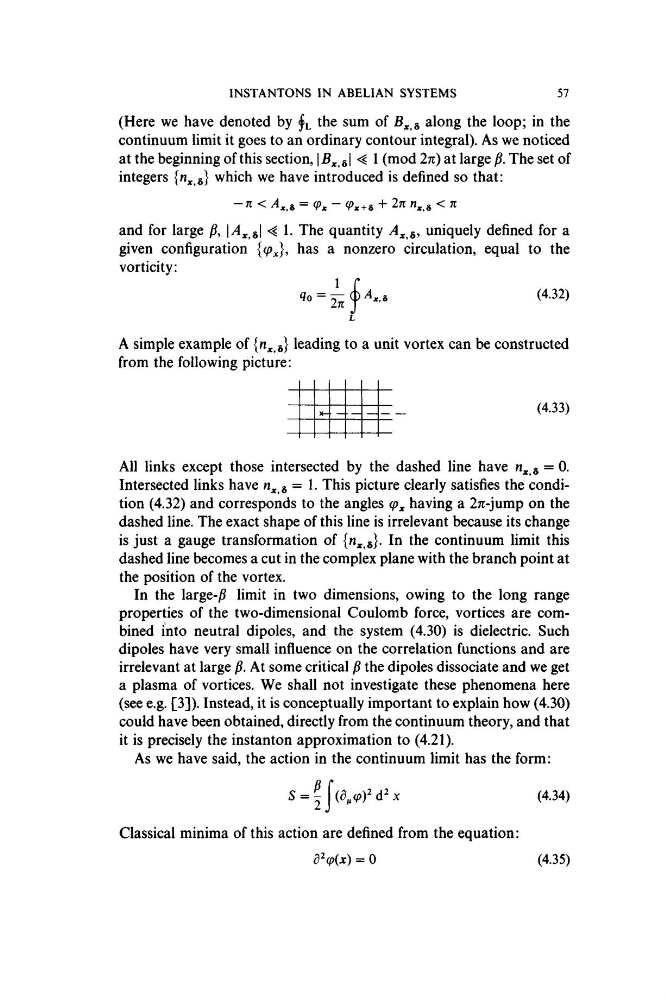
A simple example of
leading to a unit vortex can be constructed
from the following picture:
(4.33)
All links except those intersected by the dashed line have
§ = 0.
Intersected links have
1. This picture clearly satisfies the condition (4.32) and corresponds to the angles
having a 27r-jump on the
dashed line. The exact shape of this line is irrelevant because its change
is just a gauge transformation of {Wjcs}the continuum limit this
dashed line becomes a cut in the complex plane with the branch point at
the position of the vortex.
In the large-j8 limit in two dimensions, owing to the long range
properties of the two-dimensional Coulomb force, vortices are combined into neutral dipoles, and the system (4.30) is dielectric. Such
dipoles have very small influence on the correlation functions and are
irrelevant at large p. At some critical P the dipoles dissociate and we get
a plasma of vortices. We shall not investigate these phenomena here
(see e.g. [3]). Instead, it is conceptually important to explain how (4.30)
could have been obtained, directly from the continuum theory, and that
it is precisely the instanton approximation to (4.21).
As we have said, the action in the continuum limit has the form:
S =
P (d.cpy d^x
(4.34)
Classical minima of this action are defined from the equation:
a > (jc ) = 0
(4.35)
57
(Here we have denoted by
the sum of
g along the loop; in the
continuum limit it goes to an ordinary contour integral). As we noticed
at the beginning of this section,
g| 1 (mod 2n) at large p. The set of
integers
which we have introduced is defined so that:
< ^ x , 6 = (P x~ (Px + 6 + 2 7 T ^*x,6 < 71
and for large J?,
1. The quantity
§, uniquely defined for a
given configuration {cp^}, has a nonzero circulation, equal to the
vorticity:
=
(4.32)
A simple example of
leading to a unit vortex can be constructed
from the following picture:
(4.33)
All links except those intersected by the dashed line have
§ = 0.
Intersected links have
1. This picture clearly satisfies the condition (4.32) and corresponds to the angles
having a 27r-jump on the
dashed line. The exact shape of this line is irrelevant because its change
is just a gauge transformation of {Wjcs}the continuum limit this
dashed line becomes a cut in the complex plane with the branch point at
the position of the vortex.
In the large-j8 limit in two dimensions, owing to the long range
properties of the two-dimensional Coulomb force, vortices are combined into neutral dipoles, and the system (4.30) is dielectric. Such
dipoles have very small influence on the correlation functions and are
irrelevant at large p. At some critical P the dipoles dissociate and we get
a plasma of vortices. We shall not investigate these phenomena here
(see e.g. [3]). Instead, it is conceptually important to explain how (4.30)
could have been obtained, directly from the continuum theory, and that
it is precisely the instanton approximation to (4.21).
As we have said, the action in the continuum limit has the form:
S =
P (d.cpy d^x
(4.34)
Classical minima of this action are defined from the equation:
a > (jc ) = 0
(4.35)