

INSTANTONS IN ABELIAN SYSTEMS
55
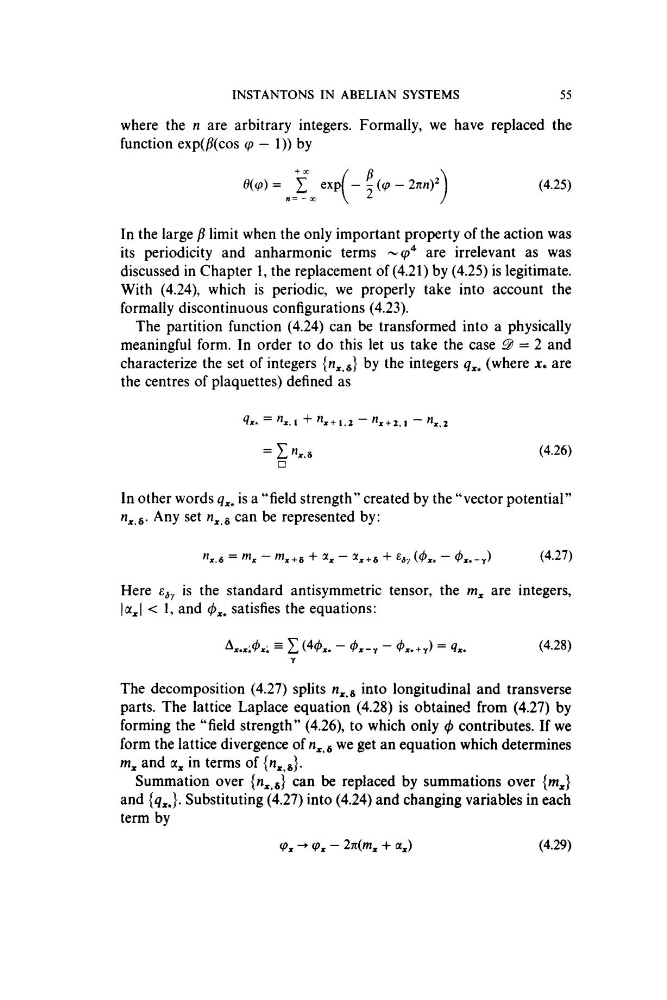
where the n are arbitrary integers. Formally, we have replaced the
function exp(jS(cos (p — 1)) by
9{ - 2nnf
w = — m
\
^
(4.25)
In the large P limit when the only important property of the action was
its periodicity and anharmonic terms
are irrelevant as was
discussed in Chapter 1, the replacement of (4.21) by (4.25) is legitimate.
With (4.24), which is periodic, we properly take into account the
formally discontinuous configurations (4.23).
The partition function (4.24) can be transformed into a physically
meaningful form. In order to do this let us take the case ^ = 2 and
characterize the set of integers
by the integers
(where jc* are
the centres of plaquettes) defined as
^x* = 'îx. 1 + «X
= I "x.S
□
- n.
(4.26)
In other words
is a “field strength” created by the “vector potential”
M j, g. Any set n, § can be represented by:
« X .Ô = ^ x - ^ x + 0 +
+ g
( ( /> , , -
(4.27)
Here ¿¿y is the standard antisymmetric tensor, the
are integers,
la^^l < 1, and
satisfies the equations:
= Z ( 4 0 X . -
< / > x - r - x . + y ) = (4.28)
The decomposition (4.27) splits n, g into longitudinal and transverse
parts. The lattice Laplace equation (4.28) is obtained from (4.27) by
forming the “field strength” (4.26), to which only < /> contributes. If we
form the lattice divergence of g we get an equation which determines
m, and a, in terms of
Summation over
can be replaced by summations over {m,}
and
Substituting (4.27) into (4.24) and changing variables in each
term by
(Px-*(Px- Mrri:, F a ,)
(4.29)
55
where the n are arbitrary integers. Formally, we have replaced the
function exp(jS(cos (p — 1)) by
9{
w = — m
\
^
(4.25)
In the large P limit when the only important property of the action was
its periodicity and anharmonic terms
are irrelevant as was
discussed in Chapter 1, the replacement of (4.21) by (4.25) is legitimate.
With (4.24), which is periodic, we properly take into account the
formally discontinuous configurations (4.23).
The partition function (4.24) can be transformed into a physically
meaningful form. In order to do this let us take the case ^ = 2 and
characterize the set of integers
by the integers
(where jc* are
the centres of plaquettes) defined as
^x* = 'îx. 1 + «X
= I "x.S
□
- n.
(4.26)
In other words
is a “field strength” created by the “vector potential”
M j, g. Any set n, § can be represented by:
« X .Ô = ^ x - ^ x + 0 +
+ g
( ( /> , , -
(4.27)
Here ¿¿y is the standard antisymmetric tensor, the
are integers,
la^^l < 1, and
satisfies the equations:
= Z ( 4 0 X . -
< / > x - r - x . + y ) = (4.28)
The decomposition (4.27) splits n, g into longitudinal and transverse
parts. The lattice Laplace equation (4.28) is obtained from (4.27) by
forming the “field strength” (4.26), to which only < /> contributes. If we
form the lattice divergence of g we get an equation which determines
m, and a, in terms of
Summation over
can be replaced by summations over {m,}
and
Substituting (4.27) into (4.24) and changing variables in each
term by
(Px-*(Px- Mrri:, F a ,)
(4.29)