

INSTANTONS IN ABELIAN SYSTEMS
51
limit it becomes very large. This is in complete agreement with the
tunnelling interpretation of our solution, namely the characteristic time
we have introduced, is just the tunnelling time and hence the time for
restoration of symmetry.
Let us perform now a more quantitative analysis.
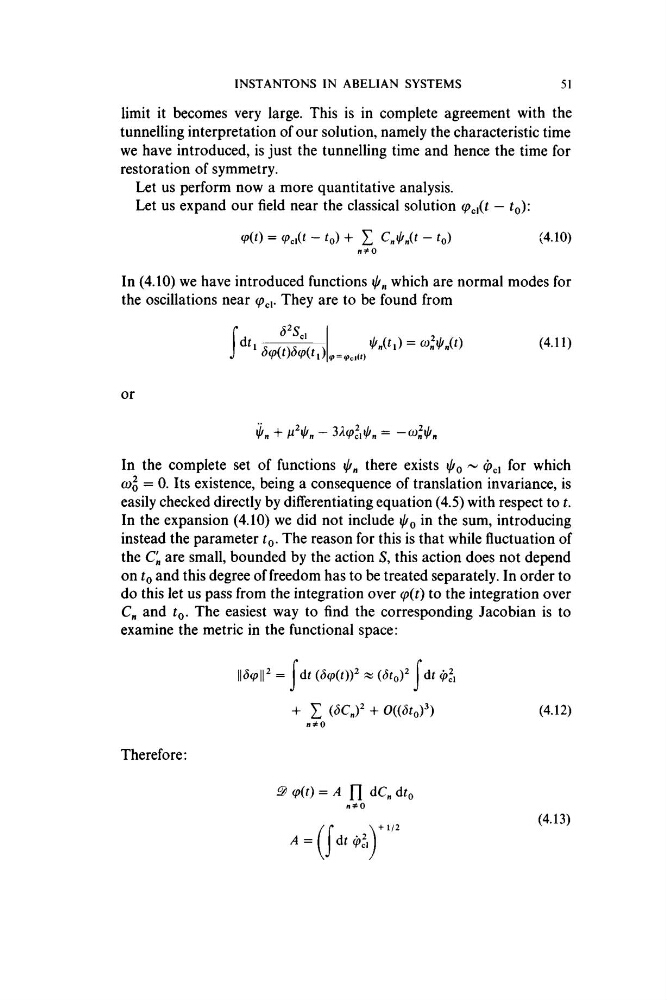
Let us expand our field near the classical solution
— Iq):
(4.10)
In (4.10) we have introduced functions ij/„ which are normal modes for
the oscillations near
They are to be found from
dt.
d < p {t)d (p {ti)
W ii) =
< P =
or
In the complete set of functions
there exists i/^o
for which
col = 0- fis existence, being a consequence of translation invariance, is
easily checked directly by differentiating equation (4.5) with respect to t.
In the expansion (4.10) we did not include i^o th® sum, introducing
instead the parameter
The reason for this is that while fluctuation of
the C„ are small, bounded by the action S, this action does not depend
on io and this degree of freedom has to be treated separately. In order to
do this let us pass from the integration over cp(t) to the integration over
C„ and io- The easiest way to find the corresponding Jacobian is to
examine the metric in the functional space:
I I S(pf= dt
% (Sto)^ dt cpli
+ Z (SCf + OHStof)
(4.12)
Therefore:
^ (pit) = A H dC„ dio
A = dt
- 1/2
(4.13)
51
limit it becomes very large. This is in complete agreement with the
tunnelling interpretation of our solution, namely the characteristic time
we have introduced, is just the tunnelling time and hence the time for
restoration of symmetry.
Let us perform now a more quantitative analysis.
Let us expand our field near the classical solution
— Iq):
(4.10)
In (4.10) we have introduced functions ij/„ which are normal modes for
the oscillations near
They are to be found from
dt.
d < p {t)d (p {ti)
W ii) =
< P =
or
In the complete set of functions
there exists i/^o
for which
col = 0- fis existence, being a consequence of translation invariance, is
easily checked directly by differentiating equation (4.5) with respect to t.
In the expansion (4.10) we did not include i^o th® sum, introducing
instead the parameter
The reason for this is that while fluctuation of
the C„ are small, bounded by the action S, this action does not depend
on io and this degree of freedom has to be treated separately. In order to
do this let us pass from the integration over cp(t) to the integration over
C„ and io- The easiest way to find the corresponding Jacobian is to
examine the metric in the functional space:
I I S(pf= dt
% (Sto)^ dt cpli
+ Z (SCf + OHStof)
(4.12)
Therefore:
^ (pit) = A H dC„ dio
A = dt
- 1/2
(4.13)