

THE STRONG COUPLING EXPANSION
45
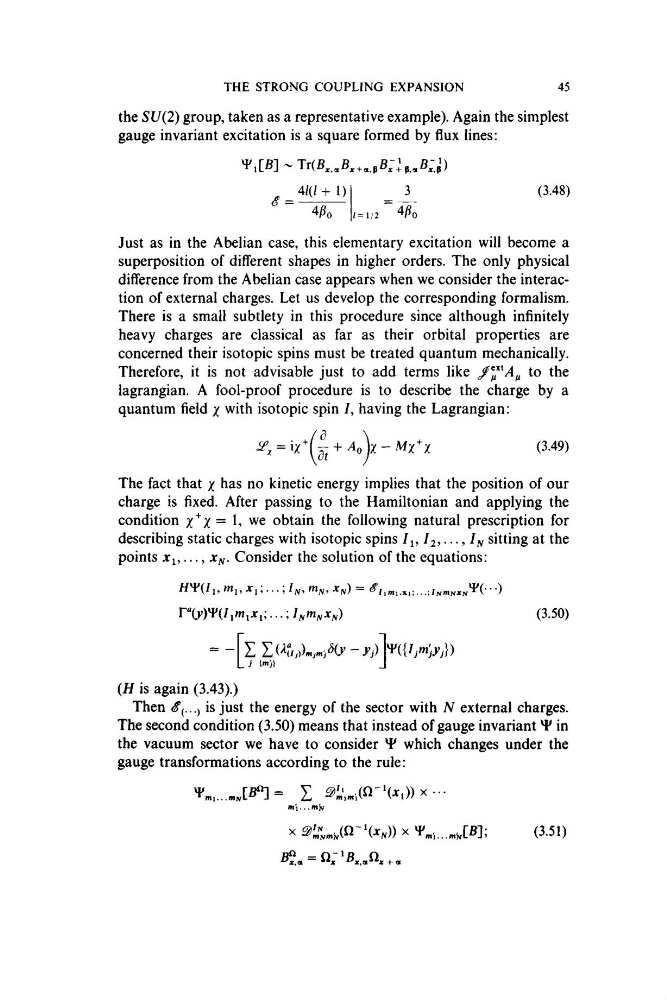
the SU(2) group, taken as a representative example). Again the simplest
gauge invariant excitation is a square formed by flux lines:
4/(/ + 1)
0 -1
X + «x, P
4- P,« ^ x , P
4/^0 1= 1/2
3
4^0
(3.48)
Just as in the Abelian case, this elementary excitation will become a
superposition of different shapes in higher orders. The only physical
difference from the Abelian case appears when we consider the interaction of external charges. Let us develop the corresponding formalism.
There is a small subtlety in this procedure since although infinitely
heavy charges are classical as far as their orbital properties are
concerned their isotopic spins must be treated quantum mechanically.
Therefore, it is not advisable just to add terms like
to the
lagrangian. A fool-proof procedure is to describe the charge by a
quantum field x with isotopic spin /, having the Lagrangian:
(3.49)
The fact that x has no kinetic energy implies that the position of our
charge is fixed. After passing to the Hamiltonian and applying the
condition x^X = we obtain the following natural prescription for
describing static charges with isotopic spins
/ 2,...,
sitting at the
points JCi,...,
Consider the solution of the equations:
P(j)'F(/imijri;... ;
^ /i mi.xi:. . /jvmjvxjv
(3.50)
LJ ("»)}
J
(H is again (3.43).)
Then ^(...) is just the energy of the sector with N external charges.
The second condition (3.50) means that instead of gauge invariant ^ in
the vacuum sector we have to consider 'F which changes under the
gauge transformations according to the rule:
m 'l. . . ntfi
(3.51)
45
the SU(2) group, taken as a representative example). Again the simplest
gauge invariant excitation is a square formed by flux lines:
4/(/ + 1)
0 -1
X + «x, P
4- P,« ^ x , P
4/^0 1= 1/2
3
4^0
(3.48)
Just as in the Abelian case, this elementary excitation will become a
superposition of different shapes in higher orders. The only physical
difference from the Abelian case appears when we consider the interaction of external charges. Let us develop the corresponding formalism.
There is a small subtlety in this procedure since although infinitely
heavy charges are classical as far as their orbital properties are
concerned their isotopic spins must be treated quantum mechanically.
Therefore, it is not advisable just to add terms like
to the
lagrangian. A fool-proof procedure is to describe the charge by a
quantum field x with isotopic spin /, having the Lagrangian:
(3.49)
The fact that x has no kinetic energy implies that the position of our
charge is fixed. After passing to the Hamiltonian and applying the
condition x^X = we obtain the following natural prescription for
describing static charges with isotopic spins
/ 2,...,
sitting at the
points JCi,...,
Consider the solution of the equations:
P(j)'F(/imijri;... ;
^ /i mi.xi:. . /jvmjvxjv
(3.50)
LJ ("»)}
J
(H is again (3.43).)
Then ^(...) is just the energy of the sector with N external charges.
The second condition (3.50) means that instead of gauge invariant ^ in
the vacuum sector we have to consider 'F which changes under the
gauge transformations according to the rule:
m 'l. . . ntfi
(3.51)