

44
GAUGE FIELDS AND STRINGS
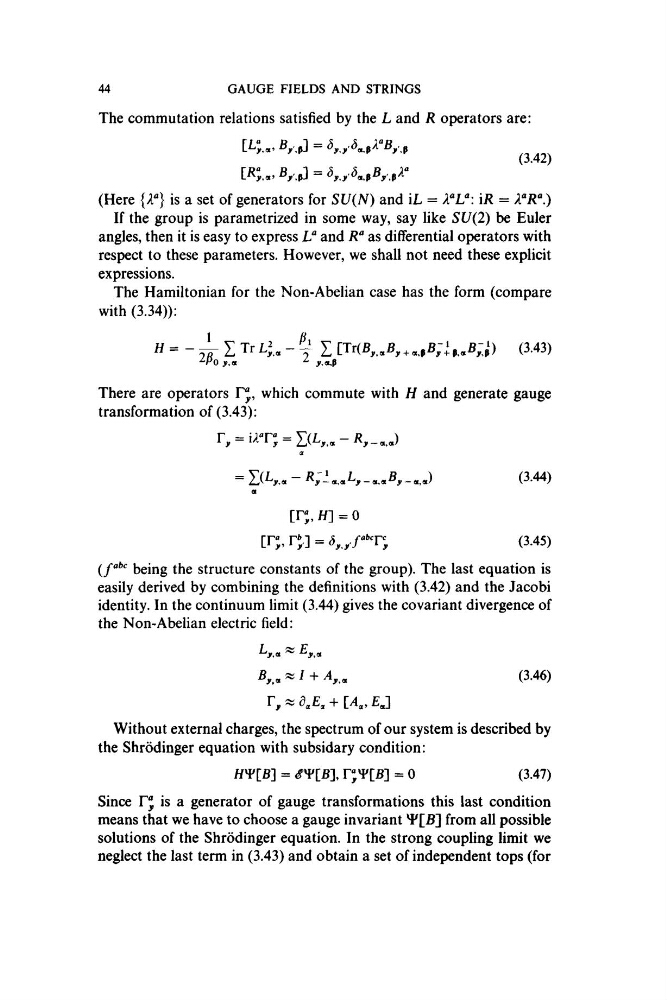
The commutation relations satisfied by the L and R operators are:
(Here (A"} is a set of generators for SU(N) and iL = A"L“: iR =
If the group is parametrized in some way, say like SU(2) be Euler
angles, then it is easy to express L" and R "" as differential operators with
respect to these parameters. However, we shall not need these explicit
expressions.
The Hamiltonian for the Non-Abelian case has the form (compare
with (3.34)):
^Po y,a
^ J,«,p
X [Tr(B,,.5, ,
(3.43)
There are operators T", which commute with H and generate gauge
transformation of (3.43):
= iAT; = Z(L,,, -
J
~
« ^y-a,ai^y-ai,a^y-ai,a)
(3.44)
[FJ, //] = 0
[r;, rjd =
(3.45)
being the structure constants of the group). The last equation is
easily derived by combining the definitions with (3.42) and the Jacobi
identity. In the continuum limit (3.44) gives the covariant divergence of
the Non-Abelian electric field:
~ f + ^y,< t
(3.46)
Ey -
EJ
Without external charges, the spectrum of our system is described by
the Shrodinger equation with subsidary condition:
= (^T[B], rjT[B] = 0
(3.47)
Since Ty is a generator of gauge transformations this last condition
means that we have to choose a gauge invariant
from all possible
solutions of the Shrodinger equation. In the strong coupling limit we
neglect the last term in (3.43) and obtain a set of independent tops (for
GAUGE FIELDS AND STRINGS
The commutation relations satisfied by the L and R operators are:
(Here (A"} is a set of generators for SU(N) and iL = A"L“: iR =
If the group is parametrized in some way, say like SU(2) be Euler
angles, then it is easy to express L" and R "" as differential operators with
respect to these parameters. However, we shall not need these explicit
expressions.
The Hamiltonian for the Non-Abelian case has the form (compare
with (3.34)):
^Po y,a
^ J,«,p
X [Tr(B,,.5, ,
(3.43)
There are operators T", which commute with H and generate gauge
transformation of (3.43):
= iAT; = Z(L,,, -
J
~
« ^y-a,ai^y-ai,a^y-ai,a)
(3.44)
[FJ, //] = 0
[r;, rjd =
(3.45)
being the structure constants of the group). The last equation is
easily derived by combining the definitions with (3.42) and the Jacobi
identity. In the continuum limit (3.44) gives the covariant divergence of
the Non-Abelian electric field:
~ f + ^y,< t
(3.46)
Ey -
EJ
Without external charges, the spectrum of our system is described by
the Shrodinger equation with subsidary condition:
= (^T[B], rjT[B] = 0
(3.47)
Since Ty is a generator of gauge transformations this last condition
means that we have to choose a gauge invariant
from all possible
solutions of the Shrodinger equation. In the strong coupling limit we
neglect the last term in (3.43) and obtain a set of independent tops (for