

46
GAUGE FIELDS AND STRINGS
and
(Q) are standard representation matrices for the SU(2) group.
The meaning of the rules (3.50) and (3.51) is quite transparent. They
imply that static charges, the state of which is characterized by their
isotopic spin / and its projection m, are sources of Non-Abelian electric
flux.
With these prescriptions at hand we can demonstrate an important
property specific to the Non-Abelian case mentioned above. Let us first
consider the interaction of two charges with isotopic spins 1/2 placed at
a distance R from each other. In the strong coupling limit the wave
function of their state is given by:
[B]
n
(3.52)
(where we have taken a product of B-matrices along the straight line
connecting the charges). Since tops placed on this line, are excited
(they have I = 1/2) we obtain the result:
Sm(xi,x2) '
(3.53)
just as in the Abelian case. Now, let us consider two charges with 7=1.
One possible wave function will be the same as (3.52) with
replaced by
However, here we have a state with much lower energy.
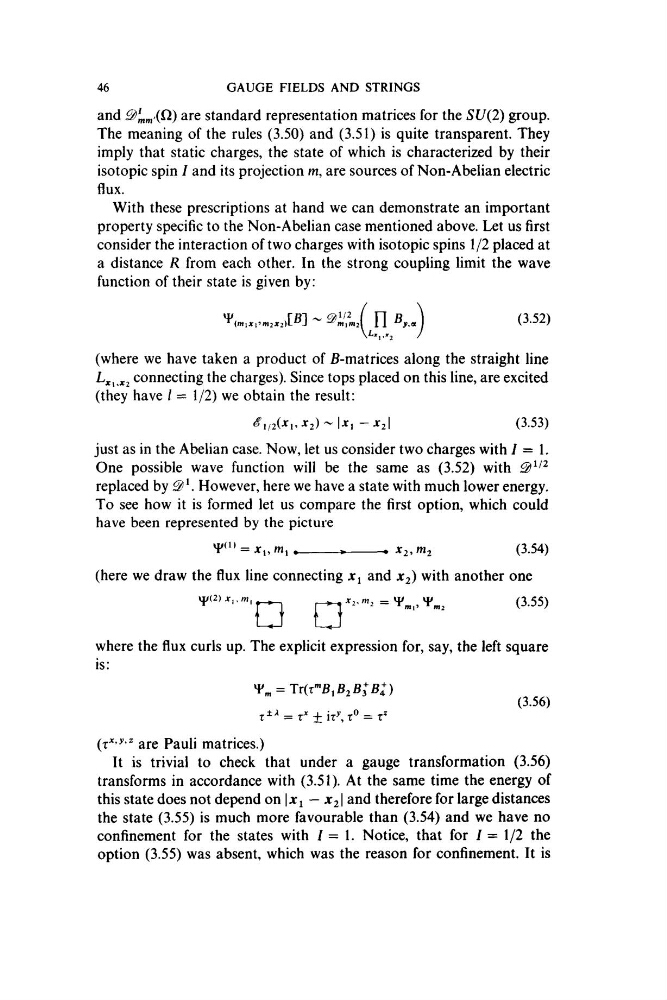
To see how it is formed let us compare the first option, which could
have been represented by the picture
X2.rri2
(3.54)
(here we draw the flux line connecting jCj and X2 ) with another one
(3.55)
D a
where the flux curls up. The explicit expression for, say, the left square
is:
± iT^ T® = t"
(3.56)
(^x,y,z
pa^lj matrices.)
It is trivial to check that under a gauge transformation (3.56)
transforms in accordance with (3.51). At the same time the energy of
this state does not depend on Ijc^ — JC2I and therefore for large distances
the state (3.55) is much more favourable than (3.54) and we have no
confinement for the states with 7=1. Notice, that for 7 = 1/2 the
option (3.55) was absent, which was the reason for confinement. It is
GAUGE FIELDS AND STRINGS
and
(Q) are standard representation matrices for the SU(2) group.
The meaning of the rules (3.50) and (3.51) is quite transparent. They
imply that static charges, the state of which is characterized by their
isotopic spin / and its projection m, are sources of Non-Abelian electric
flux.
With these prescriptions at hand we can demonstrate an important
property specific to the Non-Abelian case mentioned above. Let us first
consider the interaction of two charges with isotopic spins 1/2 placed at
a distance R from each other. In the strong coupling limit the wave
function of their state is given by:
[B]
n
(3.52)
(where we have taken a product of B-matrices along the straight line
connecting the charges). Since tops placed on this line, are excited
(they have I = 1/2) we obtain the result:
Sm(xi,x2) '
(3.53)
just as in the Abelian case. Now, let us consider two charges with 7=1.
One possible wave function will be the same as (3.52) with
replaced by
However, here we have a state with much lower energy.
To see how it is formed let us compare the first option, which could
have been represented by the picture
X2.rri2
(3.54)
(here we draw the flux line connecting jCj and X2 ) with another one
(3.55)
D a
where the flux curls up. The explicit expression for, say, the left square
is:
± iT^ T® = t"
(3.56)
(^x,y,z
pa^lj matrices.)
It is trivial to check that under a gauge transformation (3.56)
transforms in accordance with (3.51). At the same time the energy of
this state does not depend on Ijc^ — JC2I and therefore for large distances
the state (3.55) is much more favourable than (3.54) and we have no
confinement for the states with 7=1. Notice, that for 7 = 1/2 the
option (3.55) was absent, which was the reason for confinement. It is