

ATTEMPT AT A SYNTHESIS
111
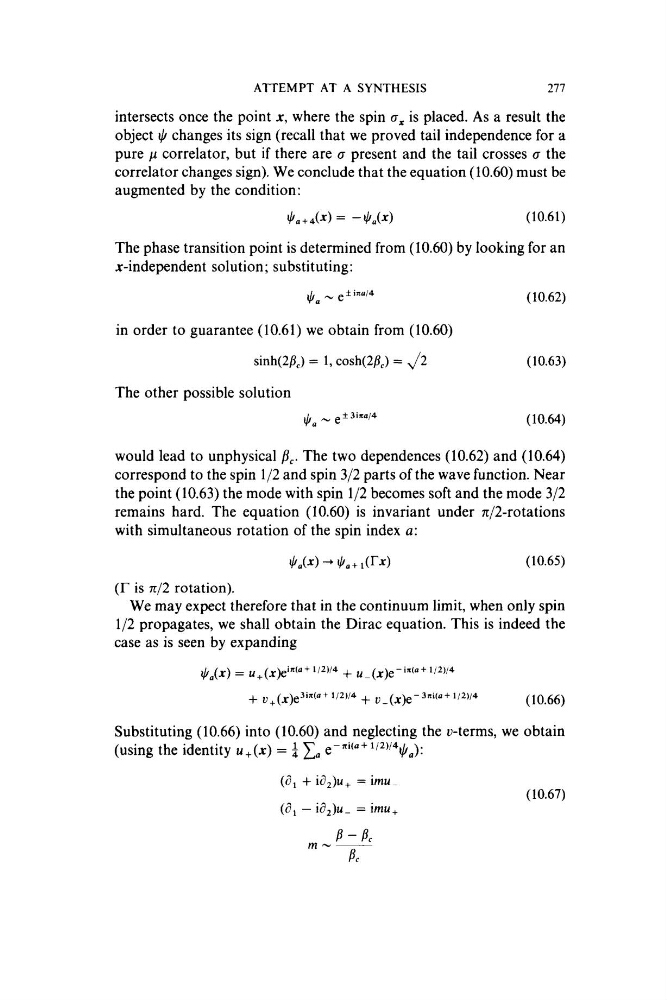
intersects once the point jc, where the spin is placed. As a result the
object {j/ changes its sign (recall that we proved tail independence for a
pure correlator, but if there are a present and the tail crosses a the
correlator changes sign). We conclude that the equation (10.60) must be
augmented by the condition:
(10.61)
The phase transition point is determined from (10.60) by looking for an
jc-independent solution; substituting:
^a'
a ± Ì7ra/4
in order to guarantee (10.61) we obtain from (10.60)
sinh(2j9^) = 1, cosh(2j5^) =
The other possible solution
a ± 3 ina 14
(10.62)
(10.63)
(10.64)
would lead to unphysical
The two dependences (10.62) and (10.64)
correspond to the spin 1/2 and spin 3/2 parts of the wave function. Near
the point (10.63) the mode with spin 1/2 becomes soft and the mode 3/2
remains hard. The equation (10.60) is invariant under 7r/2-rotations
with simultaneous rotation of the spin index a:
W^)-iAa^i(rx)
(10.65)
(T is n jl rotation).
We may expect therefore that in the continuum limit, when only spin
1/2 propagates, we shall obtain the Dirac equation. This is indeed the
case as is seen by expanding
( 10.66)
Substituting (10.66) into (10.60) and neglecting the r-terms, we obtain
(using the identity u^(x) = i
( ^ 1 H - i^2)w+ = imu_
(d^ — id2)u_ = imu +
P-Pc
(10.67)
m
P c
111
intersects once the point jc, where the spin is placed. As a result the
object {j/ changes its sign (recall that we proved tail independence for a
pure correlator, but if there are a present and the tail crosses a the
correlator changes sign). We conclude that the equation (10.60) must be
augmented by the condition:
(10.61)
The phase transition point is determined from (10.60) by looking for an
jc-independent solution; substituting:
^a'
a ± Ì7ra/4
in order to guarantee (10.61) we obtain from (10.60)
sinh(2j9^) = 1, cosh(2j5^) =
The other possible solution
a ± 3 ina 14
(10.62)
(10.63)
(10.64)
would lead to unphysical
The two dependences (10.62) and (10.64)
correspond to the spin 1/2 and spin 3/2 parts of the wave function. Near
the point (10.63) the mode with spin 1/2 becomes soft and the mode 3/2
remains hard. The equation (10.60) is invariant under 7r/2-rotations
with simultaneous rotation of the spin index a:
W^)-iAa^i(rx)
(10.65)
(T is n jl rotation).
We may expect therefore that in the continuum limit, when only spin
1/2 propagates, we shall obtain the Dirac equation. This is indeed the
case as is seen by expanding
( 10.66)
Substituting (10.66) into (10.60) and neglecting the r-terms, we obtain
(using the identity u^(x) = i
( ^ 1 H - i^2)w+ = imu_
(d^ — id2)u_ = imu +
P-Pc
(10.67)
m
P c