

276
GAUGE FIELDS AND STRINGS
intersected by the path. Consider the modified partition function Z(P).
It is obvious now that Z(P) = Z, since to any given configuration
contributing to Z(P) corresponds a configuration of the same energy
contributing to Z. The latter configuration is obtained from the former
one by reversing all the spins lying inside the drop. From this relation it
follows that two different choices of the path in (10.56) and (10.57) give
the same result. Let us notice parenthetically that such a simple
definition of the disorder variable holds true for a lattice with simple
topology (such that each closed loop bounds a drop). Otherwise there
are different variables, classified by the first homology group.
In order to obtain linear equations let us consider the variable {¡z
which is formed by the product of the order parameter
and the
adjacent disorder variable. At each point of the original lattice jc, we
have four adjacent points of the dual lattice
= x
where the four
vectors have length 1/^2 and are directed along the diagonals of the
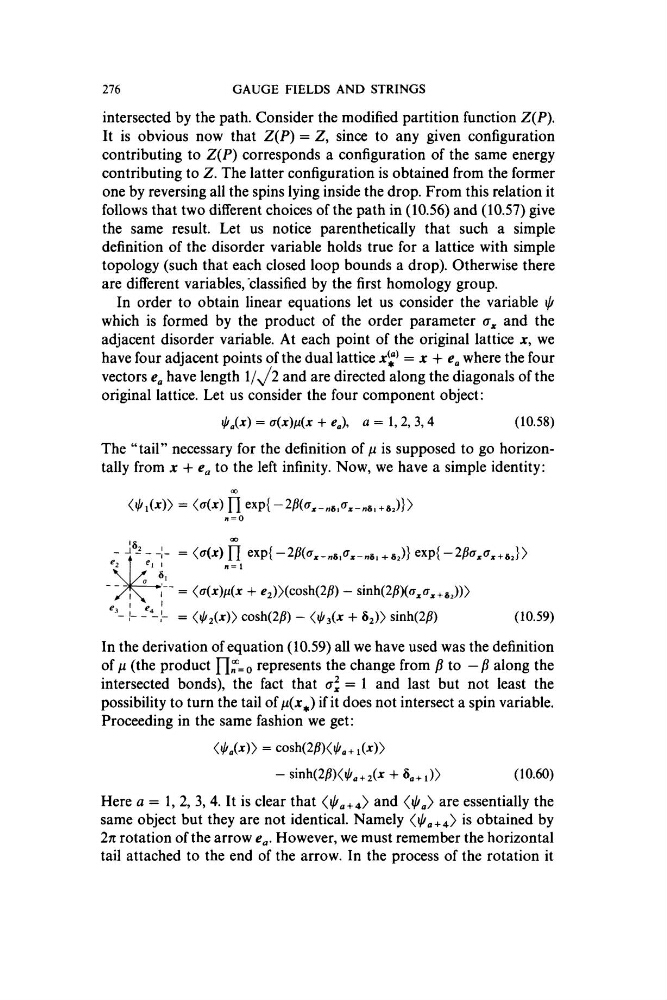
original lattice. Let us consider the four component object:
^a(x) = (r(x)fi{x + ej, ¿z = 1, 2, 3,4
(10.58)
The “tail” necessary for the definition of /x is supposed to go horizontally from JC -h to the left infinity. Now, we have a simple identity:
.)}>
r - i- 7 -I- =
n exp{
+ 8,)} exp{ - 2^<7^(T,+gJ>
•
n = 1
= { ( t ( x ) h ( x + ^ 2 ) > ( c o s h ( 2 i ? ) - s i n h ( 2 j 9 ) ( < j ,< 7 ,+ g J ) >
= <^2(x)y cosh(2j9) -
In the derivation of equation (10.59) all we have used was the definition
of /X (the product n*=o represents the change from jS to — jS along the
intersected bonds), the fact that (tI = I and last but not least the
possibility to turn the tail of /x(x^) if it does not intersect a spin variable.
Proceeding in the same fashion we get:
<,A,(jc)> = cosh(2^)
-sinh(2j5)
(10.60)
Here a = 1, 2, 3, 4. It is clear that and
are essentially the
same object but they are not identical. Namely <«Aa+4> is obtained by
2n rotation of the arrow e^. However, we must remember the horizontal
tail attached to the end of the arrow. In the process of the rotation it
GAUGE FIELDS AND STRINGS
intersected by the path. Consider the modified partition function Z(P).
It is obvious now that Z(P) = Z, since to any given configuration
contributing to Z(P) corresponds a configuration of the same energy
contributing to Z. The latter configuration is obtained from the former
one by reversing all the spins lying inside the drop. From this relation it
follows that two different choices of the path in (10.56) and (10.57) give
the same result. Let us notice parenthetically that such a simple
definition of the disorder variable holds true for a lattice with simple
topology (such that each closed loop bounds a drop). Otherwise there
are different variables, classified by the first homology group.
In order to obtain linear equations let us consider the variable {¡z
which is formed by the product of the order parameter
and the
adjacent disorder variable. At each point of the original lattice jc, we
have four adjacent points of the dual lattice
= x
where the four
vectors have length 1/^2 and are directed along the diagonals of the
original lattice. Let us consider the four component object:
^a(x) = (r(x)fi{x + ej, ¿z = 1, 2, 3,4
(10.58)
The “tail” necessary for the definition of /x is supposed to go horizontally from JC -h to the left infinity. Now, we have a simple identity:
.)}>
r - i- 7 -I- =
n exp{
+ 8,)} exp{ - 2^<7^(T,+gJ>
•
n = 1
= { ( t ( x ) h ( x + ^ 2 ) > ( c o s h ( 2 i ? ) - s i n h ( 2 j 9 ) ( < j ,< 7 ,+ g J ) >
= <^2(x)y cosh(2j9) -
In the derivation of equation (10.59) all we have used was the definition
of /X (the product n*=o represents the change from jS to — jS along the
intersected bonds), the fact that (tI = I and last but not least the
possibility to turn the tail of /x(x^) if it does not intersect a spin variable.
Proceeding in the same fashion we get:
<,A,(jc)> = cosh(2^)
-sinh(2j5)
(10.60)
Here a = 1, 2, 3, 4. It is clear that
are essentially the
same object but they are not identical. Namely <«Aa+4> is obtained by
2n rotation of the arrow e^. However, we must remember the horizontal
tail attached to the end of the arrow. In the process of the rotation it