

278
GAUGE FIELDS AND STRINGS
Equation (10.67) is precisely the two-dimensional Dirac equation with
the spinor u{x) transforming under rotations:
u(x)- P>W 2. u(T(cp)x)
( 10.68)
(r((p) is a rotation with the angle (p.) The formula (10.68) is the
continuum analogue of (10.65). Up to now we have dealt with the single
field average {il/aix)}. If we have to consider more complicated Green
functions:
(10.69)
we find that with respect to each argument they satisfy the same
equation (10.60) with the condition (10.61) but on the right hand side of
this equation we shall have contact terms as usual. These terms reduce
to the standard ¿-functions in the continuum limit. Let us demonstrate
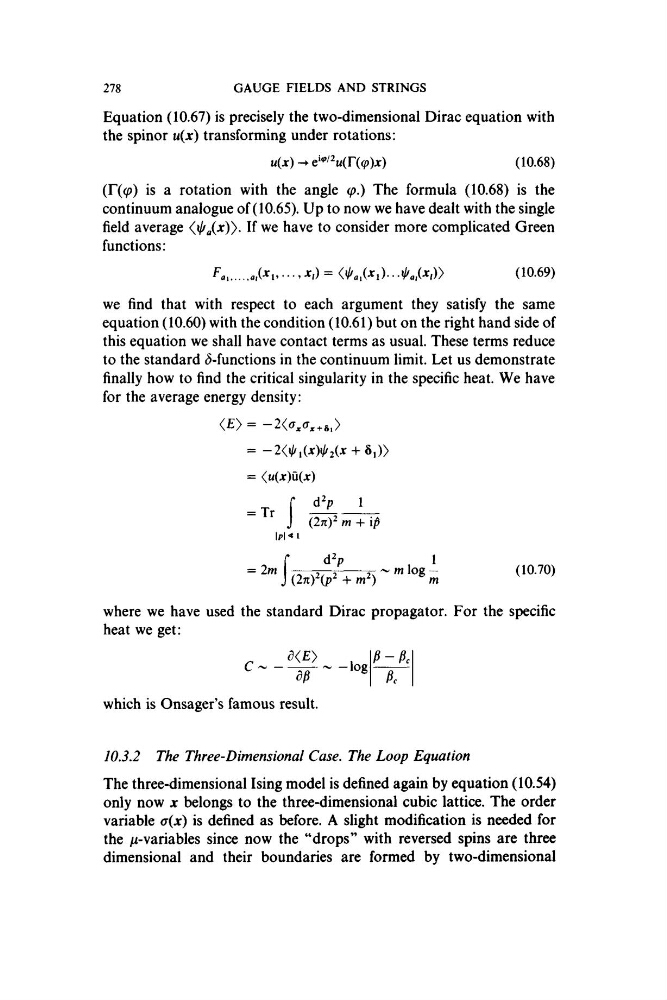
finally how to find the critical singularity in the specific heat. We have
for the average energy density:
<£>=
= -2(iP,(x)iP2Ìx + à,)>
=
1
= Tr
lpl
= 2m
dV
(27i)2(p2 + m^)
m log
(10.70)
where we have used the standard Dirac propagator. For the specific
heat we get:
C - -
d
dp
- l o g
P-Pc
P c
which is Onsager’s famous result.
10.3.2 The Three-Dimensional Case. The Loop Equation
The three-dimensional Ising model is defined again by equation (10.54)
only now jc belongs to the three-dimensional cubic lattice. The order
variable a(x) is defined as before. A slight modification is needed for
the /i-variables since now the “drops” with reversed spins are three
dimensional and their boundaries are formed by two-dimensional
GAUGE FIELDS AND STRINGS
Equation (10.67) is precisely the two-dimensional Dirac equation with
the spinor u{x) transforming under rotations:
u(x)- P>W 2. u(T(cp)x)
( 10.68)
(r((p) is a rotation with the angle (p.) The formula (10.68) is the
continuum analogue of (10.65). Up to now we have dealt with the single
field average {il/aix)}. If we have to consider more complicated Green
functions:
(10.69)
we find that with respect to each argument they satisfy the same
equation (10.60) with the condition (10.61) but on the right hand side of
this equation we shall have contact terms as usual. These terms reduce
to the standard ¿-functions in the continuum limit. Let us demonstrate
finally how to find the critical singularity in the specific heat. We have
for the average energy density:
<£>=
= -2(iP,(x)iP2Ìx + à,)>
=
1
= Tr
lpl
= 2m
dV
(27i)2(p2 + m^)
m log
(10.70)
where we have used the standard Dirac propagator. For the specific
heat we get:
C - -
d
dp
- l o g
P-Pc
P c
which is Onsager’s famous result.
10.3.2 The Three-Dimensional Case. The Loop Equation
The three-dimensional Ising model is defined again by equation (10.54)
only now jc belongs to the three-dimensional cubic lattice. The order
variable a(x) is defined as before. A slight modification is needed for
the /i-variables since now the “drops” with reversed spins are three
dimensional and their boundaries are formed by two-dimensional