

ATTEMPT AT A SYNTHESIS
271
In the case of the torus, we saw that a conformal gauge can be chosen,
provided that we represent this torus as a parallelogram, defined by
vectors
= (1,0) and (O2 = (Re t, Im t) where t is a complex parameter. Integration over all metrics was reduced to integration over the
Liouville field (absent in critical dimension and the integral J d^t. All
integrands as functions of t must be invariant under a specific discrete
group which we describe now. Therefore, to avoid repetitions one has to
integrate only over the fundamental region in i-space.
Let us take a torus and cut it along a circle, making a cylinder out of
it. Then twist one of the boundaries of this cylinder through the angle
2n and glue it back, obtaining a torus again. Clearly, this is a
diffeomorphism of the torus which is not homotopic to the identity. For
example a large circle of the torus will wind once around it after such a
diffeomorphism.
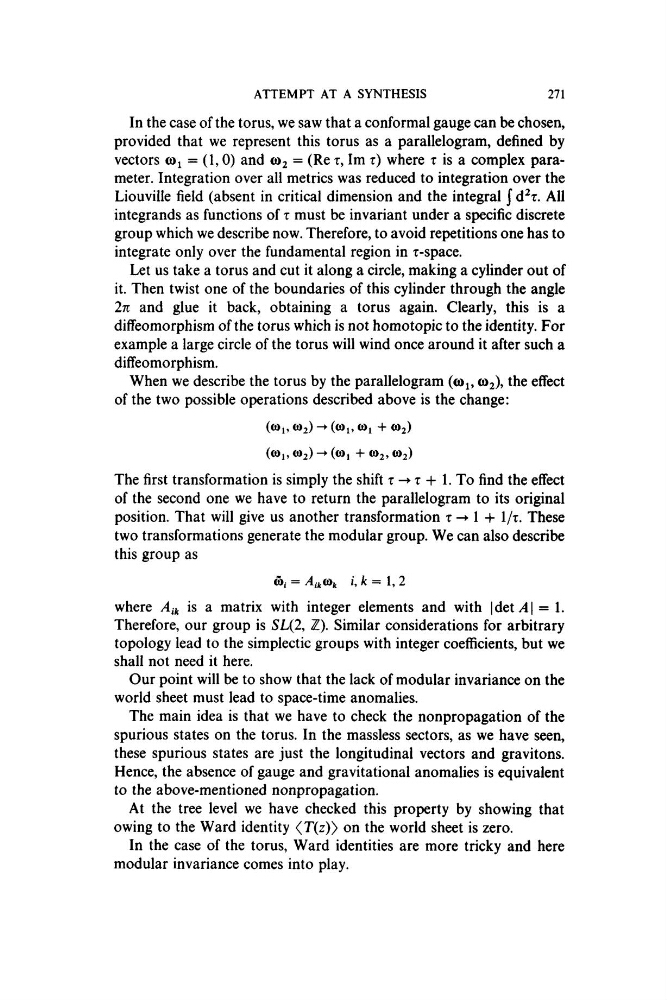
When we describe the torus by the parallelogram (coi, ©2), the effect
of the two possible operations described above is the change:
( i0 l , ( 0 2 ) - ^ ( 0 >l»«>l + «>2 )
The first transformation is simply the shift t -► t 4- 1. To find the effect
of the second one we have to return the parallelogram to its original
position. That will give us another transformation t 1 + 1/t. These
two transformations generate the modular group. We can also describe
this group as
«i = ^ik^k U /c = 1, 2
where
is a matrix with integer elements and with |det A| = 1.
Therefore, our group is SL(2, Z). Similar considerations for arbitrary
topology lead to the simplectic groups with integer coefficients, but we
shall not need it here.
Our point will be to show that the lack of modular invariance on the
world sheet must lead to space-time anomalies.
The main idea is that we have to check the nonpropagation of the
spurious states on the torus. In the massless sectors, as we have seen,
these spurious states are just the longitudinal vectors and gravitons.
Hence, the absence of gauge and gravitational anomalies is equivalent
to the above-mentioned nonpropagation.
At the tree level we have checked this property by showing that
owing to the Ward identity on the world sheet is zero.
In the case of the torus. Ward identities are more tricky and here
modular invariance comes into play.
271
In the case of the torus, we saw that a conformal gauge can be chosen,
provided that we represent this torus as a parallelogram, defined by
vectors
= (1,0) and (O2 = (Re t, Im t) where t is a complex parameter. Integration over all metrics was reduced to integration over the
Liouville field (absent in critical dimension and the integral J d^t. All
integrands as functions of t must be invariant under a specific discrete
group which we describe now. Therefore, to avoid repetitions one has to
integrate only over the fundamental region in i-space.
Let us take a torus and cut it along a circle, making a cylinder out of
it. Then twist one of the boundaries of this cylinder through the angle
2n and glue it back, obtaining a torus again. Clearly, this is a
diffeomorphism of the torus which is not homotopic to the identity. For
example a large circle of the torus will wind once around it after such a
diffeomorphism.
When we describe the torus by the parallelogram (coi, ©2), the effect
of the two possible operations described above is the change:
( i0 l , ( 0 2 ) - ^ ( 0 >l»«>l + «>2 )
The first transformation is simply the shift t -► t 4- 1. To find the effect
of the second one we have to return the parallelogram to its original
position. That will give us another transformation t 1 + 1/t. These
two transformations generate the modular group. We can also describe
this group as
«i = ^ik^k U /c = 1, 2
where
is a matrix with integer elements and with |det A| = 1.
Therefore, our group is SL(2, Z). Similar considerations for arbitrary
topology lead to the simplectic groups with integer coefficients, but we
shall not need it here.
Our point will be to show that the lack of modular invariance on the
world sheet must lead to space-time anomalies.
The main idea is that we have to check the nonpropagation of the
spurious states on the torus. In the massless sectors, as we have seen,
these spurious states are just the longitudinal vectors and gravitons.
Hence, the absence of gauge and gravitational anomalies is equivalent
to the above-mentioned nonpropagation.
At the tree level we have checked this property by showing that
owing to the Ward identity
In the case of the torus. Ward identities are more tricky and here
modular invariance comes into play.