

272
GAUGE FIELDS AND STRINGS
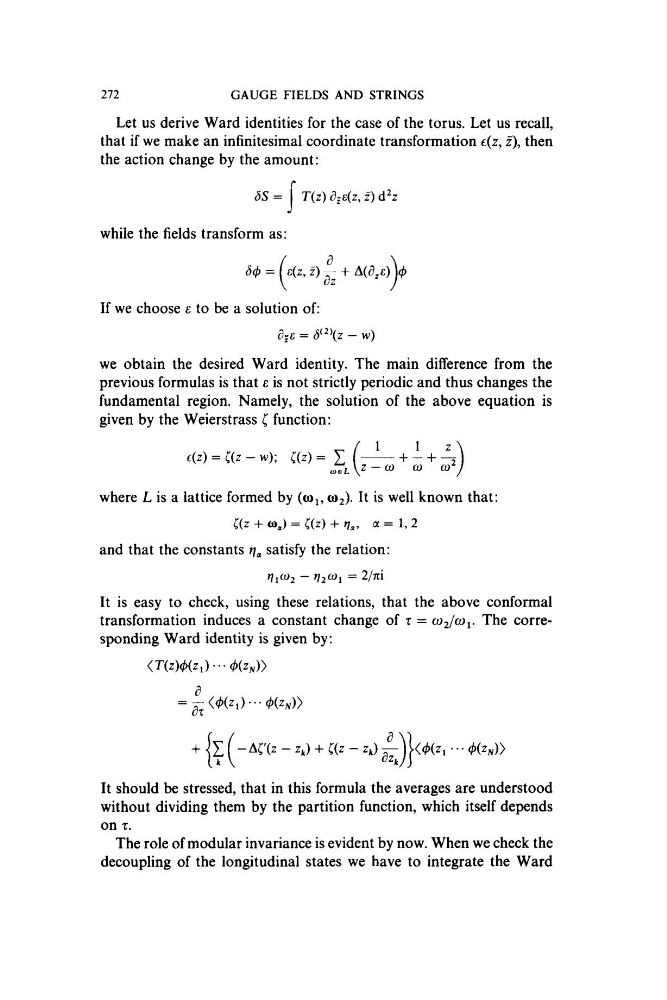
Let US derive Ward identities for the case of the torus. Let us recall,
that if we make an infinitesimal coordinate transformation e(z, z), then
the action change by the amount:
= J T(z) d¡e(z, z) d^z
while the fields transform as:
SzS)j4
S< t> = |^e( z , z ) ^ + A ( a ^ £ ) )<^
If we choose e to be a solution of:
d-e = S^^\z — w)
we obtain the desired Ward identity. The main difference from the
previous formulas is that e is not strictly periodic and thus changes the
fundamental region. Namely, the solution of the above equation is
given by the Weierstrass C function:
e(z) = C(z - w); C(z) = X
z — œ
œ
cú^
where L is a lattice formed by (cOi, ©2). It is well known that:
C(z + o j = C(z) +
a = 1, 2
and that the constants satisfy the relation:
^1^2 ~ ^2^1 = 2/7ri
It is easy to check, using these relations, that the above conformal
transformation induces a constant change of t = cojo)^. The corresponding Ward identity is given by :
+ | z
AÇ'(z - Zj) + C(z - Z»)
• • • 4>{^n)'>
It should be stressed, that in this formula the averages are understood
without dividing them by the partition function, which itself depends
on T.
The role of modular invariance is evident by now. When we check the
decoupling of the longitudinal states we have to integrate the Ward
GAUGE FIELDS AND STRINGS
Let US derive Ward identities for the case of the torus. Let us recall,
that if we make an infinitesimal coordinate transformation e(z, z), then
the action change by the amount:
= J T(z) d¡e(z, z) d^z
while the fields transform as:
SzS)j4
S< t> = |^e( z , z ) ^ + A ( a ^ £ ) )<^
If we choose e to be a solution of:
d-e = S^^\z — w)
we obtain the desired Ward identity. The main difference from the
previous formulas is that e is not strictly periodic and thus changes the
fundamental region. Namely, the solution of the above equation is
given by the Weierstrass C function:
e(z) = C(z - w); C(z) = X
z — œ
œ
cú^
where L is a lattice formed by (cOi, ©2). It is well known that:
C(z + o j = C(z) +
a = 1, 2
and that the constants satisfy the relation:
^1^2 ~ ^2^1 = 2/7ri
It is easy to check, using these relations, that the above conformal
transformation induces a constant change of t = cojo)^. The corresponding Ward identity is given by :
+ | z
AÇ'(z - Zj) + C(z - Z»)
• • • 4>{^n)'>
It should be stressed, that in this formula the averages are understood
without dividing them by the partition function, which itself depends
on T.
The role of modular invariance is evident by now. When we check the
decoupling of the longitudinal states we have to integrate the Ward