

270
GAUGE FIELDS AND STRINGS
Now, repeating the analysis of the previous chapter we would find
that generally speaking this theory is anomalous. When we take
Gab — ^ab + Kb^ we find that in general the effective action for h^i, is of
the form:
K_
W
c+ ^
c_ — ^ + + + possible local terms
where
and c_ are the central charges of the left and right parts of the
theory. We have seen in Chapter 9 that for
= c_ the local term can
be arranged so that W is gauge invariant. For c+ ^ c_ this is not
possible any more. Hence, if we want to maintain general covariance we
have to equalize c+ and c_ .
To do this we recall that we have ghosts with
= —15 (for the
supersymmetric part of the theory) and c_ = — 26 for the ordinary
part. Therefore:
cT =
- 15 +
^tot = ^ _ 26 -h c_
We conclude that
must describe a left-supersymmetric field theory
on the world sheet with c_ — c+ = ^ /2 -h 11. The critical dimension is
given by
= 1(10 — ^). The simplest choice would be to take
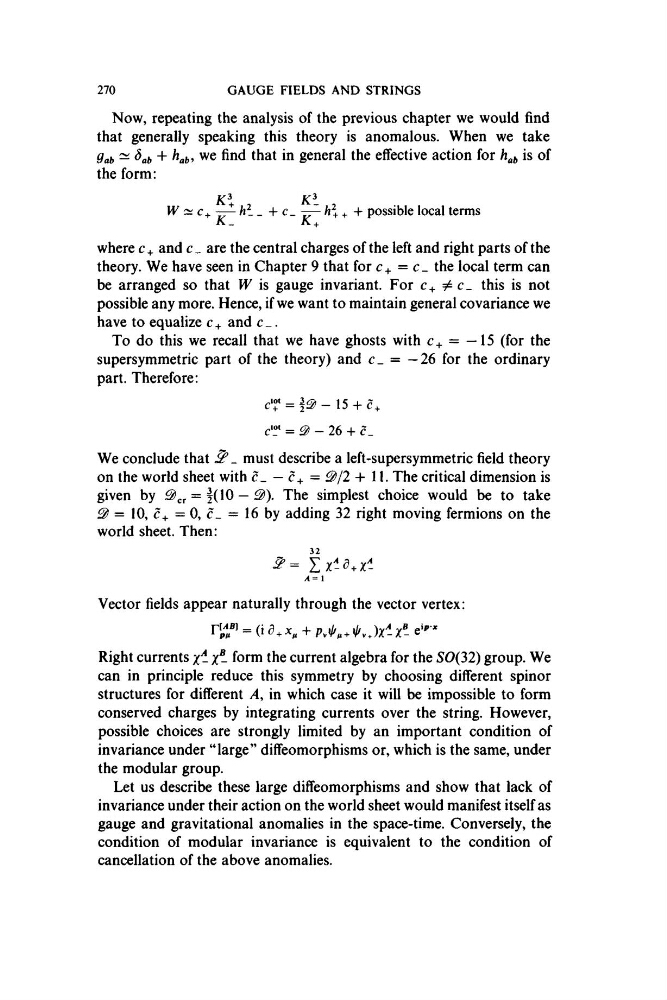
3^ = \0, c+ = 0 , c_ = 16 by adding 32 right moving fermions on the
world sheet. Then:
^ ■
Vector fields appear naturally through the vector vertex:
= (i 5 + + Pv'/'^+ J z - X- e*'’ *
Right currents x - X - form the current algebra for the SO(32) group. We
can in principle reduce this symmetry by choosing different spinor
structures for different A, in which case it will be impossible to form
conserved charges by integrating currents over the string. However,
possible choices are strongly limited by an important condition of
invariance under “large” diffeomorphisms or, which is the same, under
the modular group.
Let us describe these large diffeomorphisms and show that lack of
invariance under their action on the world sheet would manifest itself as
gauge and gravitational anomalies in the space-time. Conversely, the
condition of modular invariance is equivalent to the condition of
cancellation of the above anomalies.
GAUGE FIELDS AND STRINGS
Now, repeating the analysis of the previous chapter we would find
that generally speaking this theory is anomalous. When we take
Gab — ^ab + Kb^ we find that in general the effective action for h^i, is of
the form:
K_
W
c+ ^
c_ — ^ + + + possible local terms
where
and c_ are the central charges of the left and right parts of the
theory. We have seen in Chapter 9 that for
= c_ the local term can
be arranged so that W is gauge invariant. For c+ ^ c_ this is not
possible any more. Hence, if we want to maintain general covariance we
have to equalize c+ and c_ .
To do this we recall that we have ghosts with
= —15 (for the
supersymmetric part of the theory) and c_ = — 26 for the ordinary
part. Therefore:
cT =
- 15 +
^tot = ^ _ 26 -h c_
We conclude that
must describe a left-supersymmetric field theory
on the world sheet with c_ — c+ = ^ /2 -h 11. The critical dimension is
given by
= 1(10 — ^). The simplest choice would be to take
3^ = \0, c+ = 0 , c_ = 16 by adding 32 right moving fermions on the
world sheet. Then:
^ ■
Vector fields appear naturally through the vector vertex:
= (i 5 + + Pv'/'^+ J z - X- e*'’ *
Right currents x - X - form the current algebra for the SO(32) group. We
can in principle reduce this symmetry by choosing different spinor
structures for different A, in which case it will be impossible to form
conserved charges by integrating currents over the string. However,
possible choices are strongly limited by an important condition of
invariance under “large” diffeomorphisms or, which is the same, under
the modular group.
Let us describe these large diffeomorphisms and show that lack of
invariance under their action on the world sheet would manifest itself as
gauge and gravitational anomalies in the space-time. Conversely, the
condition of modular invariance is equivalent to the condition of
cancellation of the above anomalies.