

ATTEMPT AT A SYNTHESIS
269
There are two problems in implementing this idea to the real world.
First, the minimal symmetry group must be SU{3) (x) SU(2) (x) 1/(1) in
order to include known interactions. Such a group can act only on
manifolds of sufficiently large dimension. Namely, we must have one
dimension for U{1) two dimensions for SU(2) (which can act on the
two-dimensional sphere S^) and four dimensions for SU(3) (which acts
naturally on CP^). Adding four space-time dimensions we get the
minimal number of dimensions equal to eleven (the number obtained
by Witten) which is larger than the critical dimension of the fermionic
string.
A possible way out of this problem would be to find a a-model which
has a j?-function with an isolated zero. In this case, as we have seen, the
resulting central charge is less than the number of y-dimensions. Hence
it is conceivably possible to begin with ^ > 10 (perhaps ^ = 11 is the
best) and to descend to ^ = 4 from there. One example of isolated
zeroes is given by the Wess-Zumino a-model, which has a nonzero
B^„-background. In this case it is hard to preserve ^ = 4 supersymmetry, however. Other examples are (x-models with a 0-term at
0 = 71, but they are poorly investigated at the moment.
The second problem in the Kaluza-Klein approach is that it is rather
hard to get chiral fermions (observed in nature), roughly because the
field G„„{y\ having even charge parity, does not distinguish opposite
chiralities. Perhaps
will help here as well, but no concrete solution
has yet been found.
Another approach to the question of vector mesons and chiral
fermions rests on the heterotic version of the fermionic string (developed by Gross, Martinec, Harvey, Rohm) which we shall briefly
describe now. The major idea of the construction is to have world
sheet supersymmetry acting only among left-moving particles. The
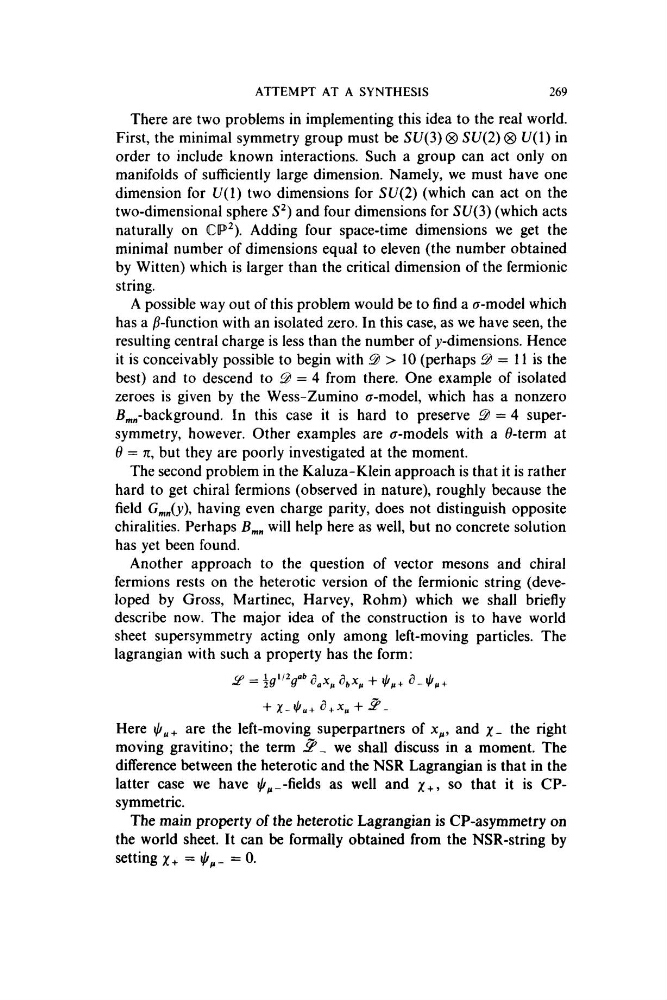
lagrangian with such a property has the form:
4- X - ^ u + ^ +
Here
are the left-moving superpartners of x^, and x - the right
moving gravitino; the term
we shall discuss in a moment. The
difference between the heterotic and the NSR Lagrangian is that in the
latter case we have
-fields as well and
so that it is CPsymmetric.
The main property of the heterotic Lagrangian is CP-asymmetry on
the world sheet. It can be formally obtained from the NSR-string by
setting
= (Aii- = 0-
269
There are two problems in implementing this idea to the real world.
First, the minimal symmetry group must be SU{3) (x) SU(2) (x) 1/(1) in
order to include known interactions. Such a group can act only on
manifolds of sufficiently large dimension. Namely, we must have one
dimension for U{1) two dimensions for SU(2) (which can act on the
two-dimensional sphere S^) and four dimensions for SU(3) (which acts
naturally on CP^). Adding four space-time dimensions we get the
minimal number of dimensions equal to eleven (the number obtained
by Witten) which is larger than the critical dimension of the fermionic
string.
A possible way out of this problem would be to find a a-model which
has a j?-function with an isolated zero. In this case, as we have seen, the
resulting central charge is less than the number of y-dimensions. Hence
it is conceivably possible to begin with ^ > 10 (perhaps ^ = 11 is the
best) and to descend to ^ = 4 from there. One example of isolated
zeroes is given by the Wess-Zumino a-model, which has a nonzero
B^„-background. In this case it is hard to preserve ^ = 4 supersymmetry, however. Other examples are (x-models with a 0-term at
0 = 71, but they are poorly investigated at the moment.
The second problem in the Kaluza-Klein approach is that it is rather
hard to get chiral fermions (observed in nature), roughly because the
field G„„{y\ having even charge parity, does not distinguish opposite
chiralities. Perhaps
will help here as well, but no concrete solution
has yet been found.
Another approach to the question of vector mesons and chiral
fermions rests on the heterotic version of the fermionic string (developed by Gross, Martinec, Harvey, Rohm) which we shall briefly
describe now. The major idea of the construction is to have world
sheet supersymmetry acting only among left-moving particles. The
lagrangian with such a property has the form:
4- X - ^ u + ^ +
Here
are the left-moving superpartners of x^, and x - the right
moving gravitino; the term
we shall discuss in a moment. The
difference between the heterotic and the NSR Lagrangian is that in the
latter case we have
-fields as well and
so that it is CPsymmetric.
The main property of the heterotic Lagrangian is CP-asymmetry on
the world sheet. It can be formally obtained from the NSR-string by
setting
= (Aii- = 0-