

268
GAUGE FIELDS AND STRINGS
bosonic (7-model in the strong coupling limit must have a finite
correlation length. When superpartners are included, the question
becomes more complicated and the answer is not known in general.
There are arguments to the extent that if K is Ricci-flat and has Kahler
structure, then the supersymmetric (7-model has zero )S-function perturbatively. If so, then we have an exact solution of the string equations in
the tree approximation, and are in a position to start string perturbation theory. If it is not so, then one can either hope that string loop
corrections will correct the effective action in such a way that K
eventually will be a minimum, or we have to look for some other
solutions.
At this point it is worth noticing, that the effect of the compactified
dimensions is described by a conformal field theory on the world sheet,
such that the total central charge is zero. In principle it is not necessary
to insist that this field theory is just a (7-model of the six dimensional
manifold. Any superconformai field theory will do, provided that it has
the correct central charge, no world sheet supersymmetry breaking and
stability (by stability we mean the absence of operators with dimensions
less than two, so it is just stability in the sense of the renormalization
group). Whether we should call these extra fields, living on the world
sheet, “extra dimensions” is actually a matter of convention.
The properties, which we have listed are sufficient for having
consistent four-dimensional gravity with some matter fields, including
fermions. One has to impose further conditions, that some of these
fermions are chiral, and also that there should be Yang-Mills fields in
the theory.
One way of getting Yang-Mills fields is to exploit an old idea of
Kaluza and Klein and to presume that K has some symmetry group
acting on it, represented by Killing deformations k:"* which do not
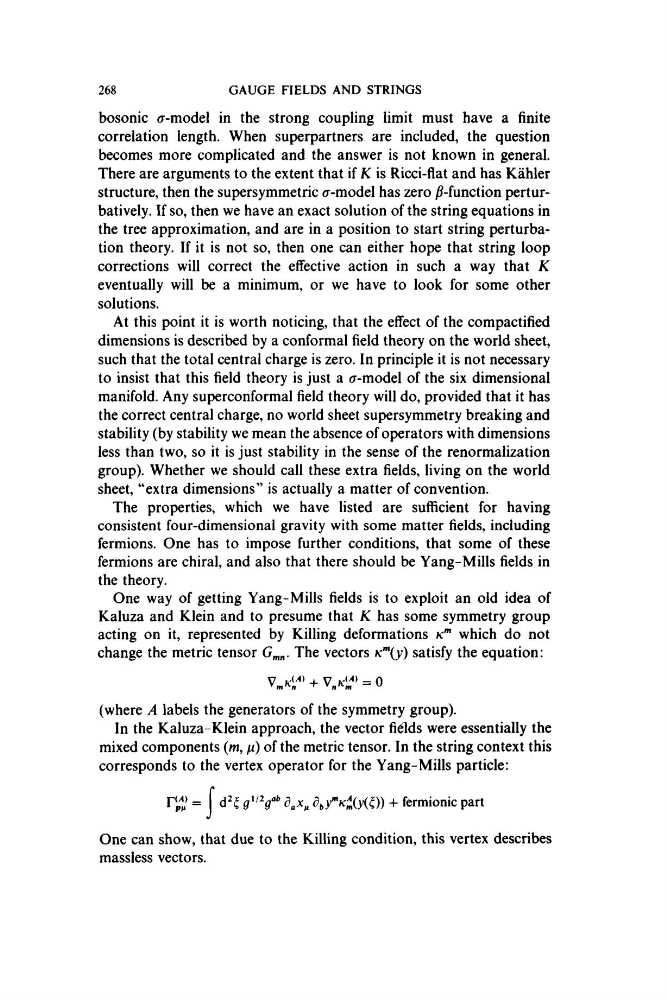
change the metric tensor G^„. The vectors /c"*(y) satisfy the equation:
^iA) +
= 0
(where A labels the generators of the symmetry group).
In the Kaluza-Klein approach, the vector fidds were essentially the
mixed components (m, fi) of the metric tensor. In the string context this
corresponds to the vertex operator for the Yang-Mills particle:
r(^) =
P M
+ fermionic part
One can show, that due to the Killing condition, this vertex describes
massless vectors.
GAUGE FIELDS AND STRINGS
bosonic (7-model in the strong coupling limit must have a finite
correlation length. When superpartners are included, the question
becomes more complicated and the answer is not known in general.
There are arguments to the extent that if K is Ricci-flat and has Kahler
structure, then the supersymmetric (7-model has zero )S-function perturbatively. If so, then we have an exact solution of the string equations in
the tree approximation, and are in a position to start string perturbation theory. If it is not so, then one can either hope that string loop
corrections will correct the effective action in such a way that K
eventually will be a minimum, or we have to look for some other
solutions.
At this point it is worth noticing, that the effect of the compactified
dimensions is described by a conformal field theory on the world sheet,
such that the total central charge is zero. In principle it is not necessary
to insist that this field theory is just a (7-model of the six dimensional
manifold. Any superconformai field theory will do, provided that it has
the correct central charge, no world sheet supersymmetry breaking and
stability (by stability we mean the absence of operators with dimensions
less than two, so it is just stability in the sense of the renormalization
group). Whether we should call these extra fields, living on the world
sheet, “extra dimensions” is actually a matter of convention.
The properties, which we have listed are sufficient for having
consistent four-dimensional gravity with some matter fields, including
fermions. One has to impose further conditions, that some of these
fermions are chiral, and also that there should be Yang-Mills fields in
the theory.
One way of getting Yang-Mills fields is to exploit an old idea of
Kaluza and Klein and to presume that K has some symmetry group
acting on it, represented by Killing deformations k:"* which do not
change the metric tensor G^„. The vectors /c"*(y) satisfy the equation:
^iA) +
= 0
(where A labels the generators of the symmetry group).
In the Kaluza-Klein approach, the vector fidds were essentially the
mixed components (m, fi) of the metric tensor. In the string context this
corresponds to the vertex operator for the Yang-Mills particle:
r(^) =
P M
+ fermionic part
One can show, that due to the Killing condition, this vertex describes
massless vectors.