

ATTEMPT AT A SYNTHESIS
267
the form:
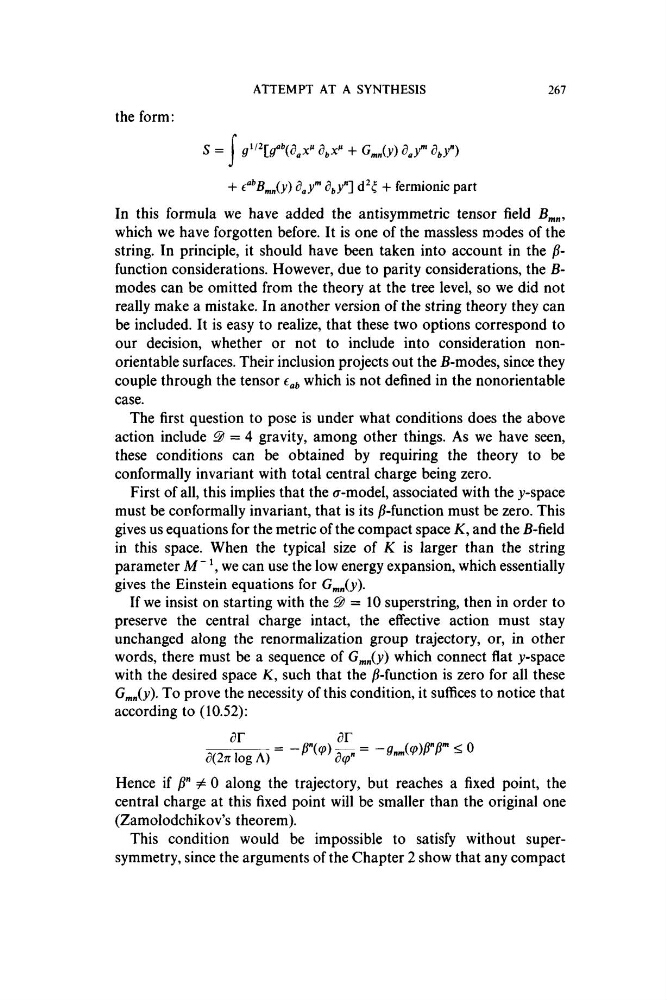
s = j
+ G„„{y)
0 ,f)
+ £‘"’B„„(y)
d,y"2
+ fermionic part
In this formula we have added the antisymmetric tensor field
which we have forgotten before. It is one of the massless modes of the
string. In principle, it should have been taken into account in the jSfunction considerations. However, due to parity considerations, the Bmodes can be omitted from the theory at the tree level, so we did not
really make a mistake. In another version of the string theory they can
be included. It is easy to realize, that these two options correspond to
our decision, whether or not to include into consideration nonorientable surfaces. Their inclusion projects out the B-modes, since they
couple through the tensor 6^^, which is not defined in the nonorientable
case.
The first question to pose is under what conditions does the above
action include ^ — 4 gravity, among other things. As we have seen,
these conditions can be obtained by requiring the theory to be
conformally invariant with total central charge being zero.
First of all, this implies that the tj-model, associated with the y-space
must be conformally invariant, that is its j?-function must be zero. This
gives us equations for the metric of the compact space K, and the B-field
in this space. When the typical size of K is larger than the string
parameter M" ^ we can use the low energy expansion, which essentially
gives the Einstein equations for G^„(y).
If we insist on starting with the ^ = 10 superstring, then in order to
preserve the central charge intact, the effective action must stay
unchanged along the renormalization group trajectory, or, in other
words, there must be a sequence of G^„(y) which connect flat y-space
with the desired space X, such that the )?-function is zero for all these
Gmniy)’ To prove the necessity of this condition, it suffices to notice that
according to (10.52):
dr
- n c p ) ^ „ = - g n M P ^ r < o
d(2n log A)
d(p"
Hence if jS" / 0 along the trajectory, but reaches a fixed point, the
central charge at this fixed point will be smaller than the original one
(Zamolodchikov’s theorem).
This condition would be impossible to satisfy without supersymmetry, since the arguments of the Chapter 2 show that any compact
267
the form:
s = j
+ G„„{y)
0 ,f)
+ £‘"’B„„(y)
d,y"2
+ fermionic part
In this formula we have added the antisymmetric tensor field
which we have forgotten before. It is one of the massless modes of the
string. In principle, it should have been taken into account in the jSfunction considerations. However, due to parity considerations, the Bmodes can be omitted from the theory at the tree level, so we did not
really make a mistake. In another version of the string theory they can
be included. It is easy to realize, that these two options correspond to
our decision, whether or not to include into consideration nonorientable surfaces. Their inclusion projects out the B-modes, since they
couple through the tensor 6^^, which is not defined in the nonorientable
case.
The first question to pose is under what conditions does the above
action include ^ — 4 gravity, among other things. As we have seen,
these conditions can be obtained by requiring the theory to be
conformally invariant with total central charge being zero.
First of all, this implies that the tj-model, associated with the y-space
must be conformally invariant, that is its j?-function must be zero. This
gives us equations for the metric of the compact space K, and the B-field
in this space. When the typical size of K is larger than the string
parameter M" ^ we can use the low energy expansion, which essentially
gives the Einstein equations for G^„(y).
If we insist on starting with the ^ = 10 superstring, then in order to
preserve the central charge intact, the effective action must stay
unchanged along the renormalization group trajectory, or, in other
words, there must be a sequence of G^„(y) which connect flat y-space
with the desired space X, such that the )?-function is zero for all these
Gmniy)’ To prove the necessity of this condition, it suffices to notice that
according to (10.52):
dr
- n c p ) ^ „ = - g n M P ^ r < o
d(2n log A)
d(p"
Hence if jS" / 0 along the trajectory, but reaches a fixed point, the
central charge at this fixed point will be smaller than the original one
(Zamolodchikov’s theorem).
This condition would be impossible to satisfy without supersymmetry, since the arguments of the Chapter 2 show that any compact