

266
GAUGE FIELDS AND STRINGS
some amplitude for each plant and to define it self-consistently. We can
say that the string is floating in its own condensate.
In principle there are corrections to the effective action, coming from
higher topologies of the world sheet. Their structure has at this time not
yet been investigated.
10.2 Possible Applications of Critical Strings
A unique property of the critical strings is that they describe gravitons.
Let us discuss possible ways to utilize this fact. First of all, the bosonic
strings, which we discussed in the previous section, are not totally
consistent, since they contain tachyons. This flaw is absent in the case of
fermionic strings, provided that we sum over spin structures on the
world sheet (meaning, as we showed in the previous chapter, that we
include space-time fermions into the spectrum).
According to the ideas of Sherk and Schwarz, such ^ = 10 Fermistrings can describe our world; provided that we compactify somehow 6
out of the 10 dimensions.
In this section we shall briefly describe the picture of the world which
arises in this way.
We begin from the ^ = 10 NSR string. As we know, it does not
contain a tachyon and its ground states are massless. These ground
states contain gravitons, dilatons, antisymmetric tensor fields, and their
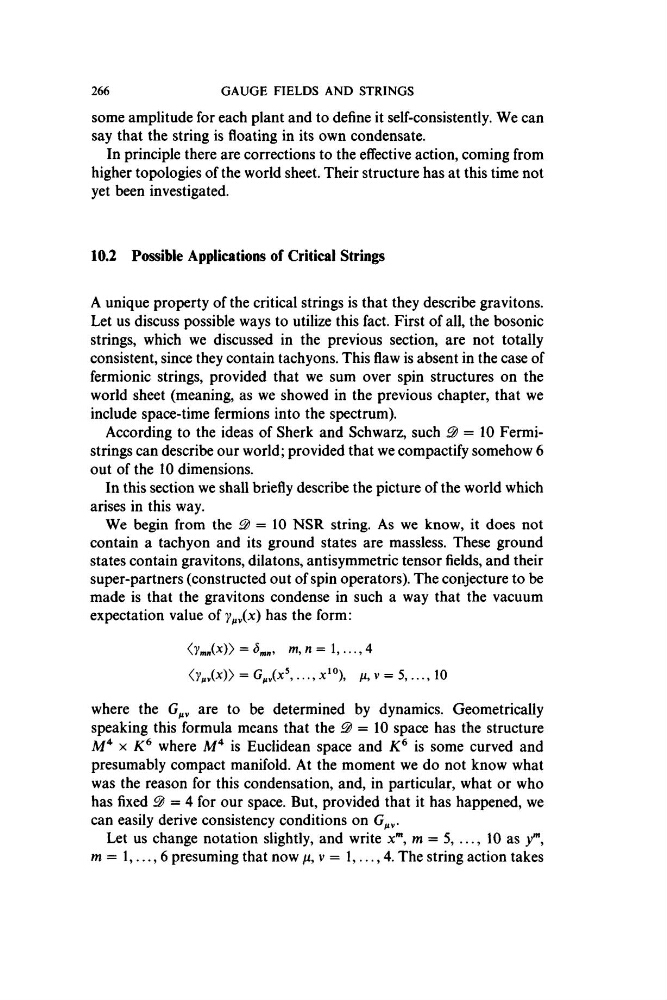
super-partners (constructed out of spin operators). The conjecture to be
made is that the gravitons condense in such a way that the vacuum
expectation value of
has the form:
, X^®),
/X, V = 5 ,..., 10
where the
are to be determined by dynamics. Geometrically
speaking this formula means that the ^ = 10 space has the structure
X
where M'*’ is Euclidean space and
is some curved and
presumably compact manifold. At the moment we do not know what
was the reason for this condensation, and, in particular, what or who
has fixed ^ = 4 for our space. But, provided that it has happened, we
can easily derive consistency conditions on G^^.
Let us change notation slightly, and write x"*, m = 5, ..., 10 as y"*,
m = 1,..., 6 presuming that now
1 ,..., 4. The string action takes
GAUGE FIELDS AND STRINGS
some amplitude for each plant and to define it self-consistently. We can
say that the string is floating in its own condensate.
In principle there are corrections to the effective action, coming from
higher topologies of the world sheet. Their structure has at this time not
yet been investigated.
10.2 Possible Applications of Critical Strings
A unique property of the critical strings is that they describe gravitons.
Let us discuss possible ways to utilize this fact. First of all, the bosonic
strings, which we discussed in the previous section, are not totally
consistent, since they contain tachyons. This flaw is absent in the case of
fermionic strings, provided that we sum over spin structures on the
world sheet (meaning, as we showed in the previous chapter, that we
include space-time fermions into the spectrum).
According to the ideas of Sherk and Schwarz, such ^ = 10 Fermistrings can describe our world; provided that we compactify somehow 6
out of the 10 dimensions.
In this section we shall briefly describe the picture of the world which
arises in this way.
We begin from the ^ = 10 NSR string. As we know, it does not
contain a tachyon and its ground states are massless. These ground
states contain gravitons, dilatons, antisymmetric tensor fields, and their
super-partners (constructed out of spin operators). The conjecture to be
made is that the gravitons condense in such a way that the vacuum
expectation value of
has the form:
, X^®),
/X, V = 5 ,..., 10
where the
are to be determined by dynamics. Geometrically
speaking this formula means that the ^ = 10 space has the structure
X
where M'*’ is Euclidean space and
is some curved and
presumably compact manifold. At the moment we do not know what
was the reason for this condensation, and, in particular, what or who
has fixed ^ = 4 for our space. But, provided that it has happened, we
can easily derive consistency conditions on G^^.
Let us change notation slightly, and write x"*, m = 5, ..., 10 as y"*,
m = 1,..., 6 presuming that now
1 ,..., 4. The string action takes