

S= (\Si^cj>9.4> +
d0. d0+ d^i
w
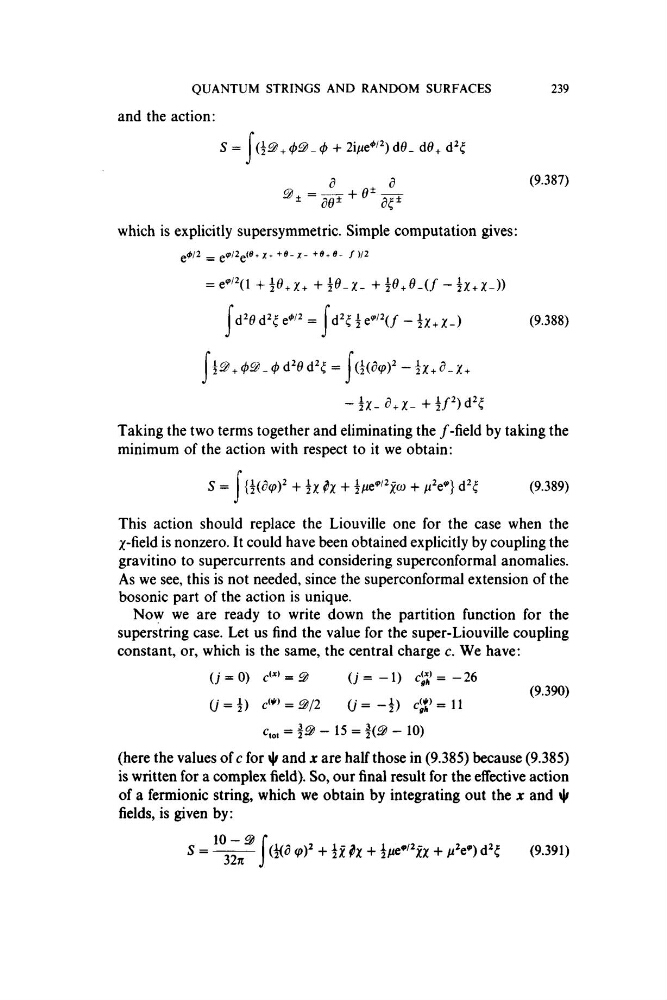
which is explicitly supersymmetric. Simple computation gives:
q 4>!2 ^
+ e -x - +0+0- /)/2
QUANTUM STRINGS AND RANDOM SURFACES
and the a ctio n :
239
(9.387)
(9.388)
- k+^-X+
Taking the two terms together and eliminating the / -field by taking the
minimum of the action with respect to it we obtain:
S = {jid
(9.389)
This action should replace the Liouville one for the case when the
/-field is nonzero. It could have been obtained explicitly by coupling the
gravitino to supercurrents and considering superconformal anomalies.
As we see, this is not needed, since the superconformal extension of the
bosonic part of the action is unique.
Now we are ready to write down the partition function for the
superstring case. Let us find the value for the super-Liouville coupling
constant, or, which is the same, the central charge c. We have:
U = 0)
0' = i)
= -26
= ^
0 = - i) c :
c ^ ^ > = ^/2
0 = -i) c^r=ll
q,, = f ^ - 15 = f(^ - 10)
(9.390)
(here the values of c for \|/ and x are half those in (9.385) because (9.385)
is written for a complex field). So, our final result for the effective action
of a fermionic string, which we obtain by integrating out the x and
fields, is given by:
5 =
10-£
327T
J* (2(5 < p y + \ih +
d^i
(9.391)
d0. d0+ d^i
w
which is explicitly supersymmetric. Simple computation gives:
q 4>!2 ^
+ e -x - +0+0- /)/2
QUANTUM STRINGS AND RANDOM SURFACES
and the a ctio n :
239
(9.387)
(9.388)
- k+^-X+
Taking the two terms together and eliminating the / -field by taking the
minimum of the action with respect to it we obtain:
S = {jid
(9.389)
This action should replace the Liouville one for the case when the
/-field is nonzero. It could have been obtained explicitly by coupling the
gravitino to supercurrents and considering superconformal anomalies.
As we see, this is not needed, since the superconformal extension of the
bosonic part of the action is unique.
Now we are ready to write down the partition function for the
superstring case. Let us find the value for the super-Liouville coupling
constant, or, which is the same, the central charge c. We have:
U = 0)
0' = i)
= -26
= ^
0 = - i) c :
c ^ ^ > = ^/2
0 = -i) c^r=ll
q,, = f ^ - 15 = f(^ - 10)
(9.390)
(here the values of c for \|/ and x are half those in (9.385) because (9.385)
is written for a complex field). So, our final result for the effective action
of a fermionic string, which we obtain by integrating out the x and
fields, is given by:
5 =
10-£
327T
J* (2(5 < p y + \ih +
d^i
(9.391)