

2 3 8
GAUGE FIELDS AND STRINGS
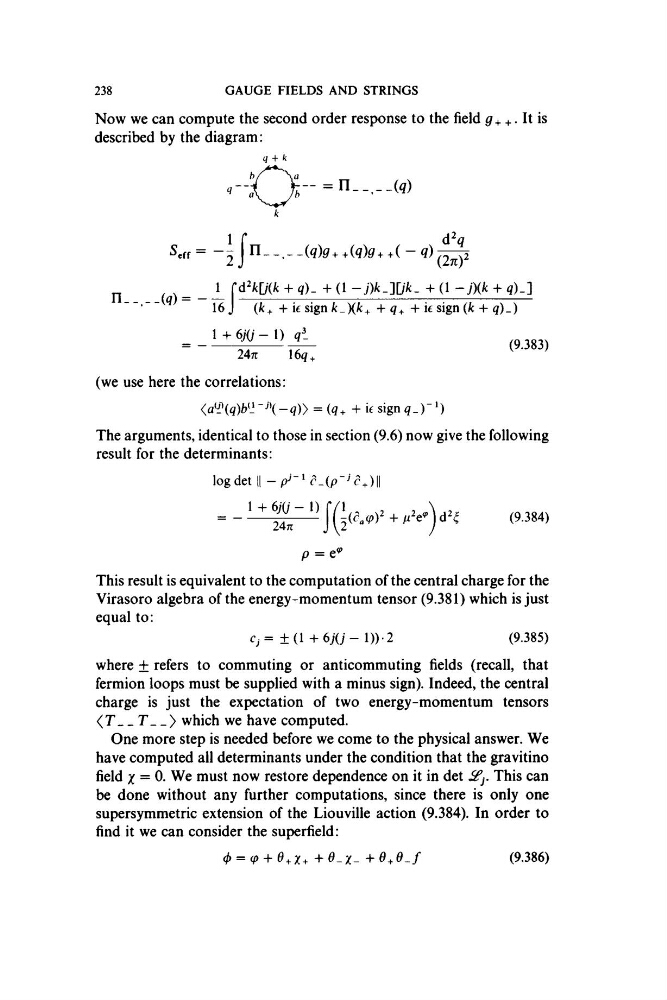
Now we can compute the second order response to the field ^ + . It is
described by the diagram:
q + k
- 0
- -
(q)
^eff
- g)
d^q
n_ -( 1
16
d^k{J(k + q). + (1 - 7 ) /c_]D7c_ + (1 - j)(k + (?)_]
(/c+ + \e sign k_)(k^
q+
ie sign (k -f q)_)
l+6;0 - l ) q i
(9.383)
24n
16q+
(we use here the correlations:
= (q+ + ie sign q .y ^ )
The arguments, identical to those in section (9.6) now give the following
result for the determinants:
log det I I —
1 + 6j(/ ■
C-(P~
1)
2471
(9.384)
p = Q^
This result is equivalent to the computation of the central charge for the
Virasoro algebra of the energy-momentum tensor (9.381) which is just
equal to:
c, = ±(l+6;0-l)) 2
(9.385)
where ± refers to commuting or anticommuting fields (recall, that
fermion loops must be supplied with a minus sign). Indeed, the central
charge is just the expectation of two energy-momentum tensors
which we have computed.
One more step is needed before we come to the physical answer. We
have computed all determinants under the condition that the gravitino
field X = 0- We must now restore dependence on it in det
This can
be done without any further computations, since there is only one
supersymmetric extension of the Liouville action (9.384). In order to
find it we can consider the superfield:
(j) = (p +
+ ^-X- +
(9.386)
GAUGE FIELDS AND STRINGS
Now we can compute the second order response to the field ^ + . It is
described by the diagram:
q + k
- 0
- -
(q)
^eff
- g)
d^q
n_ -( 1
16
d^k{J(k + q). + (1 - 7 ) /c_]D7c_ + (1 - j)(k + (?)_]
(/c+ + \e sign k_)(k^
q+
ie sign (k -f q)_)
l+6;0 - l ) q i
(9.383)
24n
16q+
(we use here the correlations:
= (q+ + ie sign q .y ^ )
The arguments, identical to those in section (9.6) now give the following
result for the determinants:
log det I I —
1 + 6j(/ ■
C-(P~
1)
2471
(9.384)
p = Q^
This result is equivalent to the computation of the central charge for the
Virasoro algebra of the energy-momentum tensor (9.381) which is just
equal to:
c, = ±(l+6;0-l)) 2
(9.385)
where ± refers to commuting or anticommuting fields (recall, that
fermion loops must be supplied with a minus sign). Indeed, the central
charge is just the expectation of two energy-momentum tensors
One more step is needed before we come to the physical answer. We
have computed all determinants under the condition that the gravitino
field X = 0- We must now restore dependence on it in det
This can
be done without any further computations, since there is only one
supersymmetric extension of the Liouville action (9.384). In order to
find it we can consider the superfield:
(j) = (p +
+ ^-X- +
(9.386)