

240
GAUGE FIELDS AND STRINGS
As in the bosonic case, this action describes longitudinal motions of the
string. In the critical dimension,
= 10, they are absent.
So far, we have been dealing with surfaces of spherical topology
without external lines. As in the bosonic case, in order to obtain
scattering amplitudes, one has to puncture the sphere, and in order to
find corrections to the tree amplitude one has to sum over topologies.
We shall start with the first task, which in the fermionic case has some
unusual features.
9.13 Vertex Operators
In the case of the bosonic string we have punctured its world surface by
introducing factors:
0(x -
V{x) =
V(p) = Jc dH VSO
(9.392)
into the functional integral. Our task now is to find a supersymmetric
generalization of these formulas.
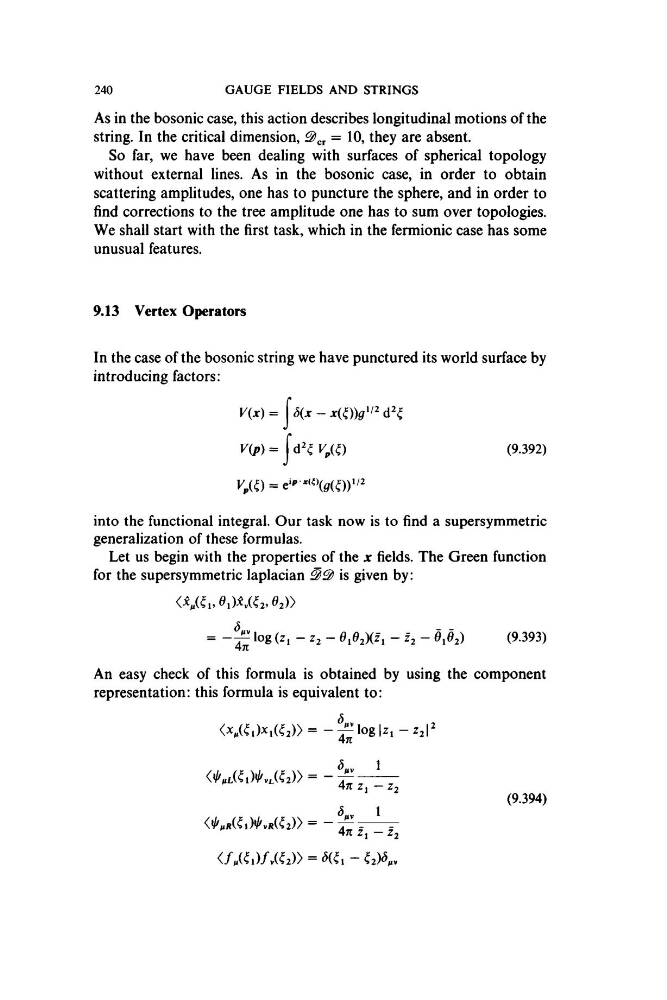
Let us begin with the properties of the j c fields. The Green function
for the supersymmetric laplacian
is given by:
=
log (^1 - ^2 -
- ^2 - ^1^2)
(9.393)
An easy check of this formula is obtained by using the component
representation: this formula is equivalent to:
<^.(^l»l(Î2»= -^10glZi-Z2|^
< M ^ i)«A v .(Î2)> = -
< M il) ‘Avi.(^2)> =
1
47T Z j — Z2
¿„V 1
A n Zj — Z2
< / . ( ^ l ) / v ( Î 2 » =
(9.394)
GAUGE FIELDS AND STRINGS
As in the bosonic case, this action describes longitudinal motions of the
string. In the critical dimension,
= 10, they are absent.
So far, we have been dealing with surfaces of spherical topology
without external lines. As in the bosonic case, in order to obtain
scattering amplitudes, one has to puncture the sphere, and in order to
find corrections to the tree amplitude one has to sum over topologies.
We shall start with the first task, which in the fermionic case has some
unusual features.
9.13 Vertex Operators
In the case of the bosonic string we have punctured its world surface by
introducing factors:
0(x -
V{x) =
V(p) = Jc dH VSO
(9.392)
into the functional integral. Our task now is to find a supersymmetric
generalization of these formulas.
Let us begin with the properties of the j c fields. The Green function
for the supersymmetric laplacian
is given by:
=
log (^1 - ^2 -
- ^2 - ^1^2)
(9.393)
An easy check of this formula is obtained by using the component
representation: this formula is equivalent to:
<^.(^l»l(Î2»= -^10glZi-Z2|^
< M ^ i)«A v .(Î2)> = -
< M il) ‘Avi.(^2)> =
1
47T Z j — Z2
¿„V 1
A n Zj — Z2
< / . ( ^ l ) / v ( Î 2 » =
(9.394)