

14
GAUGE FIELDS AND STRINGS
Another important Non-Abelian case is described by having group
elements attached to each link. Let us consider matrices g eG where G
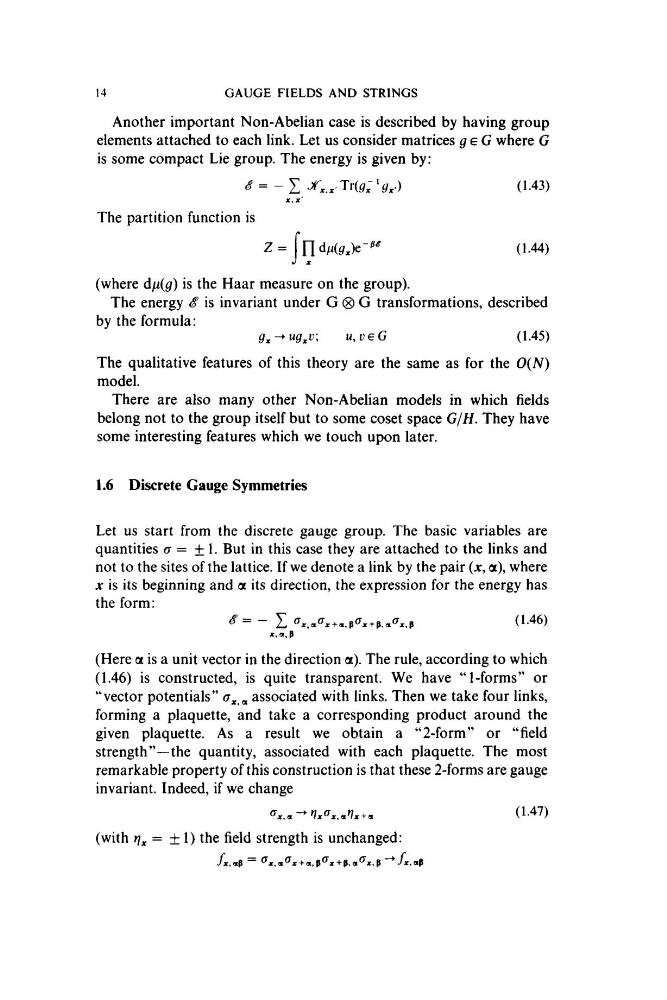
is some compact Lie group. The energy is given by:
The partition function is
Z = r[d/<(ÿje(1.43)
(1.44)
(where dfi(g) is the Haar measure on the group).
The energy S’ is invariant under G (x) G transformations, described
by the formula:
g^^ug^v;
u,veG
(1.45)
The qualitative features of this theory are the same as for the 0(N)
model.
There are also many other Non-Abelian models in which fields
belong not to the group itself but to some coset space G/H. They have
some interesting features which we touch upon later.
1.6 Discrete Gauge Symmetries
Let us start from the discrete gauge group. The basic variables are
quantities g = ± \. But in this case they are attached to the links and
not to the sites of the lattice. If we denote a link by the pair (jc, a), where
X is its beginning and a its direction, the expression for the energy has
the form:
z
X, (X, P
f a, P -I- p, ot ^x, p
(1.46)
(Here a is a unit vector in the direction a). The rule, according to which
(1.46) is constructed, is quite transparent. We have “ 1-forms” or
“vector potentials”
associated with links. Then we take four links,
forming a plaquette, and take a corresponding product around the
given plaquette. As a result we obtain a “2-form” or “field
strength”—the quantity, associated with each plaquette. The most
remarkable property of this construction is that these 2-forms are gauge
invariant. Indeed, if we change
(with rj^= ± 1) the field strength is unchanged:
^X ,«^X + «, P^X + P, *^X , p * fx,(lfl
(1.47)
GAUGE FIELDS AND STRINGS
Another important Non-Abelian case is described by having group
elements attached to each link. Let us consider matrices g eG where G
is some compact Lie group. The energy is given by:
The partition function is
Z = r[d/<(ÿje(1.43)
(1.44)
(where dfi(g) is the Haar measure on the group).
The energy S’ is invariant under G (x) G transformations, described
by the formula:
g^^ug^v;
u,veG
(1.45)
The qualitative features of this theory are the same as for the 0(N)
model.
There are also many other Non-Abelian models in which fields
belong not to the group itself but to some coset space G/H. They have
some interesting features which we touch upon later.
1.6 Discrete Gauge Symmetries
Let us start from the discrete gauge group. The basic variables are
quantities g = ± \. But in this case they are attached to the links and
not to the sites of the lattice. If we denote a link by the pair (jc, a), where
X is its beginning and a its direction, the expression for the energy has
the form:
z
X, (X, P
f a, P -I- p, ot ^x, p
(1.46)
(Here a is a unit vector in the direction a). The rule, according to which
(1.46) is constructed, is quite transparent. We have “ 1-forms” or
“vector potentials”
associated with links. Then we take four links,
forming a plaquette, and take a corresponding product around the
given plaquette. As a result we obtain a “2-form” or “field
strength”—the quantity, associated with each plaquette. The most
remarkable property of this construction is that these 2-forms are gauge
invariant. Indeed, if we change
(with rj^= ± 1) the field strength is unchanged:
^X ,«^X + «, P^X + P, *^X , p * fx,(lfl
(1.47)