

STATISTICAL MECHANICS AND QUANTUM FIELD THEORY
13
detail in later sections. We observe here a feature, characteristic for all
continuous symmetries. Namely, we have two critical dimensions—the
upper one,
= 4) at which fluctuations at the phase transition point
become irrelevant; and the lower one,
= 2) at which Goldstone
bosons start to interact strongly.
1.5 Non-AbeUan Global Symmetries
There are several Non-Abelian generalizations of the preceeding models. The most straightforward possibility is to consider again the
expression (1.32) for the energy but to take the unit vectors
to be
iV-dimensional. The symmetry group in this case will be 0{N), The
major qualitative difference from the Non-Abelian case reveals itself for
= 2. Due to the strong interaction of the Goldstone bosons, they
acquire an energy gap for all values of jS and the Non-Abelian system
does not have a phase transition at all. At our preliminary level this
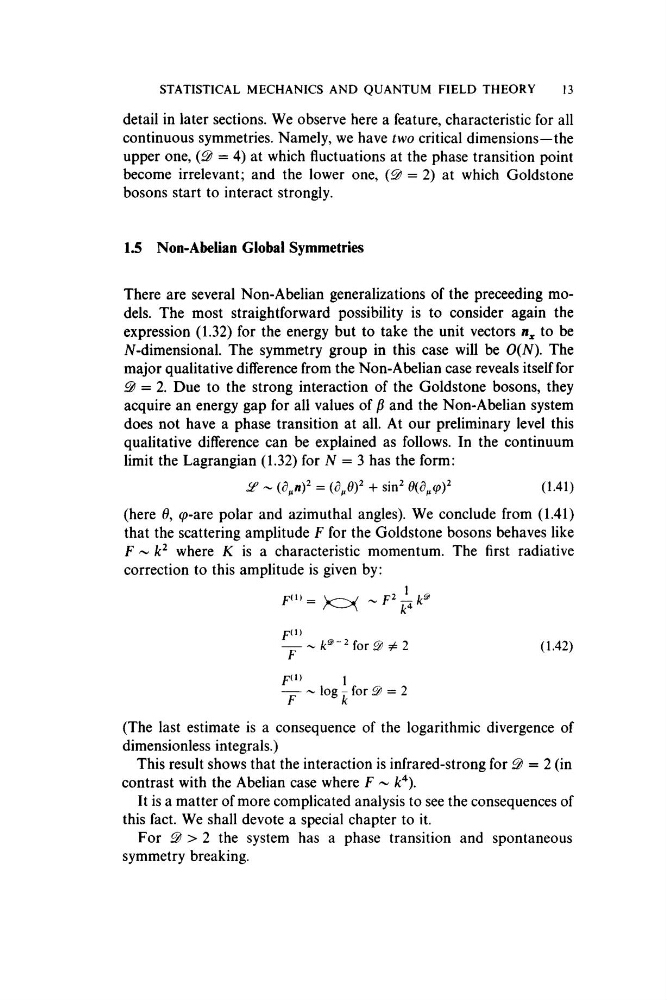
qualitative difference can be explained as follows. In the continuum
limit the Lagrangian (1.32) for N = 3 has the form:
if - {d^nf = {d^ef + sin^
(1.41)
(here 0, (/)-are polar and azimuthal angles). We conclude from (1.41)
that the scattering amplitude F for the Goldstone bosons behaves like
F ^
where iC is a characteristic momentum. The first radiative
correction to this amplitude is given by:
1
(1.42)
Kz>(
fO)
F
/7(1)
1
^ log - for ^ = 2
F
k
(The last estimate is a consequence of the logarithmic divergence of
dimensionless integrals.)
This result shows that the interaction is infrared-strong for ^ = 2 (in
contrast with the Abelian case where F ^ k"^ ).
It is a matter of more complicated analysis to see the consequences of
this fact. We shall devote a special chapter to it.
For Q) > 2 the system has a phase transition and spontaneous
symmetry breaking.
13
detail in later sections. We observe here a feature, characteristic for all
continuous symmetries. Namely, we have two critical dimensions—the
upper one,
= 4) at which fluctuations at the phase transition point
become irrelevant; and the lower one,
= 2) at which Goldstone
bosons start to interact strongly.
1.5 Non-AbeUan Global Symmetries
There are several Non-Abelian generalizations of the preceeding models. The most straightforward possibility is to consider again the
expression (1.32) for the energy but to take the unit vectors
to be
iV-dimensional. The symmetry group in this case will be 0{N), The
major qualitative difference from the Non-Abelian case reveals itself for
= 2. Due to the strong interaction of the Goldstone bosons, they
acquire an energy gap for all values of jS and the Non-Abelian system
does not have a phase transition at all. At our preliminary level this
qualitative difference can be explained as follows. In the continuum
limit the Lagrangian (1.32) for N = 3 has the form:
if - {d^nf = {d^ef + sin^
(1.41)
(here 0, (/)-are polar and azimuthal angles). We conclude from (1.41)
that the scattering amplitude F for the Goldstone bosons behaves like
F ^
where iC is a characteristic momentum. The first radiative
correction to this amplitude is given by:
1
(1.42)
Kz>(
fO)
F
/7(1)
1
^ log - for ^ = 2
F
k
(The last estimate is a consequence of the logarithmic divergence of
dimensionless integrals.)
This result shows that the interaction is infrared-strong for ^ = 2 (in
contrast with the Abelian case where F ^ k"^ ).
It is a matter of more complicated analysis to see the consequences of
this fact. We shall devote a special chapter to it.
For Q) > 2 the system has a phase transition and spontaneous
symmetry breaking.