

STATISTICAL MECHANICS AND QUANTUM FIELD THEORY
15
Therefore, the action has the symmetry {Z 2 )^ where N is the number of
lattice sites. We conclude that while in the global Z 2 case the energy ^
had precisely two degenerate minima (all a^= -h 1 or — 1), in the gauge
case the degeneracy is enormous, namely any configuration which is a
“pure gauge”:
(1-48)
with arbitrary {rj^^} is the ground state.
These peculiar properties imply, first of all that there could be no
order parameter in such systems,
= 0 and moreover, only gauge
invariant quantities are nonzero. This follows from the fact, that by
fixing the values of
at the boundary of our system we do not spoil
gauge invariance inside it. All this does not have any deep influence on
the phase structure of gauge systems. Different phases are easily
distinguished by the different behaviour of gauge invariant correlation
functions. The situation is reminiscent of what we had in the 0(2) global
model, where the second order phase transition took place without
explicit violation of symmetry.
The physical properties of the Z 2-gauge system are the following: for
^ = 2 the model is trivially solved, being equivalent to the decoupled
set of = 1 Ising models (which follows from the fact that by the
transformation (1.47) we can easily set
1 = 1), and therefore has no
phase transitions. For ^ = 3 we shall show that it is equivalent to the
^ = 3 Ising model (by Kramers-Wannier duality.) This model is of
great interest since it describes most of the ^ = 3 phase transitions in
Nature. We shall devote a special chapter to its study. Now, for ® > 4
numerical studies of Z 2-models show that there is a first order
transition in this case. That means that the correlation length never
becomes infinite and the theory does not have a continuum limit.
1.7 0(2) Gauge Systems
In this case the system is constructed of unit vectors (which we write in
complex form) attached to the links,
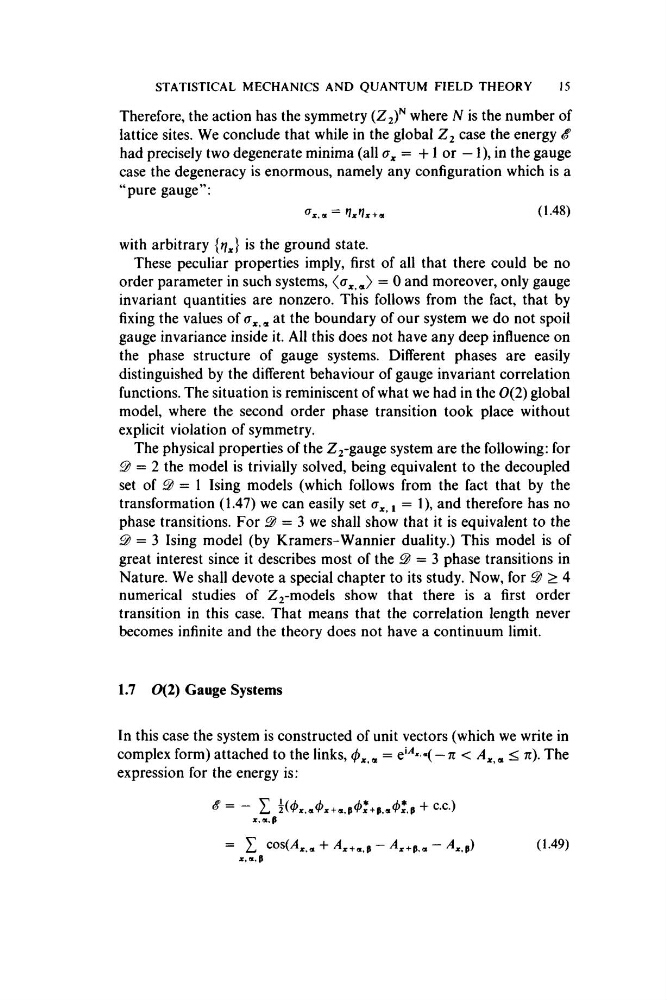
= e‘^* *( —tt <
n). The
expression for the energy is:
^ “ X i(^x,a^x + oi,p X , a , P
= X
+
(1.49)
X , (X, p
15
Therefore, the action has the symmetry {Z 2 )^ where N is the number of
lattice sites. We conclude that while in the global Z 2 case the energy ^
had precisely two degenerate minima (all a^= -h 1 or — 1), in the gauge
case the degeneracy is enormous, namely any configuration which is a
“pure gauge”:
(1-48)
with arbitrary {rj^^} is the ground state.
These peculiar properties imply, first of all that there could be no
order parameter in such systems,
= 0 and moreover, only gauge
invariant quantities are nonzero. This follows from the fact, that by
fixing the values of
at the boundary of our system we do not spoil
gauge invariance inside it. All this does not have any deep influence on
the phase structure of gauge systems. Different phases are easily
distinguished by the different behaviour of gauge invariant correlation
functions. The situation is reminiscent of what we had in the 0(2) global
model, where the second order phase transition took place without
explicit violation of symmetry.
The physical properties of the Z 2-gauge system are the following: for
^ = 2 the model is trivially solved, being equivalent to the decoupled
set of = 1 Ising models (which follows from the fact that by the
transformation (1.47) we can easily set
1 = 1), and therefore has no
phase transitions. For ^ = 3 we shall show that it is equivalent to the
^ = 3 Ising model (by Kramers-Wannier duality.) This model is of
great interest since it describes most of the ^ = 3 phase transitions in
Nature. We shall devote a special chapter to its study. Now, for ® > 4
numerical studies of Z 2-models show that there is a first order
transition in this case. That means that the correlation length never
becomes infinite and the theory does not have a continuum limit.
1.7 0(2) Gauge Systems
In this case the system is constructed of unit vectors (which we write in
complex form) attached to the links,
= e‘^* *( —tt <
n). The
expression for the energy is:
^ “ X i(^x,a^x + oi,p X , a , P
= X
+
(1.49)
X , (X, p