

226
GAUGE FIELDS AND STRINGS
first term in (9.328) coming from the zero-point energy of the jc-field
cancels with the contribution of the \|#-fields. As a result, we do not have
a divergent contribution to W^X], Instead, the coefficient 1/a in the first
term can be shown to get replaced by 1/L. Because of this, for the
fermionic path we have:
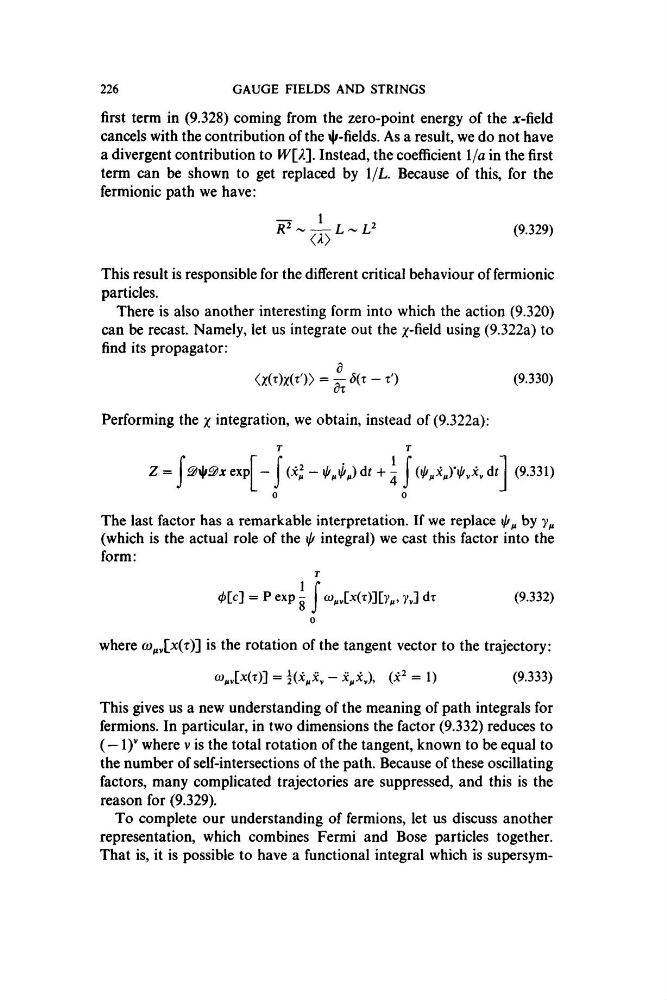
(9.329)
This result is responsible for the different critical behaviour of fermionic
particles.
There is also another interesting form into which the action (9.320)
can be recast. Namely, let us integrate out the ^-field using (9.322a) to
find its propagator:
(9.330)
Performing the x integration, we obtain, instead of (9.322a):
T
T
^ I
dtj (9.331)
Z = j*
exp
The last factor has a remarkable interpretation. If we replace
by
(which is the actual role of the {¡z integral) we cast this factor into the
form:
T
(9.332)
where co^^lxir)] is the rotation of the tangent vector to the trajectory:
(x^ = 1)
(9.333)
This gives us a new understanding of the meaning of path integrals for
fermions. In particular, in two dimensions the factor (9.332) reduces to
( —1)'' where v is the total rotation of the tangent, known to be equal to
the number of self-intersections of the path. Because of these oscillating
factors, many complicated trajectories are suppressed, and this is the
reason for (9.329).
To complete our understanding of fermions, let us discuss another
representation, which combines Fermi and Bose particles together.
That is, it is possible to have a functional integral which is supersym
GAUGE FIELDS AND STRINGS
first term in (9.328) coming from the zero-point energy of the jc-field
cancels with the contribution of the \|#-fields. As a result, we do not have
a divergent contribution to W^X], Instead, the coefficient 1/a in the first
term can be shown to get replaced by 1/L. Because of this, for the
fermionic path we have:
(9.329)
This result is responsible for the different critical behaviour of fermionic
particles.
There is also another interesting form into which the action (9.320)
can be recast. Namely, let us integrate out the ^-field using (9.322a) to
find its propagator:
(9.330)
Performing the x integration, we obtain, instead of (9.322a):
T
T
^ I
dtj (9.331)
Z = j*
exp
The last factor has a remarkable interpretation. If we replace
by
(which is the actual role of the {¡z integral) we cast this factor into the
form:
T
(9.332)
where co^^lxir)] is the rotation of the tangent vector to the trajectory:
(x^ = 1)
(9.333)
This gives us a new understanding of the meaning of path integrals for
fermions. In particular, in two dimensions the factor (9.332) reduces to
( —1)'' where v is the total rotation of the tangent, known to be equal to
the number of self-intersections of the path. Because of these oscillating
factors, many complicated trajectories are suppressed, and this is the
reason for (9.329).
To complete our understanding of fermions, let us discuss another
representation, which combines Fermi and Bose particles together.
That is, it is possible to have a functional integral which is supersym