

QUANTUM STRINGS AND RANDOM SURFACES
225
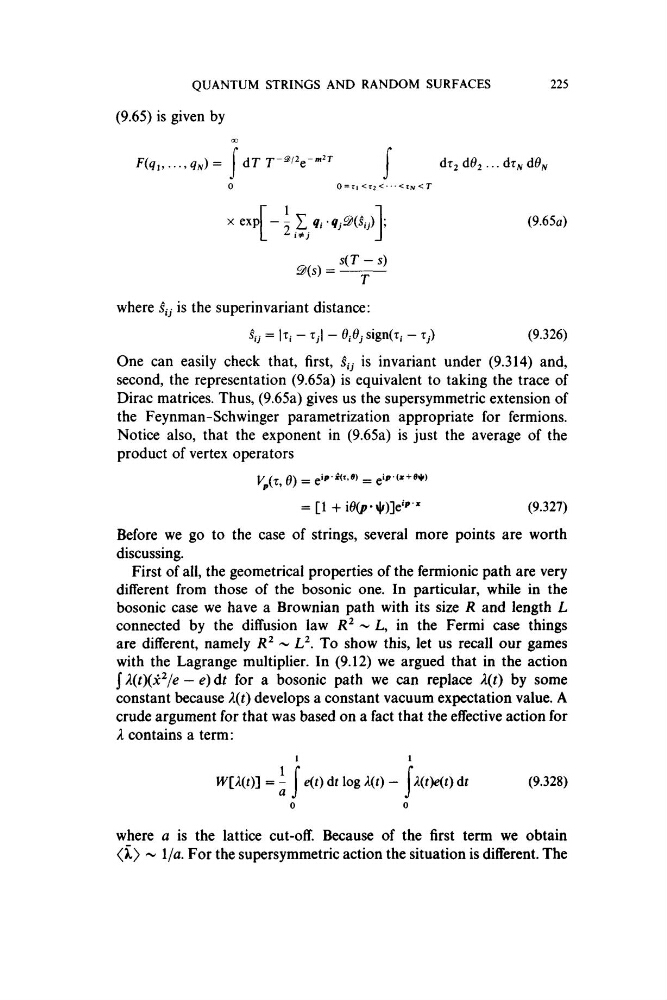
(9.65) is given by
F(q„...,q^)= ^
|
dr^dO^ ...dXf,d6^
0
o = n
(9.65a)
S>{s) =
s(T - s)
where Sij is the superinvariant distance:
T^.| - e^Oj sign(T,. - Tj)
(9.326)
One can easily check that, first,
is invariant under (9.314) and,
second, the representation (9.65a) is equivalent to taking the trace of
Dirac matrices. Thus, (9.65a) gives us the supersymmetric extension of
the Feynman-Schwinger parametrization appropriate for fermions.
Notice also, that the exponent in (9.65a) is just the average of the
product of vertex operators
y
0 ) =
= [i + i0(P‘x|/)y'»*
(9.327)
Before we go to the case of strings, several more points are worth
discussing.
First of all, the geometrical properties of the fermionic path are very
different from those of the bosonic one. In particular, while in the
bosonic case we have a Brownian path with its size R and length L
connected by the diffusion law
^ L, in the Fermi case things
are different, namely R^ ^ L^. To show this, let us recall our games
with the Lagrange multiplier. In (9.12) we argued that in the action
j X(t)(x^/e — e) dt for a bosonic path we can replace X(t) by some
constant because l(t) develops a constant vacuum expectation value. A
crude argument for that was based on a fact that the effective action for
A contains a term:
W im i = - a
0
1
e(t) di log A(0 - j>l(i)e(i)dt
0
(9.328)
where a is the lattice cut-off. Because of the first term we obtain
(k) ~ l/a. For the supersymmetric action the situation is different. The
225
(9.65) is given by
F(q„...,q^)= ^
|
dr^dO^ ...dXf,d6^
0
o = n
(9.65a)
S>{s) =
s(T - s)
where Sij is the superinvariant distance:
T^.| - e^Oj sign(T,. - Tj)
(9.326)
One can easily check that, first,
is invariant under (9.314) and,
second, the representation (9.65a) is equivalent to taking the trace of
Dirac matrices. Thus, (9.65a) gives us the supersymmetric extension of
the Feynman-Schwinger parametrization appropriate for fermions.
Notice also, that the exponent in (9.65a) is just the average of the
product of vertex operators
y
0 ) =
= [i + i0(P‘x|/)y'»*
(9.327)
Before we go to the case of strings, several more points are worth
discussing.
First of all, the geometrical properties of the fermionic path are very
different from those of the bosonic one. In particular, while in the
bosonic case we have a Brownian path with its size R and length L
connected by the diffusion law
^ L, in the Fermi case things
are different, namely R^ ^ L^. To show this, let us recall our games
with the Lagrange multiplier. In (9.12) we argued that in the action
j X(t)(x^/e — e) dt for a bosonic path we can replace X(t) by some
constant because l(t) develops a constant vacuum expectation value. A
crude argument for that was based on a fact that the effective action for
A contains a term:
W im i = - a
0
1
e(t) di log A(0 - j>l(i)e(i)dt
0
(9.328)
where a is the lattice cut-off. Because of the first term we obtain
(k) ~ l/a. For the supersymmetric action the situation is different. The