

224
GAUGE FIELDS AND STRINGS
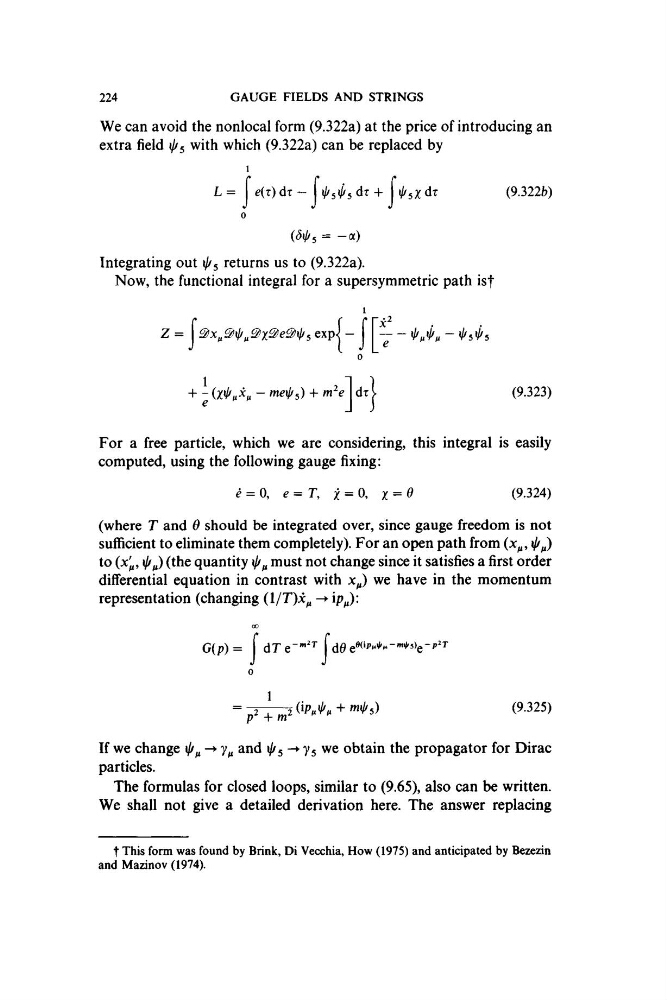
We can avoid the nonlocal form (9.322a) at the price of introducing an
extra field
with which (9.322a) can be replaced by
L =
^(t) di
^5 di +
di
(9.322b)
(biAs = -a )
Integrating out ij/^ returns us to (9.322a).
Now, the functional integral for a supersymmetric path isf
^ exp
(9.323)
For a free particle, which we are considering, this integral is easily
computed, using the following gauge fixing:
¿ = 0, e = r, x = o, x = ^
(9.324)
(where T and 6 should be integrated over, since gauge freedom is not
sufficient to eliminate them completely). For an open path from (x^, ij/^)
to (xj,, ij/^) (the quantity must not change since it satisfies a first order
differential equation in contrast with x^) we have in the momentum
representation (changing (1/T)x^ -► ip^):
G(p) =
■ i
(9.325)
If we change
-► and ^As 7 s we obtain the propagator for Dirac
particles.
The formulas for closed loops, similar to (9.65), also can be written.
We shall not give a detailed derivation here. The answer replacing
t This form was found by Brink, Di Vecchia, How (1975) and anticipated by Bezezin
and Mazinov (1974).
GAUGE FIELDS AND STRINGS
We can avoid the nonlocal form (9.322a) at the price of introducing an
extra field
with which (9.322a) can be replaced by
L =
^(t) di
^5 di +
di
(9.322b)
(biAs = -a )
Integrating out ij/^ returns us to (9.322a).
Now, the functional integral for a supersymmetric path isf
^ exp
(9.323)
For a free particle, which we are considering, this integral is easily
computed, using the following gauge fixing:
¿ = 0, e = r, x = o, x = ^
(9.324)
(where T and 6 should be integrated over, since gauge freedom is not
sufficient to eliminate them completely). For an open path from (x^, ij/^)
to (xj,, ij/^) (the quantity must not change since it satisfies a first order
differential equation in contrast with x^) we have in the momentum
representation (changing (1/T)x^ -► ip^):
G(p) =
■ i
(9.325)
If we change
-► and ^As 7 s we obtain the propagator for Dirac
particles.
The formulas for closed loops, similar to (9.65), also can be written.
We shall not give a detailed derivation here. The answer replacing
t This form was found by Brink, Di Vecchia, How (1975) and anticipated by Bezezin
and Mazinov (1974).