

QUANTUM STRINGS AND RANDOM SURFACES
223
We shall see in a moment that the fields
will play the role of the
y-matrices in the usual approach. The action (9.317) is invariant under
the supersymmetry:
ÔX^ = Ell/^
Ô lj/^ = SX^
(9.318)
The action (9.317) is only globally invariant, while the proper action
should be invariant under general supercovariant transformations. This
can be achieved by the introduction of the “einbein” field e(t) (as we
have done in the bosonic case) and its superpartner—the “gravitino”
field x(ty While e(t) is coupled to the energy-momentum tensor, which
in our case is
the field %(i) must be coupled to the supercurrent. It is
clear from (3.318) that this symmetry is associated with the conserved
current:
s(0 =
s = 0
(9.319)
Therefore, we can expect that the covariant action will be:
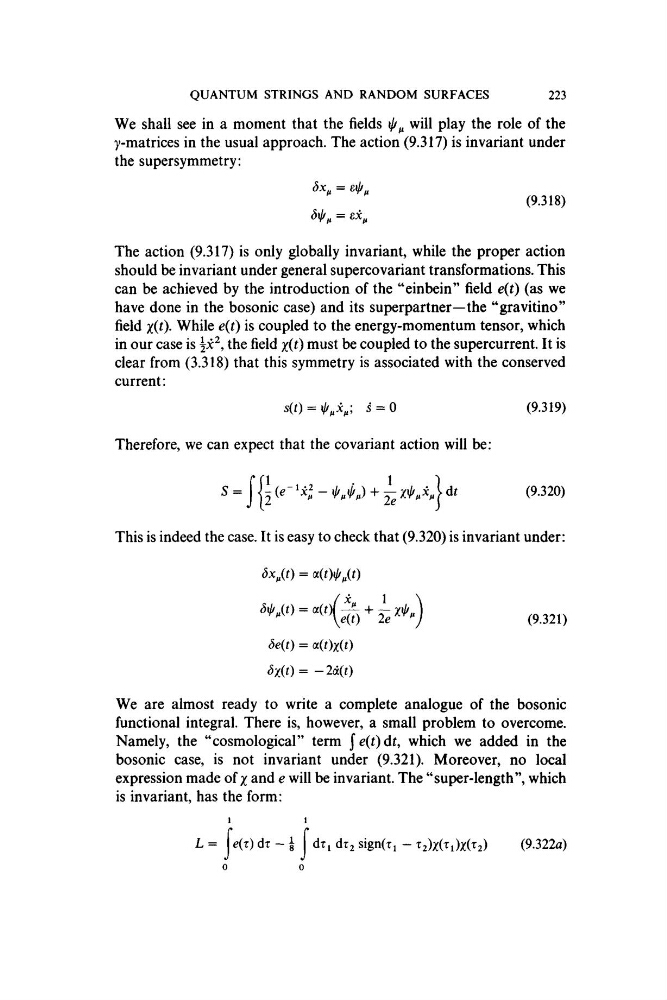
S =
(9.320)
This is indeed the case. It is easy to check that (9.320) is invariant under:
ôx^(t) = oc{t)il/^{t)
(9.321)
0e(t) = ct(t)x(t)
Sx(t) = -2a(0
We are almost ready to write a complete analogue of the bosonic
functional integral. There is, however, a small problem to overcome.
Namely, the “cosmological” term je(i)di, which we added in the
bosonic case, is not invariant under (9.321). Moreover, no local
expression made of x and e will be invariant. The “super-length”, which
is invariant, has the form:
L = e(T) di - I dll di2 sign(Tj - T2)x(^i)z(t^2)
(9322a)
223
We shall see in a moment that the fields
will play the role of the
y-matrices in the usual approach. The action (9.317) is invariant under
the supersymmetry:
ÔX^ = Ell/^
Ô lj/^ = SX^
(9.318)
The action (9.317) is only globally invariant, while the proper action
should be invariant under general supercovariant transformations. This
can be achieved by the introduction of the “einbein” field e(t) (as we
have done in the bosonic case) and its superpartner—the “gravitino”
field x(ty While e(t) is coupled to the energy-momentum tensor, which
in our case is
the field %(i) must be coupled to the supercurrent. It is
clear from (3.318) that this symmetry is associated with the conserved
current:
s(0 =
s = 0
(9.319)
Therefore, we can expect that the covariant action will be:
S =
(9.320)
This is indeed the case. It is easy to check that (9.320) is invariant under:
ôx^(t) = oc{t)il/^{t)
(9.321)
0e(t) = ct(t)x(t)
Sx(t) = -2a(0
We are almost ready to write a complete analogue of the bosonic
functional integral. There is, however, a small problem to overcome.
Namely, the “cosmological” term je(i)di, which we added in the
bosonic case, is not invariant under (9.321). Moreover, no local
expression made of x and e will be invariant. The “super-length”, which
is invariant, has the form:
L = e(T) di - I dll di2 sign(Tj - T2)x(^i)z(t^2)
(9322a)