

QUANTUM STRINGS AND RANDOM SURFACES
227
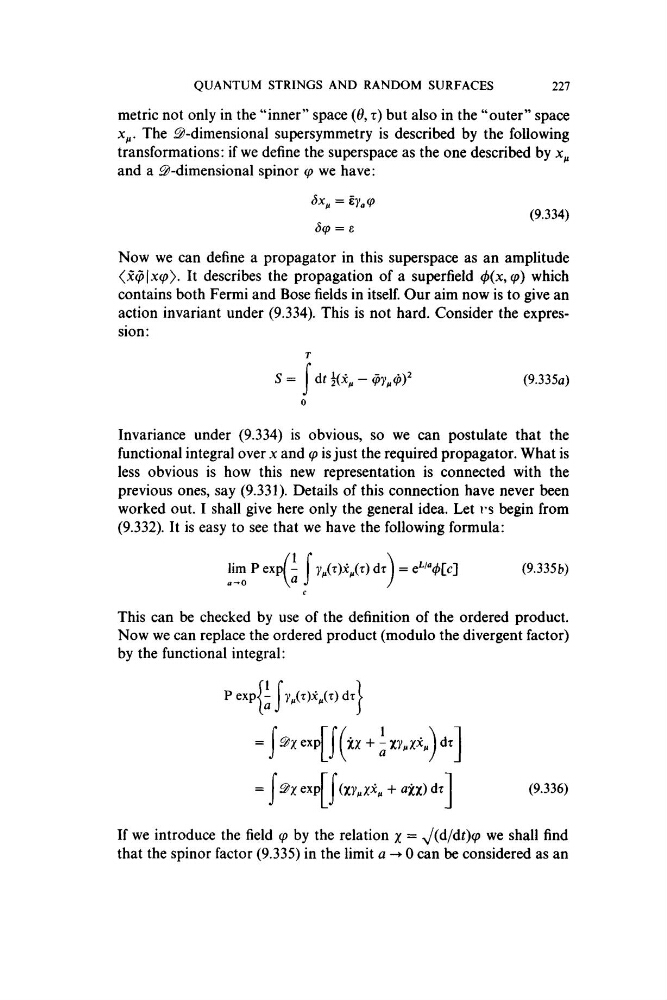
metric not only in the “inner” space (0, t) but also in the “outer” space
x^. The ^-dimensional supersymmetry is described by the following
transformations: if we define the superspace as the one described by
and a ^-dimensional spinor (p we have:
= lya(f>
S(p = 8
(9.334)
Now we can define a propagator in this superspace as an amplitude
<^x(p\x(p}. It describes the propagation of a superfield (¡>{x,(p) which
contains both Fermi and Bose fields in itself. Our aim now is to give an
action invariant under (9.334). This is not hard. Consider the expression:
S =
dr
- (py q>Ÿ
(9.335a)
Invariance under (9.334) is obvious, so we can postulate that the
functional integral over x and cp is just the required propagator. What is
less obvious is how this new representation is connected with the
previous ones, say (9.331). Details of this connection have never been
worked out. I shall give here only the general idea. Let rs begin from
(9.332). It is easy to see that we have the following formula:
, 1
lim P expl -
y M x M dr =
(9.335 b)
This can be checked by use of the definition of the ordered product.
Now we can replace the ordered product (modulo the divergent factor)
by the functional integral:
P exp-( -
a
y^(r)x^M dr
exp
= I Q¡x ^xp
XX + -
) dr
(xy^iX^^ + ^XX) dr
(9.336)
If we introduce the field q > by the relation x = \/W^t)(p we shall find
that the spinor factor (9.335) in the limit a 0 can be considered as an
227
metric not only in the “inner” space (0, t) but also in the “outer” space
x^. The ^-dimensional supersymmetry is described by the following
transformations: if we define the superspace as the one described by
and a ^-dimensional spinor (p we have:
= lya(f>
S(p = 8
(9.334)
Now we can define a propagator in this superspace as an amplitude
<^x(p\x(p}. It describes the propagation of a superfield (¡>{x,(p) which
contains both Fermi and Bose fields in itself. Our aim now is to give an
action invariant under (9.334). This is not hard. Consider the expression:
S =
dr
- (py q>Ÿ
(9.335a)
Invariance under (9.334) is obvious, so we can postulate that the
functional integral over x and cp is just the required propagator. What is
less obvious is how this new representation is connected with the
previous ones, say (9.331). Details of this connection have never been
worked out. I shall give here only the general idea. Let rs begin from
(9.332). It is easy to see that we have the following formula:
, 1
lim P expl -
y M x M dr =
(9.335 b)
This can be checked by use of the definition of the ordered product.
Now we can replace the ordered product (modulo the divergent factor)
by the functional integral:
P exp-( -
a
y^(r)x^M dr
exp
= I Q¡x ^xp
XX + -
) dr
(xy^iX^^ + ^XX) dr
(9.336)
If we introduce the field q > by the relation x = \/W^t)(p we shall find
that the spinor factor (9.335) in the limit a 0 can be considered as an