

QUANTUM STRINGS AND RANDOM SURFACES
209
There are always several ways to derive formulas like (9.258) since for
example one can start not from T(z) but from T(u) in deriving Ward
identities. One can check that the condition that the resulting formula is
independent of the order of derivation is just the Jacobi identity for the
algebra (9.257). The Ward identities (9.258) give important information
concerning the operator algebra (9.218). Namely, they must be such
that after fusing together any two 0„ in the left hand side, we obtain a
result consistent with the corresponding fusion of two points in the
right hand side (which depends on {zj} explicitly). In other words the
operator algebra must be conformally invariant.
In order to classify possible operators let us consider the operator
product of T(z) and some primary operator {¡/(O ) with dimension A. We
have:
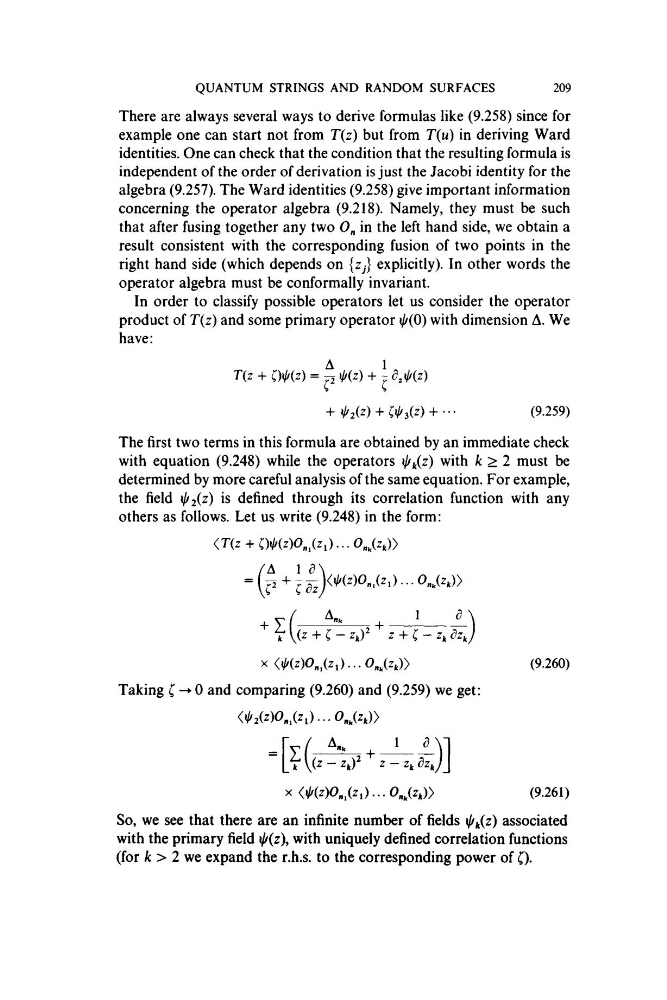
T(z + 0^(z) = ^
-f ~ d,il/(z)
-h il/jiz) -f- c^^(z) + •
(9.259)
The first two terms in this formula are obtained by an immediate check
with equation (9.248) while the operators
with k> 2 must be
determined by more careful analysis of the same equation. For example,
the field il/2{z) is defined through its correlation function with any
others as follows. Let us write (9.248) in the form:
. a
A,
+
1
■ 5z,
Taking i
+ i -
z + C
■ 0 and comparing (9.260) and (9.259) we get:
<«/'2(z)0„.(Zi) •••OJZ)c)>
1
d
(9.260)
-h
x < ^ ( z ) O J z ,) ...O J z ,) >
(9.261)
So, we see that there are an infinite number of fields ij/jXz) associated
with the primary field i/^(z), with uniquely defined correlation functions
(for k > 2 we expand the r.h.s. to the corresponding power of C).
209
There are always several ways to derive formulas like (9.258) since for
example one can start not from T(z) but from T(u) in deriving Ward
identities. One can check that the condition that the resulting formula is
independent of the order of derivation is just the Jacobi identity for the
algebra (9.257). The Ward identities (9.258) give important information
concerning the operator algebra (9.218). Namely, they must be such
that after fusing together any two 0„ in the left hand side, we obtain a
result consistent with the corresponding fusion of two points in the
right hand side (which depends on {zj} explicitly). In other words the
operator algebra must be conformally invariant.
In order to classify possible operators let us consider the operator
product of T(z) and some primary operator {¡/(O ) with dimension A. We
have:
T(z + 0^(z) = ^
-f ~ d,il/(z)
-h il/jiz) -f- c^^(z) + •
(9.259)
The first two terms in this formula are obtained by an immediate check
with equation (9.248) while the operators
with k> 2 must be
determined by more careful analysis of the same equation. For example,
the field il/2{z) is defined through its correlation function with any
others as follows. Let us write (9.248) in the form:
. a
A,
+
1
■ 5z,
Taking i
+ i -
z + C
■ 0 and comparing (9.260) and (9.259) we get:
<«/'2(z)0„.(Zi) •••OJZ)c)>
1
d
(9.260)
-h
x < ^ ( z ) O J z ,) ...O J z ,) >
(9.261)
So, we see that there are an infinite number of fields ij/jXz) associated
with the primary field i/^(z), with uniquely defined correlation functions
(for k > 2 we expand the r.h.s. to the corresponding power of C).