

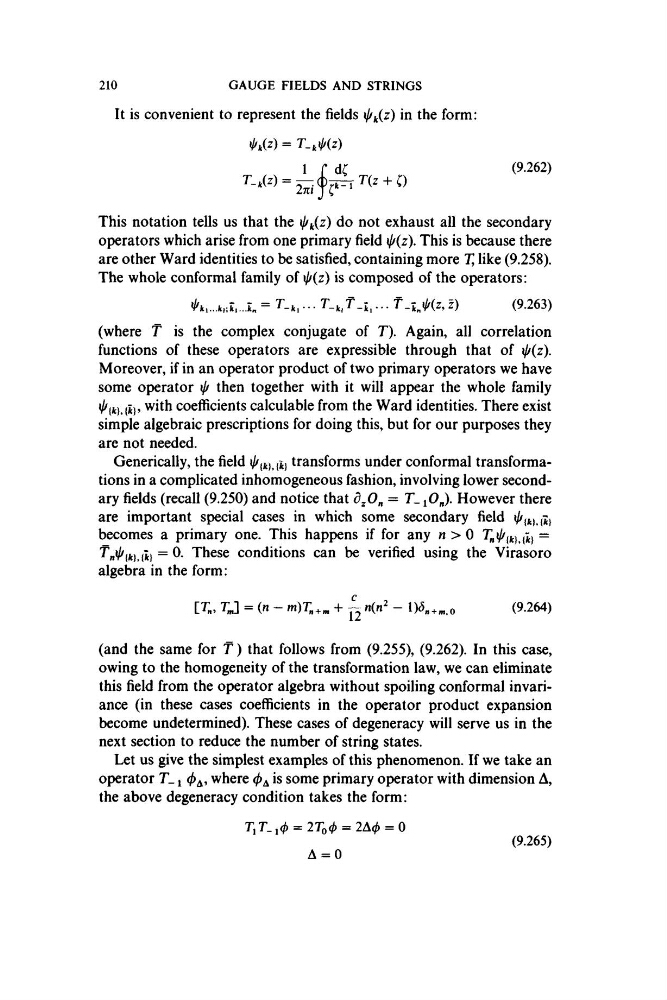
It is convenient to represent the fields ^^(z) in the form:
210
GAUGE FIELDS AND STRINGS
1
dC
(9.262)
This notation tells us that the il/^iz) do not exhaust all the secondary
operators which arise from one primary field \l/(z). This is because there
are other Ward identities to be satisfied, containing more T, like (9.258).
The whole conformal family of {¡/(z) is composed of the operators:
,ki...k„ —
... T
z )
(9.263)
(where T is the complex conjugate of T). Again, all correlation
functions of these operators are expressible through that of {¡/(z).
Moreover, if in an operator product of two primary operators we have
some operator ij/ then together with it will appear the whole family
with coefficients calculable from the Ward identities. There exist
simple algebraic prescriptions for doing this, but for our purposes they
are not needed.
Generically, the field ^{k),[k} transforms under conformal transformations in a complicated inhomogeneous fashion, involving lower secondary fields (recall (9.250) and notice that d^O„ = T_ ^0„). However there
are important special cases in which some secondary field iA {nc},{X }
becomes a primary one. This happens if for any « > 0
{fc} “
Tn^{k},{h ~
These conditions can be verified using the Virasoro
algebra in the form:
[T„, TJ = (n- m)T„^„ -f — n(n^ -
o
(9.264)
(and the same for T ) that follows from (9.255), (9.262). In this case,
owing to the homogeneity of the transformation law, we can eliminate
this field from the operator algebra without spoiling conformal invariance (in these cases coefficients in the operator product expansion
become undetermined). These cases of degeneracy will serve us in the
next section to reduce the number of string states.
Let us give the simplest examples of this phenomenon. If we take an
operator T_ ^ 0^, where is some primary operator with dimension A,
the above degeneracy condition takes the form:
TiT_i0 = 2To(/) = 2A = O
A = 0
(9.265)
210
GAUGE FIELDS AND STRINGS
1
dC
(9.262)
This notation tells us that the il/^iz) do not exhaust all the secondary
operators which arise from one primary field \l/(z). This is because there
are other Ward identities to be satisfied, containing more T, like (9.258).
The whole conformal family of {¡/(z) is composed of the operators:
,ki...k„ —
... T
z )
(9.263)
(where T is the complex conjugate of T). Again, all correlation
functions of these operators are expressible through that of {¡/(z).
Moreover, if in an operator product of two primary operators we have
some operator ij/ then together with it will appear the whole family
with coefficients calculable from the Ward identities. There exist
simple algebraic prescriptions for doing this, but for our purposes they
are not needed.
Generically, the field ^{k),[k} transforms under conformal transformations in a complicated inhomogeneous fashion, involving lower secondary fields (recall (9.250) and notice that d^O„ = T_ ^0„). However there
are important special cases in which some secondary field iA {nc},{X }
becomes a primary one. This happens if for any « > 0
{fc} “
Tn^{k},{h ~
These conditions can be verified using the Virasoro
algebra in the form:
[T„, TJ = (n- m)T„^„ -f — n(n^ -
o
(9.264)
(and the same for T ) that follows from (9.255), (9.262). In this case,
owing to the homogeneity of the transformation law, we can eliminate
this field from the operator algebra without spoiling conformal invariance (in these cases coefficients in the operator product expansion
become undetermined). These cases of degeneracy will serve us in the
next section to reduce the number of string states.
Let us give the simplest examples of this phenomenon. If we take an
operator T_ ^ 0^, where is some primary operator with dimension A,
the above degeneracy condition takes the form:
TiT_i0 = 2To(/) = 2A = O
A = 0
(9.265)