

208
GAUGE FIELDS AND STRINGS
where the contour
surrounds all singularities of 82 and {zj} and
subtract the same expression with 1 and 2 interchanged the correlation
function:
will appear. This is not quite true because of the C-term. The correct
formula can be derived from (9.249). We have, first of all:
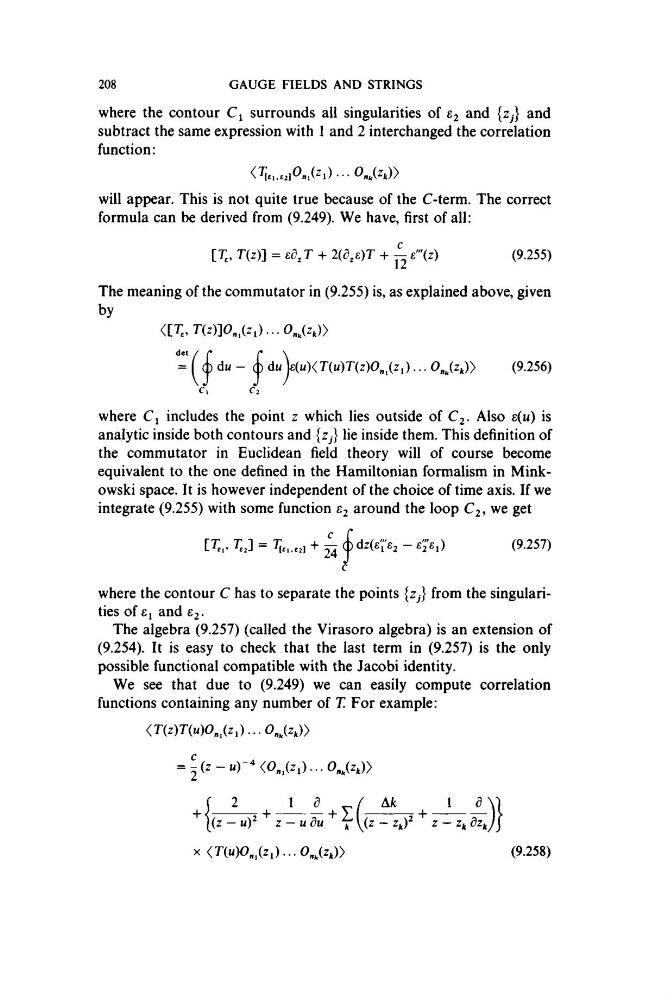
[T „ T(z)] = ed,T + 2(d,8)T + - e-(z)
(9.255)
The meaning of the commutator in (9.255) is, as explained above, given
by
< [T „ T (z )]O J z 0 ...O J z ,)>
= ^ d« - ^ du^e(u)
(9.256)
C l
c i
where
includes the point z which lies outside of C 2 . Also e(u) is
analytic inside both contours and {zj} lie inside them. This definition of
the commutator in Euclidean field theory will of course become
equivalent to the one defined in the Hamiltonian formalism in Minkowski space. It is however independent of the choice of time axis. If we
integrate (9.255) with some function 82 around the loop C2, we get
[T,,, T J =
-f — (J)dz(87£2 - ^2^l)
(9.257)
where the contour C has to separate the points {zj} from the singularities of 81 and 82.
The algebra (9.257) (called the Virasoro algebra) is an extension of
(9.254). It is easy to check that the last term in (9.257) is the only
possible functional compatible with the Jacobi identity.
We see that due to (9.249) we can easily compute correlation
functions containing any number of T For example:
< r(z )T (w )0 „ / z J...O Jz ,)>
= - ( z - t i) - " < O J z ,) ...O J z * ) >
(z - uy
1 ^ y f A /C
1 a \]
' - « ^ * \(Z - Zk)^ z - Zk SzJ]
X < r ( « ) 0 „ .( z ,) ...0 J z * ) >
(9.258)
GAUGE FIELDS AND STRINGS
where the contour
surrounds all singularities of 82 and {zj} and
subtract the same expression with 1 and 2 interchanged the correlation
function:
will appear. This is not quite true because of the C-term. The correct
formula can be derived from (9.249). We have, first of all:
[T „ T(z)] = ed,T + 2(d,8)T + - e-(z)
(9.255)
The meaning of the commutator in (9.255) is, as explained above, given
by
< [T „ T (z )]O J z 0 ...O J z ,)>
= ^ d« - ^ du^e(u)
(9.256)
C l
c i
where
includes the point z which lies outside of C 2 . Also e(u) is
analytic inside both contours and {zj} lie inside them. This definition of
the commutator in Euclidean field theory will of course become
equivalent to the one defined in the Hamiltonian formalism in Minkowski space. It is however independent of the choice of time axis. If we
integrate (9.255) with some function 82 around the loop C2, we get
[T,,, T J =
-f — (J)dz(87£2 - ^2^l)
(9.257)
where the contour C has to separate the points {zj} from the singularities of 81 and 82.
The algebra (9.257) (called the Virasoro algebra) is an extension of
(9.254). It is easy to check that the last term in (9.257) is the only
possible functional compatible with the Jacobi identity.
We see that due to (9.249) we can easily compute correlation
functions containing any number of T For example:
< r(z )T (w )0 „ / z J...O Jz ,)>
= - ( z - t i) - " < O J z ,) ...O J z * ) >
(z - uy
1 ^ y f A /C
1 a \]
' - « ^ * \(Z - Zk)^ z - Zk SzJ]
X < r ( « ) 0 „ .( z ,) ...0 J z * ) >
(9.258)