

QUANTUM STRINGS AND RANDOM SURFACES
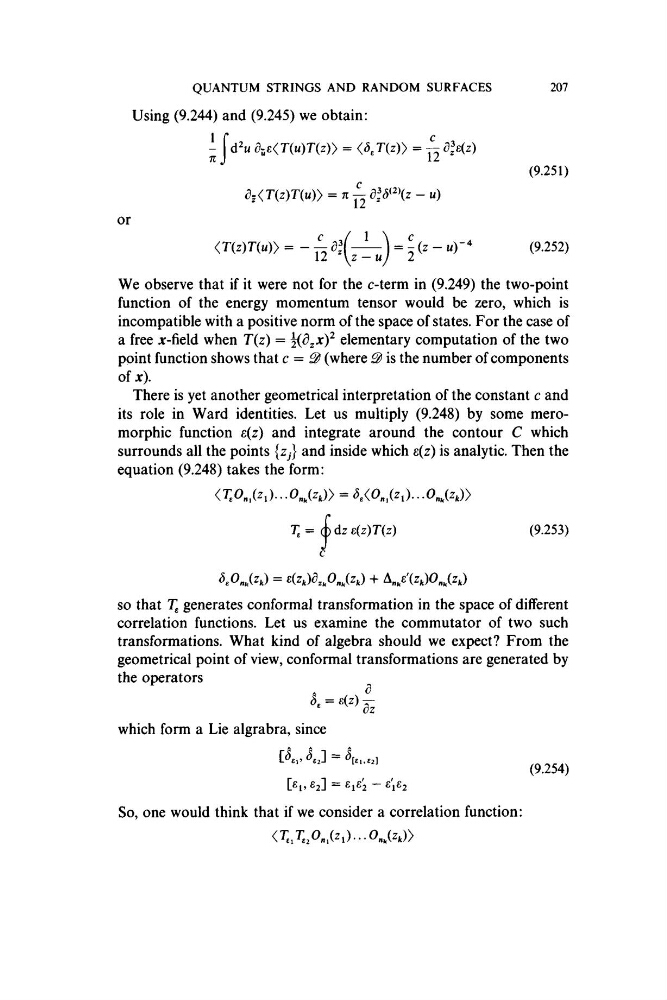
Using (9.244) and (9.245) we obtain:
^ d^u d,s(T(u)T(z)) = = - d^8(z)
or
d,(T(z)T(u)> = 71-d ^ S ^ ^ \z-u )
207
(9.251)
(9.252)
We observe that if it were not for the c-term in (9.249) the two-point
function of the energy momentum tensor would be zero, which is
incompatible with a positive norm of the space of states. For the case of
a free jc-field when T(z) =
elementary computation of the two
point function shows that c = ^ (where 9) is the number of components
of jc).
There is yet another geometrical interpretation of the constant c and
its role in Ward identities. Let us multiply (9.248) by some meromorphic function a(z) and integrate around the contour C which
surrounds all the points [Zj] and inside which e(z) is analytic. Then the
equation (9.248) takes the form:
T,= (hdz8iz)T(z)
(9.253)
= £(^fc)^z.i>„.(^k) + \AZk)0„^(Zk)
S O that 7^ generates conformal transformation in the space of different
correlation functions. Let us examine the commutator of two such
transformations. What kind of algebra should we expect? From the
geometrical point of view, conformal transformations are generated by
the operators
S, = e(z) dz
which form a Lie algrabra, since
[8l, £2] = £1^2 - £1^2
So, one would think that if we consider a correlation function:
Using (9.244) and (9.245) we obtain:
^ d^u d,s(T(u)T(z)) =
or
d,(T(z)T(u)> = 71-d ^ S ^ ^ \z-u )
207
(9.251)
(9.252)
We observe that if it were not for the c-term in (9.249) the two-point
function of the energy momentum tensor would be zero, which is
incompatible with a positive norm of the space of states. For the case of
a free jc-field when T(z) =
elementary computation of the two
point function shows that c = ^ (where 9) is the number of components
of jc).
There is yet another geometrical interpretation of the constant c and
its role in Ward identities. Let us multiply (9.248) by some meromorphic function a(z) and integrate around the contour C which
surrounds all the points [Zj] and inside which e(z) is analytic. Then the
equation (9.248) takes the form:
T,= (hdz8iz)T(z)
(9.253)
= £(^fc)^z.i>„.(^k) + \AZk)0„^(Zk)
S O that 7^ generates conformal transformation in the space of different
correlation functions. Let us examine the commutator of two such
transformations. What kind of algebra should we expect? From the
geometrical point of view, conformal transformations are generated by
the operators
S, = e(z) dz
which form a Lie algrabra, since
[8l, £2] = £1^2 - £1^2
So, one would think that if we consider a correlation function: