

206
GAUGE FIELDS AND STRINGS
The reason why the correlation functions involving T(z) are found
explicitly lies in the fact that due to the tracelessness of
the
energy-momentum conservation law involves only
and not d^.
Speaking less technically, T{z) generates some conformal transformation, and owing to invariance of the theory its result can be expressed in
terms of variations of
We shall also need Ward identities
involving several T(z). In order to find them we have to analyse how
T(z) is transformed under the conformal group. Since T(z) is a second
rank symmetric traceless tensor under SL(2, C) we expect that its
general transformation law respects these properties. Since the parameter of a general transformation is a vector field 8(z) (remember, that
we are using a complex notation) the most general variation of T(z) has
the form:
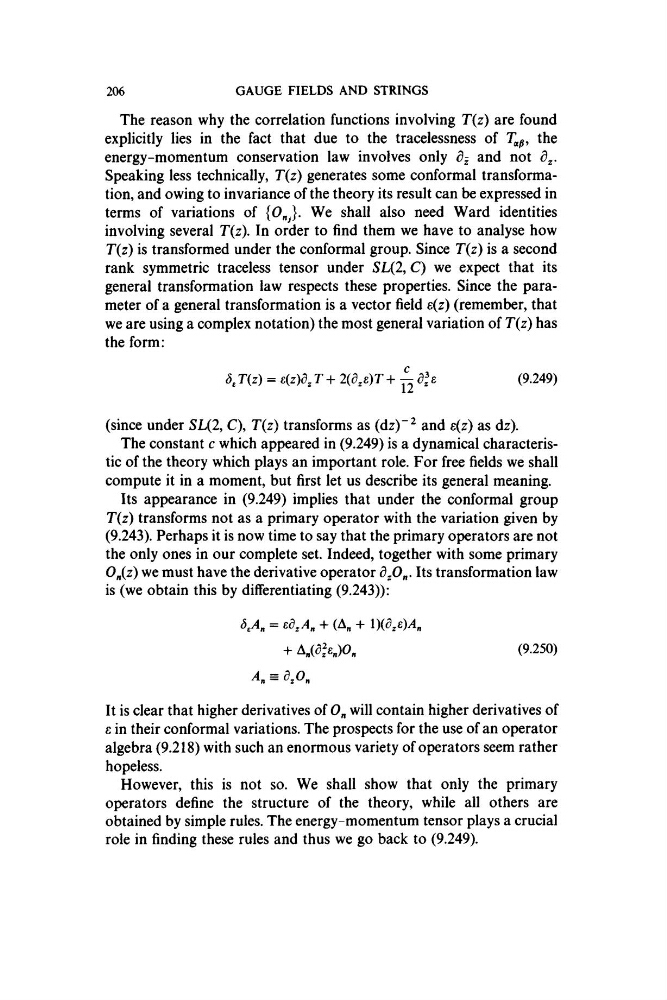
0J{z) = E{z)dJ+2{d,E)T+-dle
(9.249)
(since under SL(2, C), T(z) transforms as (dz)"^ and 8(z) as dz).
The constant c which appeared in (9.249) is a dynamical characteristic of the theory which plays an important role. For free fields we shall
compute it in a moment, but first let us describe its general meaning.
Its appearance in (9.249) implies that under the conformal group
T(z) transforms not as a primary operator with the variation given by
(9.243). Perhaps it is now time to say that the primary operators are not
the only ones in our complete set. Indeed, together with some primary
0„(z) we must have the derivative operator
Its transformation law
is (we obtain this by differentiating (9.243)):
Mn =
(^n +
+ A„{dlE„)0„
(9.250)
It is clear that higher derivatives of 0„ will contain higher derivatives of
£ in their conformal variations. The prospects for the use of an operator
algebra (9.218) with such an enormous variety of operators seem rather
hopeless.
However, this is not so. We shall show that only the primary
operators define the structure of the theory, while all others are
obtained by simple rules. The energy-momentum tensor plays a crucial
role in finding these rules and thus we go back to (9.249).
GAUGE FIELDS AND STRINGS
The reason why the correlation functions involving T(z) are found
explicitly lies in the fact that due to the tracelessness of
the
energy-momentum conservation law involves only
and not d^.
Speaking less technically, T{z) generates some conformal transformation, and owing to invariance of the theory its result can be expressed in
terms of variations of
We shall also need Ward identities
involving several T(z). In order to find them we have to analyse how
T(z) is transformed under the conformal group. Since T(z) is a second
rank symmetric traceless tensor under SL(2, C) we expect that its
general transformation law respects these properties. Since the parameter of a general transformation is a vector field 8(z) (remember, that
we are using a complex notation) the most general variation of T(z) has
the form:
0J{z) = E{z)dJ+2{d,E)T+-dle
(9.249)
(since under SL(2, C), T(z) transforms as (dz)"^ and 8(z) as dz).
The constant c which appeared in (9.249) is a dynamical characteristic of the theory which plays an important role. For free fields we shall
compute it in a moment, but first let us describe its general meaning.
Its appearance in (9.249) implies that under the conformal group
T(z) transforms not as a primary operator with the variation given by
(9.243). Perhaps it is now time to say that the primary operators are not
the only ones in our complete set. Indeed, together with some primary
0„(z) we must have the derivative operator
Its transformation law
is (we obtain this by differentiating (9.243)):
Mn =
(^n +
+ A„{dlE„)0„
(9.250)
It is clear that higher derivatives of 0„ will contain higher derivatives of
£ in their conformal variations. The prospects for the use of an operator
algebra (9.218) with such an enormous variety of operators seem rather
hopeless.
However, this is not so. We shall show that only the primary
operators define the structure of the theory, while all others are
obtained by simple rules. The energy-momentum tensor plays a crucial
role in finding these rules and thus we go back to (9.249).