

QUANTUM STRINGS AND RANDOM SURFACES
205
where we have passed to infinitesimal transformations, z-^f{z) —
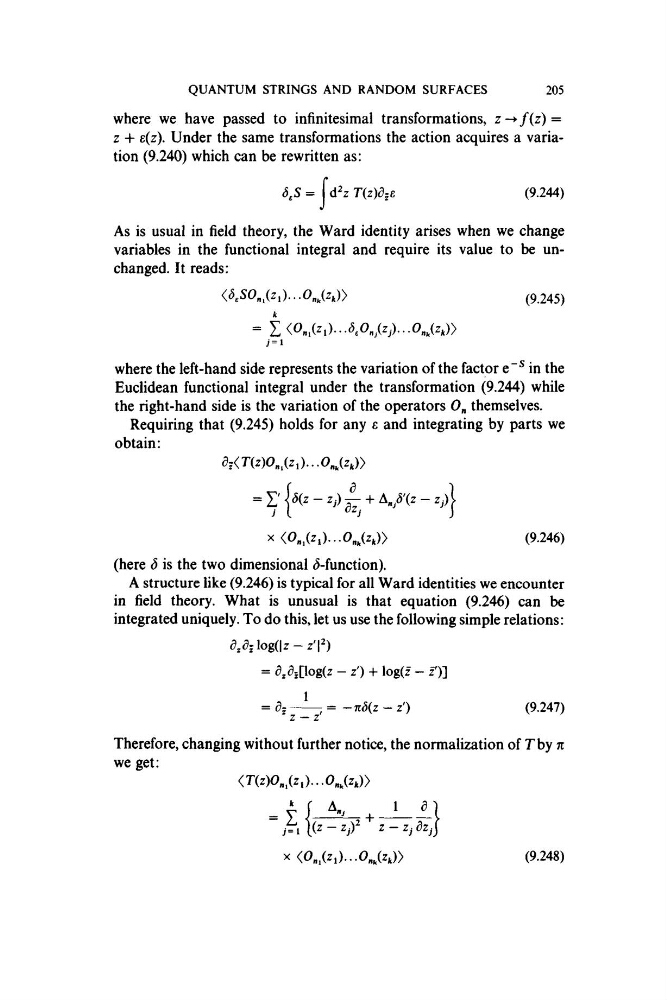
z -h e(z). Under the same transformations the action acquires a variation (9.240) which can be rewritten as:
S^S= \ d^z T{z)d-e
(9.244)
As is usual in field theory, the Ward identity arises when we change
variables in the functional integral and require its value to be unchanged. It reads:
(9.245)
where the left-hand side represents the variation of the factor e“® in the
Euclidean functional integral under the transformation (9.244) while
the right-hand side is the variation of the operators 0„ themselves.
Requiring that (9.245) holds for any e and integrating by parts we
obtain:
aj
= X ' |<5(z - Zj)
+ \ . 5 ' ( Z - Z ,.)|
X < 0 „ .(z,)...0 J z * )>
(9.246)
(here S is the two dimensional ¿-function).
A structure like (9.246) is typical for all Ward identities we encounter
in field theory. What is unusual is that equation (9.246) can be
integrated uniquely. To do this, let us use the following simple relations:
lo g ( |z -z '|2 )
= d^d^\\og{z - z') + log(z - z')]
= ¿ j
; = — nS(z — z')
(9.247)
Therefore, changing without further notice, the normalization of Tby t t
we get:
< T (z)0„,(z,)...O Jz,)>
X < 0 „ ( z , ) . . . 0 J z , ) >
(9.248)
205
where we have passed to infinitesimal transformations, z-^f{z) —
z -h e(z). Under the same transformations the action acquires a variation (9.240) which can be rewritten as:
S^S= \ d^z T{z)d-e
(9.244)
As is usual in field theory, the Ward identity arises when we change
variables in the functional integral and require its value to be unchanged. It reads:
(9.245)
where the left-hand side represents the variation of the factor e“® in the
Euclidean functional integral under the transformation (9.244) while
the right-hand side is the variation of the operators 0„ themselves.
Requiring that (9.245) holds for any e and integrating by parts we
obtain:
aj
= X ' |<5(z - Zj)
+ \ . 5 ' ( Z - Z ,.)|
X < 0 „ .(z,)...0 J z * )>
(9.246)
(here S is the two dimensional ¿-function).
A structure like (9.246) is typical for all Ward identities we encounter
in field theory. What is unusual is that equation (9.246) can be
integrated uniquely. To do this, let us use the following simple relations:
lo g ( |z -z '|2 )
= d^d^\\og{z - z') + log(z - z')]
= ¿ j
; = — nS(z — z')
(9.247)
Therefore, changing without further notice, the normalization of Tby t t
we get:
< T (z)0„,(z,)...O Jz,)>
X < 0 „ ( z , ) . . . 0 J z , ) >
(9.248)