

178
GAUGE FIELDS AND STRINGS
any dg^t we can find S(p and co such that (9.111) will hold. In other
words, we must be able to solve the equation:
or
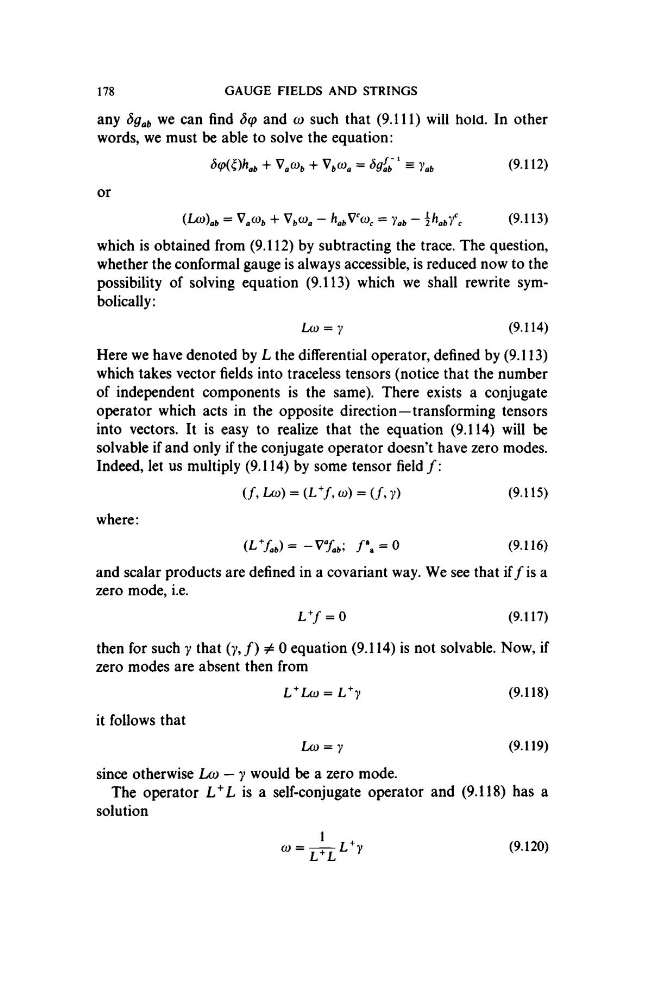
ScpiOhat + V.o;, + V,co, = Sgi, ^ ^ y,,
(9.112)
(Lo)\t, = V,co, + Vfcco, -
V H = 7ab -
(9-113)
which is obtained from (9.112) by subtracting the trace. The question,
whether the conformal gauge is always accessible, is reduced now to the
possibility of solving equation (9.113) which we shall rewrite symbolically:
Leo = y
(9.114)
Here we have denoted by L the diflferential operator, defined by (9.113)
which takes vector fields into traceless tensors (notice that the number
of independent components is the same). There exists a conjugate
operator which acts in the opposite direction—transforming tensors
into vectors. It is easy to realize that the equation (9.114) will be
solvable if and only if the conjugate operator doesn’t have zero modes.
Indeed, let us multiply (9.114) by some tensor field / :
where:
(/,Lco) = (L 7,co) = (/,y )
(L Y ,,)=-V % ,; f \ = 0
(9.115)
(9.116)
and scalar products are defined in a covariant way. We see that if / is a
zero mode, i.e.
L 7 = 0
(9.117)
then for such y that (y, / ) / 0 equation (9.114) is not solvable. Now, if
zero modes are absent then from
it follows that
L^L(o = L^y
Lo) = y
(9.118)
(9.119)
since otherwise Leo — y would be a zero mode.
The operator L"^L is a self-conjugate operator and (9.118) has a
solution
(9.120)
GAUGE FIELDS AND STRINGS
any dg^t we can find S(p and co such that (9.111) will hold. In other
words, we must be able to solve the equation:
or
ScpiOhat + V.o;, + V,co, = Sgi, ^ ^ y,,
(9.112)
(Lo)\t, = V,co, + Vfcco, -
V H = 7ab -
(9-113)
which is obtained from (9.112) by subtracting the trace. The question,
whether the conformal gauge is always accessible, is reduced now to the
possibility of solving equation (9.113) which we shall rewrite symbolically:
Leo = y
(9.114)
Here we have denoted by L the diflferential operator, defined by (9.113)
which takes vector fields into traceless tensors (notice that the number
of independent components is the same). There exists a conjugate
operator which acts in the opposite direction—transforming tensors
into vectors. It is easy to realize that the equation (9.114) will be
solvable if and only if the conjugate operator doesn’t have zero modes.
Indeed, let us multiply (9.114) by some tensor field / :
where:
(/,Lco) = (L 7,co) = (/,y )
(L Y ,,)=-V % ,; f \ = 0
(9.115)
(9.116)
and scalar products are defined in a covariant way. We see that if / is a
zero mode, i.e.
L 7 = 0
(9.117)
then for such y that (y, / ) / 0 equation (9.114) is not solvable. Now, if
zero modes are absent then from
it follows that
L^L(o = L^y
Lo) = y
(9.118)
(9.119)
since otherwise Leo — y would be a zero mode.
The operator L"^L is a self-conjugate operator and (9.118) has a
solution
(9.120)