

QUANTUM STRINGS AND RANDOM SURFACES
177
we obtain:
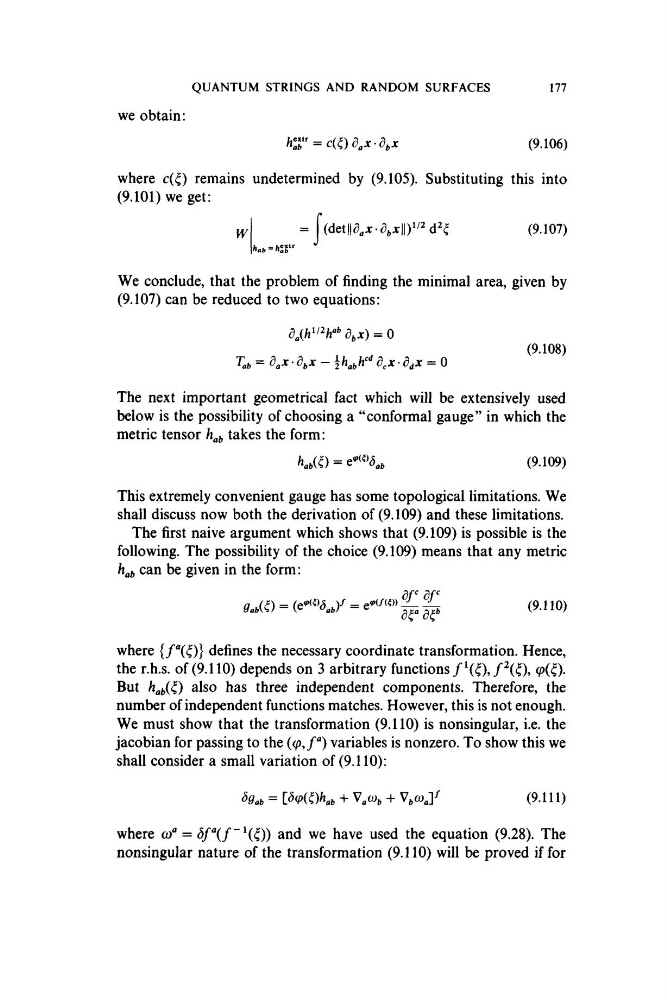
hT = c(0
(9.106)
where c(0 remains undetermined by (9.105). Substituting this into
(9.101) we get:
W
{dQX\\d^x-d^x\\y'^ d^(^
(9.107)
We conclude, that the problem of finding the minimal area, given by
(9.107) can be reduced to two equations:
d,x) = 0
T ab =
• df,x -
d^x d^x = 0
(9.108)
The next important geometrical fact which will be extensively used
below is the possibility of choosing a “conformal gauge” in which the
metric tensor
takes the form:
=
(9.109)
This extremely convenient gauge has some topological limitations. We
shall discuss now both the derivation of (9.109) and these limitations.
The first naive argument which shows that (9.109) is possible is the
following. The possibility of the choice (9.109) means that any metric
hab can be given in the form:
(9.110)
where { /“((^)} defines the necessary coordinate transformation. Hence,
the r.h.s. of (9.110) depends on 3 arbitrary functions
(p(0But h^biO ^Iso has three independent components. Therefore, the
number of independent functions matches. However, this is not enough.
We must show that the transformation (9.110) is nonsingular, i.e. the
Jacobian for passing to the ((/?,/") variables is nonzero. To show this we
shall consider a small variation of (9.110):
^G ab = i^(p(Ohab +
(9.111)
where a;" = <5/"(/ HO) and we have used the equation (9.28). The
nonsingular nature of the transformation (9.110) will be proved if for
177
we obtain:
hT = c(0
(9.106)
where c(0 remains undetermined by (9.105). Substituting this into
(9.101) we get:
W
{dQX\\d^x-d^x\\y'^ d^(^
(9.107)
We conclude, that the problem of finding the minimal area, given by
(9.107) can be reduced to two equations:
d,x) = 0
T ab =
• df,x -
d^x d^x = 0
(9.108)
The next important geometrical fact which will be extensively used
below is the possibility of choosing a “conformal gauge” in which the
metric tensor
takes the form:
=
(9.109)
This extremely convenient gauge has some topological limitations. We
shall discuss now both the derivation of (9.109) and these limitations.
The first naive argument which shows that (9.109) is possible is the
following. The possibility of the choice (9.109) means that any metric
hab can be given in the form:
(9.110)
where { /“((^)} defines the necessary coordinate transformation. Hence,
the r.h.s. of (9.110) depends on 3 arbitrary functions
(p(0But h^biO ^Iso has three independent components. Therefore, the
number of independent functions matches. However, this is not enough.
We must show that the transformation (9.110) is nonsingular, i.e. the
Jacobian for passing to the ((/?,/") variables is nonzero. To show this we
shall consider a small variation of (9.110):
^G ab = i^(p(Ohab +
(9.111)
where a;" = <5/"(/ HO) and we have used the equation (9.28). The
nonsingular nature of the transformation (9.110) will be proved if for